

Bed bug infestations have surged dramatically across London in recent years, with call-outs up 35% between 2022 and 2024. Many homeowners and renters reach for a supermarket spray at the first sign of bites, assuming the problem can be sorted over a weekend. This is one of the most costly mistakes you can make. Bed bugs are remarkably resilient pests, and a failed DIY attempt rarely ends the infestation. Instead, it often forces insects deeper into walls and furniture, making them far harder to eliminate. Professional removal is not a luxury. For London properties, it is genuinely the most effective and economical route.
Table of Contents
- Why bed bugs are a growing problem in London
- DIY bed bug control: Why it rarely works
- What professional bed bug removal involves
- How to prepare for professional treatment and avoid re-infestation
- The overlooked truth about bed bug removal in London
- Get swift, expert bed bug removal for your London home
- Frequently asked questions
Key Takeaways
| Point | Details |
|---|---|
| London’s rising bed bug risk | Bed bug infestations in the city have increased sharply due to dense housing, travel, and older buildings. |
| DIY falls short | Most self-treatments fail and often worsen bed bug infestations in London homes. |
| Professionals deliver results | Professional teams use advanced methods that target all hiding spots and prevent re-infestation. |
| Preparation is essential | Proper prep and aftercare are as important as treatment itself for complete eradication. |
Why bed bugs are a growing problem in London
With infestations sharply on the rise, it is vital to understand what makes London uniquely vulnerable to bed bugs compared with other UK cities.
London’s combination of extreme urban density, constant international travel, and a large stock of older housing creates ideal conditions for bed bugs to thrive. The city receives tens of millions of tourists and business travellers every year, and bed bugs hitch rides in luggage, clothing, and second-hand furniture with remarkable ease. A single piece of upholstered furniture bought from an online marketplace or a charity shop can introduce an infestation into an otherwise clean home.
High-density housing, travel, and older buildings all facilitate spread, and multi-unit properties require whole-property treatment rather than treating a single flat in isolation. This is a crucial point that many Londoners do not consider until it is too late.
| Factor | Why it matters for London |
|---|---|
| Urban density | Infestations spread quickly between neighbouring units |
| International travel | Insects imported through luggage and clothing |
| Older housing stock | More cracks, crevices, and voids for bed bugs to hide |
| Multi-tenancy buildings | One untreated unit can re-infest treated ones |
Key facts that highlight the scale of the problem:
- Bed bug infestations in the UK jumped 35% between 2022 and 2024
- London accounts for a disproportionate share of reported cases nationally
- Bed bugs can survive for up to a year without feeding, making them extremely persistent
- A single female bed bug can lay up to 500 eggs in her lifetime
Before any treatment begins, preparing for pest treatment correctly is one of the most important steps you can take to give professionals the access they need to tackle the whole property effectively.
DIY bed bug control: Why it rarely works
The unique factors driving London’s surge in bed bug cases make it even less likely that DIY solutions will work, and in many situations they actively worsen the outcome.
Most off-the-shelf sprays sold in supermarkets and hardware stores are contact insecticides. They kill the bugs they directly touch, but bed bugs spend the vast majority of their lives hidden deep inside mattress seams, behind skirting boards, inside electrical sockets, and within wall voids. Spray rarely reaches these areas in sufficient concentration to cause meaningful harm.
“Bed bugs can develop resistance to common insecticides, and improper use of pesticides can actually scatter insects to new hiding places, spreading the infestation further.”
This is not a minor risk. It is one of the most frequently observed consequences of DIY treatment attempts. When bugs sense chemical disruption in one area, they migrate. In a flat or terraced house, that can mean bugs moving into adjoining rooms, into neighbouring flats through shared walls, or deeper into the building fabric where they become almost impossible to reach.
Professionals using Integrated Pest Management (IPM) methods achieve near-100% success rates, whereas repeated DIY attempts often lead to resistance and widespread dispersal. Here is why home treatment programmes typically break down:
- Incomplete coverage. Without professional equipment and training, it is impossible to inspect and treat every harbouring point systematically.
- Resistance development. Repeated exposure to the same chemical at insufficient concentrations accelerates resistance in surviving populations.
- Egg survival. Most consumer-grade products offer no residual effect against eggs, meaning a new generation hatches within weeks.
- Missed timing. Professional treatments are timed around bed bug life cycles. DIY applications rarely account for this.
- No follow-up protocol. A single treatment is almost never sufficient. Professionals know when and how to return for follow-up checks.
Pro Tip: If you suspect an infestation, avoid moving furniture or bedding between rooms before a professional inspection. This is one of the most common ways bugs are accidentally spread to unaffected areas.
You will find detailed pest control tips for homes on our site, including practical guidance on what not to do while waiting for professional treatment.
What professional bed bug removal involves
Understanding why DIY fails sets the stage for seeing exactly how professionals tackle bed bug infestations and achieve results that last.
A professional treatment begins with a thorough inspection of every room in the property, not just the bedroom. Bed bugs are routinely found in sofas, curtains, wardrobes, behind picture frames, and inside plug sockets. Skipping any area leaves a reservoir population that will simply rebuild the infestation.
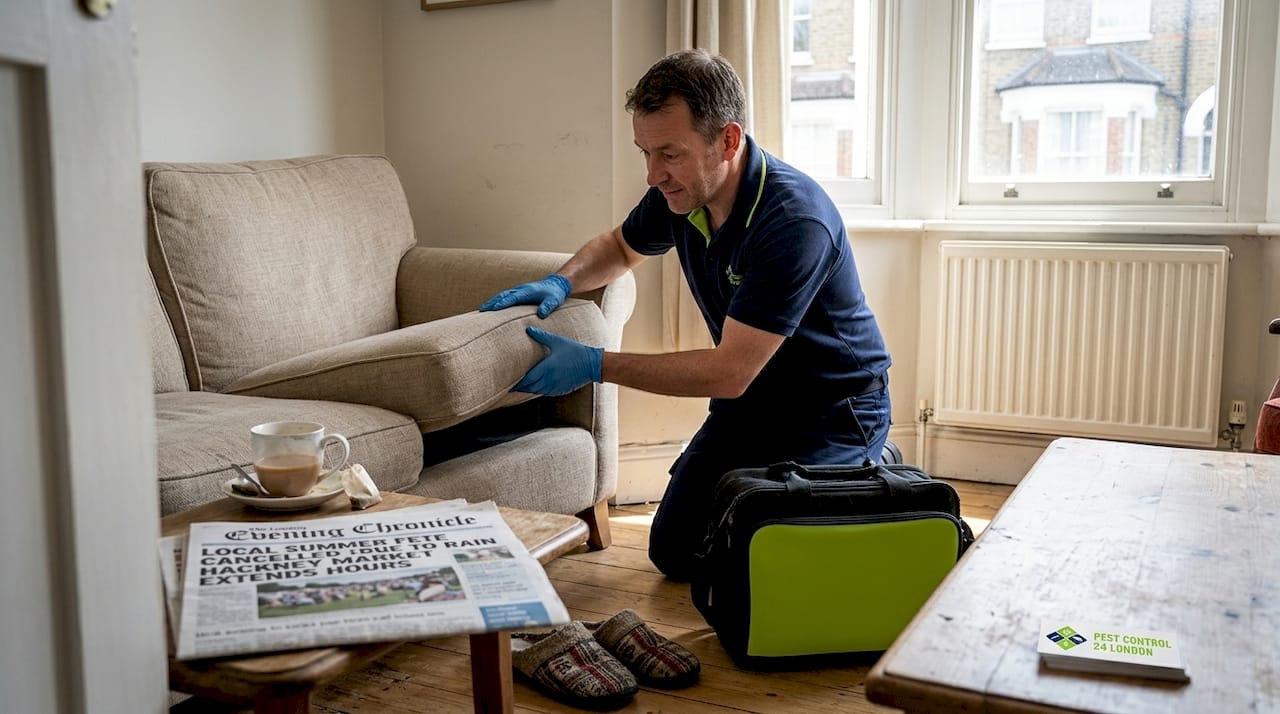
BPCA-qualified technicians use Integrated Pest Management, which combines targeted insecticide application with heat treatment where appropriate, physical removal, and a structured monitoring programme. This approach does not rely on a single method, which is precisely why it works where DIY does not.
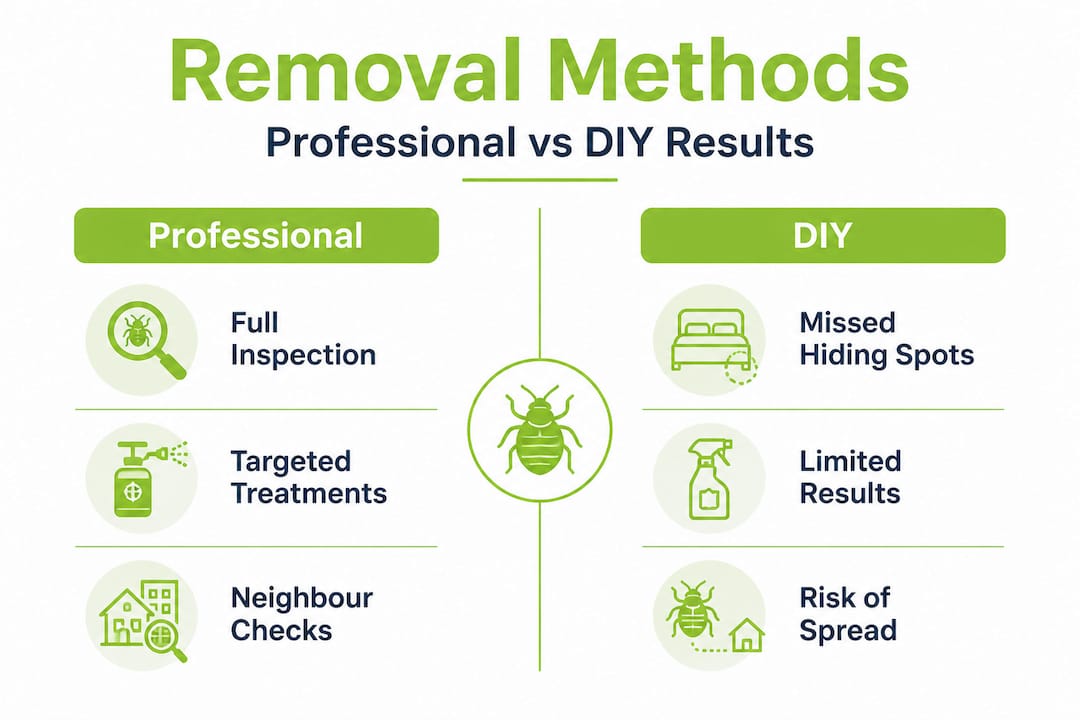
| Approach | Professional treatment | DIY treatment |
|---|---|---|
| Inspection depth | Full property, all rooms and voids | Limited to visible surfaces |
| Products used | Professional-grade, residual formulations | Consumer-grade, contact-only sprays |
| Life cycle awareness | Timed to egg hatching cycles | Rarely considered |
| Follow-up protocol | Structured revisit schedule | None |
| Multi-unit coordination | Adjacent units assessed | Not possible |
For multi-occupancy buildings, adjacent unit checks are essential to prevent re-infestation, and preparation checklists are vital to avoid treatment failures. This is something no DIY kit can replicate.
Pro Tip: Ask your technician whether your neighbours’ flats have also been checked. In a shared building, a single untreated unit is enough to undo a successful treatment in your home.
Find out exactly what our professional bed bug removal process involves, and review our best pest control practices to understand the standards we hold ourselves to on every job.
How to prepare for professional treatment and avoid re-infestation
Now that the importance of professional practice is clear, it is equally vital to know how you can actively support success through preparation and prevention.
Preparation checklists are vital to avoiding treatment failures, and this is one area where you genuinely make a difference to the outcome. A well-prepared property allows the technician to access every harbouring point without wasting time, and it ensures treatments achieve maximum penetration.
Here is what effective preparation typically involves:
- Declutter thoroughly. Remove items from under beds, inside wardrobes, and from floors. Clutter gives bed bugs more places to hide and fewer surfaces for treatments to reach.
- Launder all bedding and clothing. Wash at 60°C or higher, and dry on a high heat setting for at least 30 minutes. Seal laundered items in clean bags until treatment is complete.
- Move furniture away from walls. This gives the technician access to skirting boards, wall voids, and floor junctions where bed bugs frequently harbour.
- Vacuum thoroughly before treatment. This reduces the insect population and removes debris that can shield bugs from products. Dispose of the vacuum bag immediately in an outdoor bin.
- Avoid using sprays beforehand. As discussed, DIY sprays can scatter bugs and undermine the treatment plan.
After treatment, maintaining vigilance matters just as much. Inspect second-hand furniture before bringing it indoors, use mattress encasements, and report any new bites promptly so that follow-up checks can be arranged quickly. Our guide on eco-friendly pest solutions covers low-impact prevention measures you can build into your daily routine. Review the full bed bug treatment prep steps before your appointment to maximise results.
The overlooked truth about bed bug removal in London
With practical steps in hand, it is worth reflecting on why so many Londoners end up dealing with bed bugs repeatedly, and what actually breaks the cycle for good.
After more than ten years treating properties across London, we have seen one pattern emerge more than any other. The people who suffer the longest are not the ones who called us first. They are the ones who spent weeks or months on unsuccessful home treatments before picking up the phone. By the time we arrive, the infestation has expanded, bugs have dispersed throughout the property, and the emotional toll of disrupted sleep and anxiety is already significant.
There is a widespread belief that professional pest control is an expensive last resort. In reality, the cost of two or three months of repeated DIY attempts, combined with discarded mattresses and sleepless nights, almost always exceeds the cost of a professional treatment arranged at the outset. The money-saving logic of DIY rarely holds up under scrutiny.
The other truth that catches people off guard is this: bed bug removal is not simply about killing insects. It is about systematically removing all life stages, preventing dispersal, treating adjacent areas, and monitoring for resurgence. That requires expertise, professional-grade products, and a structured plan. Our practical guide to domestic pest control covers this approach in detail. Acting early and acting professionally is always the better choice.
Get swift, expert bed bug removal for your London home
Having seen why professional help is not only more effective but genuinely more economical, the next step is straightforward: get expert support as quickly as possible.

We have been serving homeowners, renters, hotels, and landlords across London since 2015, and our BPCA-qualified technicians know exactly how to resolve infestations in all types of property. Our guaranteed bed bug removal service covers full inspection, treatment, and follow-up support to ensure the problem is dealt with for good. Whether you are in a studio flat or a large family home, our domestic pest control team will assess your situation and provide a clear, effective treatment plan. Do not wait for the problem to grow. Contact us today and let our team take care of it.
Frequently asked questions
Can I get rid of bed bugs myself in a London flat?
DIY efforts in high-density London flats often fail and risk spreading the infestation to neighbouring units, making the problem significantly harder and more expensive to resolve.
How long does professional bed bug removal take?
Professional treatments usually resolve infestations within one to two visits, though the exact timeline depends on the severity of the infestation and the size of the property.
Why is bed bug preparation so important?
Preparation checklists are vital because proper preparation allows treatments to reach all hiding places, which is one of the key factors in successful eradication.
Are bed bug infestations increasing in London?
Yes, recent reports confirm a 35% jump in cases across London since 2022, driven by international travel, urban density, and older housing stock.
Recommended
- Bed Bug Removal London | Fast Treatment & Guaranteed Results – Pest Control 24 London
- Essential steps to prepare for pest treatment in London homes
- Essential Pest-Proofing Tips for Your London Home This Autumn – Pest Control 24 London
- Essential pest control tips for London homes and businesses
- Mattress Cleaning Tips & Guides | Mattress Magicians Blog – Twin Cities