

Professional extermination is a licensed pest management service that uses trained operators, specialist products, and structured treatment plans to control and eliminate pest infestations in residential and commercial properties. Known in the industry as pest management or integrated pest control, it goes far beyond a can of spray from a hardware shop. For homeowners and business owners in London, understanding what professional extermination involves is the first step towards making an informed decision about protecting your property, your health, and your peace of mind.
What is professional extermination vs DIY pest control?
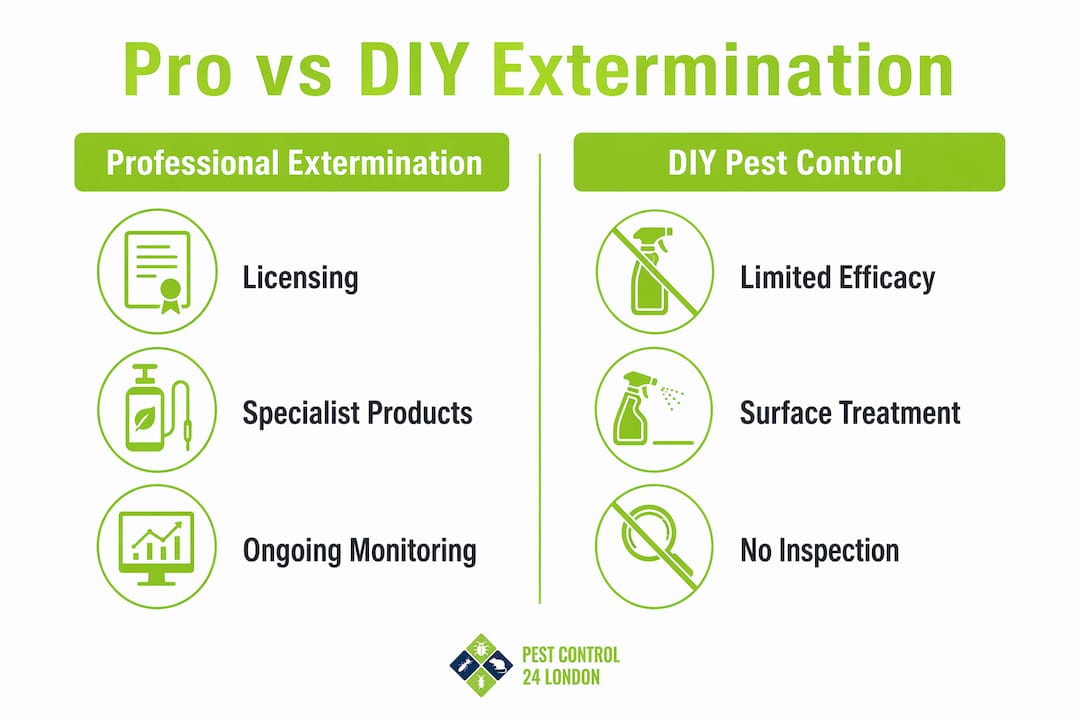
Professional extermination is defined by three things that DIY methods cannot replicate: licensing, access to specialist products, and a structured approach to root causes. A trained pest management professional (PMP) does not simply treat what is visible. They inspect the full property, identify entry points, assess environmental factors such as moisture and food access, and build a treatment plan around the specific pest and conditions present.
DIY products available in shops address surface symptoms. A can of ant spray kills the ants you see, but does nothing about the colony behind your skirting board. Licensed PMPs are required to meet statutory training and record-keeping requirements, carry insurance, and apply treatments that are not available to the public. That distinction matters enormously when dealing with public-health pests such as rats, cockroaches, or bed bugs.
Professional services also follow strict safety protocols. Correct dosage, application method, and post-treatment monitoring are all part of the service. A homeowner applying a product incorrectly can create health risks or, worse, drive pests deeper into the structure of the building.
Key differences between professional extermination and DIY pest control:
- Licensing and training: PMPs pass category-specific certification exams and work under regulated supervision.
- Specialist products: Professionals use formulations with higher efficacy and lower environmental impact than retail alternatives.
- Root cause identification: Licensed exterminators assess structural issues, moisture, and food sources that sustain infestations.
- Ongoing monitoring: Professional services include follow-up visits to confirm treatment success and prevent re-infestation.
- Safety compliance: Correct application rates and protective measures are standard practice, not optional.
Pro Tip: Before booking any pest control service, ask the provider to explain what they will inspect, which products they will use, and what follow-up is included. A professional will answer all three without hesitation.
How does integrated pest management shape professional extermination?
Integrated Pest Management (IPM) is the scientific framework that underpins professional extermination services. IPM is defined as a decision-making process that combines biological, cultural, physical, and chemical tools to keep pest populations below levels that cause unacceptable damage. The goal is not total eradication of every insect on a property. It is sustainable management that protects health and property without unnecessary chemical use.
Understanding how IPM works in practice helps you evaluate whether a provider is offering genuine professional extermination or simply a reactive spray-and-leave service. The four stages of an IPM-based treatment plan are:
- Inspection and monitoring: The technician surveys the property, identifies pest species, maps activity zones, and sets monitoring traps or devices to establish population levels.
- Threshold assessment: Treatment is triggered only when pest numbers exceed a defined threshold. This prevents unnecessary chemical application and reduces the risk of resistance developing.
- Multi-method treatment: Biological controls (such as introducing natural predators for certain pests), physical controls (proofing, trapping, sealing entry points), and cultural controls (advising on waste management or storage practices) are applied before or alongside chemical treatments.
- Chemical controls as a last resort: When pesticides are required, IPM reduces pesticide resistance by rotating methods and selecting targeted formulations with the lowest ecological impact.
The practical benefits of an IPM approach are significant. Fewer pesticide applications lower the cost of repeat treatments. Resistance management means treatments remain effective over time. Environmental contamination is reduced, which matters particularly for food businesses and properties with children or pets.
| IPM component | Practical example |
|---|---|
| Biological control | Introducing nematodes to treat vine weevil larvae in garden soil |
| Physical control | Sealing gaps around pipework to prevent rodent entry |
| Cultural control | Advising a restaurant on waste bin placement to reduce fly activity |
| Chemical control | Applying a targeted rodenticide in tamper-proof bait stations |

Pro Tip: Ask any prospective provider whether they use an IPM model or a reactive treatment model. Early assessment of this distinction is the single most reliable indicator of long-term service quality.
Why licensing and certification matter in professional extermination
Licensing is not a formality. It is the mechanism that separates professional extermination from unregulated operators who pose genuine risks to people and the environment. Illegal pest control operators pose serious threats through improper chemical use, inadequate safety measures, and no accountability when treatments fail or cause harm.
In the UK, reputable providers hold BPCA (British Pest Control Association) qualifications or equivalent certifications. Certified operators have passed examinations in specific pest categories and are responsible for supervising technicians and maintaining treatment records. Different pest categories require different certifications. A termite or wood-boring insect specialist operates under different training requirements than a general nuisance pest technician.
What to verify before hiring a professional extermination service:
- Certification category: Confirm the operator holds certification relevant to your specific pest problem.
- Insurance: Licensed providers carry public liability insurance. This protects you if anything goes wrong during treatment.
- Record-keeping: Professionals maintain written records of treatments, products used, and follow-up schedules. Ask to see this documentation.
- Regulatory compliance: In the UK, look for BPCA membership or equivalent professional body affiliation.
“Choosing a licensed exterminator is not just about effectiveness. It is about accountability, safety, and having a traceable record of every treatment carried out on your property.” — Pestcontrol24london
The role of licensing in professional pest control extends to protecting you legally. If an unlicensed operator causes damage or a health incident, you have no recourse. A licensed provider is bound by professional standards and carries the insurance to back them up.
What are the practical benefits of professional extermination?
Regular professional services apply safe, targeted treatments and provide ongoing monitoring that prevents infestations from escalating into costly structural or health problems. For homeowners, this means catching a mouse problem before it becomes a colony behind the walls. For businesses, it means protecting stock, reputation, and compliance with food safety or health regulations.
The practical benefits of professional extermination for homes and businesses include:
- Proactive prevention: Scheduled inspections identify conditions that attract pests before an infestation takes hold.
- Custom treatment plans: Professional assessments identify root causes including moisture, structural gaps, and food access, and build plans around them.
- Health protection: Targeted treatments eliminate disease-carrying pests such as rats, cockroaches, and mosquitoes without exposing occupants to unnecessary chemical risk.
- Cost reduction: Addressing an infestation early costs significantly less than treating an established colony or repairing pest-related structural damage.
- Peace of mind: Regular follow-ups and monitoring give homeowners and business owners confidence that their property is protected year-round.
Professional extermination is part of home maintenance planning in the same way that boiler servicing or roof inspections are. Treating it as a reactive measure only, called in when pests are already visible, means paying more and waiting longer for results. For businesses in hospitality, food retail, or healthcare, pest management in homes and commercial premises is not optional. It is a regulatory requirement.
Key takeaways
Professional extermination requires licensed operators, an IPM-based approach, and ongoing monitoring to deliver lasting pest control results for homes and businesses.
| Point | Details |
|---|---|
| Licensing is non-negotiable | Always verify BPCA certification or equivalent before hiring any pest control provider. |
| IPM outperforms reactive spraying | A multi-method approach reduces resistance, lowers costs, and delivers more sustainable results. |
| Root cause identification matters | Licensed exterminators assess structural and environmental factors, not just visible pest activity. |
| Regular monitoring beats one-off treatment | Scheduled follow-ups prevent re-infestation and catch new activity before it escalates. |
| Unlicensed operators carry serious risk | Illegal providers have no accountability, no insurance, and no regulatory oversight. |
Why I always ask providers about their IPM approach first
Having worked in pest management for years, the single question that tells me most about a provider is whether they use an IPM model or a reactive one. Most homeowners never ask it, and that is where things go wrong. A provider who arrives, sprays, and leaves without a follow-up plan is not offering professional extermination. They are offering a temporary fix.
The other mistake I see repeatedly is choosing the cheapest quote without checking credentials. Unlicensed operators often undercut licensed providers significantly, and the short-term saving creates long-term problems. Treatments fail, pests return, and there is no insurance or record to fall back on. Choosing a professional who communicates treatment plans clearly and educates you about what they are doing and why is the most reliable indicator of quality.
Pest control is not a one-time event. It is an ongoing relationship between you and a qualified provider who understands your property. Treat it as part of your maintenance routine, not a crisis response, and you will spend less, worry less, and get better results.
— Dan
Trusted professional pest control in London
Pestcontrol24london has delivered licensed pest management services across London since 2015, working with hotels, restaurants, retail businesses, and residential properties. Every technician is BPCA qualified, and every treatment plan is built around IPM principles to address root causes rather than surface symptoms.

Whether you need emergency pest control or a scheduled inspection, Pestcontrol24london offers 24/7 pest control services for both residential and commercial clients. Tailored plans cover everything from rodent proofing and cockroach treatment to bed bug eradication and fly control. For businesses with specific compliance requirements, commercial pest management solutions are available with full documentation and follow-up monitoring included. Contact Pestcontrol24london for a free quote and find out what a properly structured pest management plan looks like for your property.
FAQ
What does an exterminator actually do during a visit?
A licensed exterminator inspects the property to identify pest species, entry points, and environmental factors sustaining the infestation, then applies a targeted treatment plan that may include trapping, proofing, and pesticide application. Follow-up monitoring is scheduled to confirm treatment success and prevent re-infestation.
How much does professional extermination cost in London?
The cost of professional extermination varies depending on pest type, property size, and the number of treatments required. A single treatment for a common pest such as mice or cockroaches typically starts from £80 to £150, with ongoing service contracts available for commercial clients.
What is the difference between pest control and extermination?
Pest control refers to the broader management of pest populations using multiple methods including prevention, monitoring, and treatment. Extermination specifically describes the elimination of an active infestation, and professional extermination combines both approaches under a licensed, structured service.
How do I choose a reliable pest control service?
Verify that the provider holds BPCA certification or equivalent, carries public liability insurance, and provides written treatment records. A step-by-step guide to selecting a qualified provider can help you ask the right questions before committing.
When should I call a professional exterminator rather than using DIY products?
Call a professional when dealing with public-health pests such as rats, cockroaches, or bed bugs, or when a DIY treatment has failed to resolve the problem. Situations requiring urgent attention include signs of structural damage, repeated sightings after treatment, or any pest activity in a food preparation area.