

A pest risk assessment (PRA) is a structured, scientific process that evaluates whether an organism poses a genuine threat to plant health and what measures are needed to manage that threat. Defined under the IPPC framework, a PRA determines pest status, estimates the probability of introduction and spread, and guides phytosanitary decisions within a defined area. In the UK, Defra leads this process, drawing on EFSA guidance and international standards to protect agriculture, horticulture, and natural ecosystems.
The core elements evaluated in any PRA include:
- Pest identity: confirming the organism’s taxonomic status and biology
- Geographic distribution: current range and presence or absence in the PRA area
- Pathways of entry: trade routes, imported commodities, natural spread
- Host range: which plants or crops the pest can affect
- Potential impact: economic, environmental, and social consequences
- Risk management options: measures that can reduce risk to an acceptable level
What are the stages of a pest risk assessment?
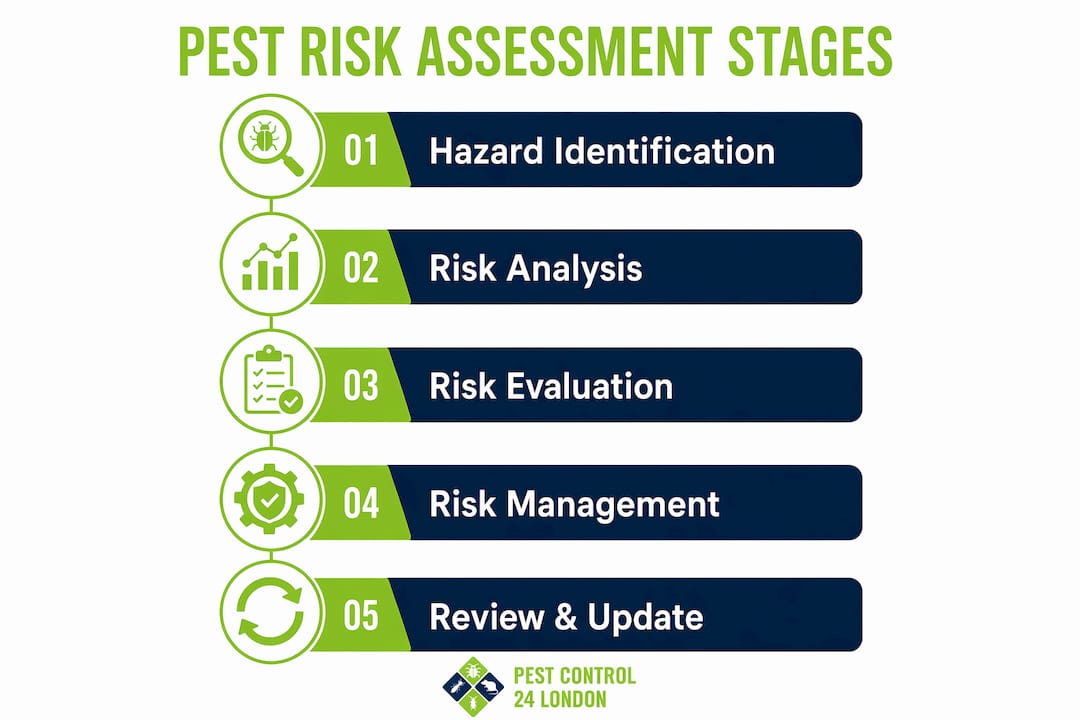
The PRA process follows three defined stages, though it is not strictly linear. Assessors may revisit earlier stages as new data emerges, and the process can stop at any point if an organism fails to meet pest criteria.
| Stage | Key activities | Objective |
|---|---|---|
| Stage 1: Initiation | Identify organism or pathway; confirm pest status; define PRA area | Determine whether a full assessment is warranted |
| Stage 2: Pest risk assessment | Pest categorisation; assess probability of introduction, spread, and economic impact | Evaluate the magnitude and likelihood of risk |
| Stage 3: Pest risk management | Identify and evaluate risk reduction options (RROs) | Recommend measures to reduce risk to an acceptable level |
Typical inputs and outputs at each stage:
- Stage 1 inputs: organism identification records, trade data, existing PRAs, pathway information
- Stage 2 inputs: biological data, climate models, host distribution maps, economic data
- Stage 2 outputs: pest categorisation conclusion, probability estimates, impact assessments
- Stage 3 outputs: recommended phytosanitary measures, RRO effectiveness evaluations
Information gathering runs throughout all three stages. A check for previously completed PRAs at national or international level is standard practice before new work begins.
How are pests categorised under regulatory criteria?
Pest categorisation is the first step within Stage 2 and determines whether a full risk assessment proceeds. IPPC ISPM standards define two primary regulatory categories: quarantine pests and regulated non-quarantine pests (RNQPs). The distinction shapes the entire scope of the subsequent assessment.
Regulatory criteria used in categorisation include:
- Pest identity: confirmed taxonomic classification
- Presence or absence in the PRA area
- Regulatory status: whether the pest is already listed or controlled
- Potential for establishment and spread within the PRA area
- Potential economic consequences, including environmental impacts
Pests commonly assessed in the UK include Xylella fastidiosa (a bacterial pathogen affecting a wide range of woody plants), the Asian longhorn beetle (Anoplophora glabripennis), and various species of Phytophthora. If a pest does not satisfy the criteria for quarantine or RNQP status, the PRA stops at this point, conserving resources and focusing regulatory effort where it is genuinely needed.
What methods are used in pest risk assessment?

Two broad methodological approaches apply in pest risk evaluation: qualitative and quantitative. EFSA guidance recommends a two-tiered framework that combines both, depending on available data and the complexity of the assessment mandate.
Qualitative methods (first tier):
- Expert scoring matrices and weight-of-evidence judgements
- Structured expert knowledge elicitation
- Suitable when data are limited or a rapid assessment is required
Quantitative methods (second tier):
- Probabilistic models estimating entry, establishment, spread, and impact
- Monte Carlo simulations to compare scenarios with and without risk reduction options
- Scenario-based comparisons to evaluate RRO effectiveness
Key point: Qualitative expressions of risk are often ambiguous. Quantitative methods allow assessments to be updated transparently as new information becomes available, and they support clearer communication of uncertainty to risk managers.
Strengths and limitations of each approach:
- Qualitative: faster, accessible with limited data, but prone to ambiguity and subjective bias
- Quantitative: more transparent and reproducible, but requires substantial data and technical expertise
Practitioners typically begin with a first-tier qualitative approach and escalate to quantitative modelling only where the data and mandate justify it. Explicitly communicating uncertainty at every step is not optional; it is a core requirement of both approaches.
How does pest risk assessment support regulatory decisions?
PRA provides the scientific basis for phytosanitary regulations, evaluating introduction likelihood, spread, and potential impacts before any regulatory action is taken. Risk managers rely on PRA outputs to determine whether a pest risk is acceptable and, if not, which management options are proportionate and feasible.
The process requires ongoing interaction between risk assessors and risk managers, particularly during problem formulation, when the scope and terms of reference for the assessment are defined. Transparency, full documentation, and readiness for peer review are prerequisites for regulatory acceptance.
Stakeholders involved in the PRA process include:
- Risk assessors: scientists and technical specialists conducting the evaluation
- Risk managers: regulators and policy-makers at Defra and equivalent bodies
- Policy-makers: those responsible for translating PRA conclusions into legislation
- Industry representatives: importers, growers, and trade bodies who may be affected by phytosanitary measures
PRA contributes to risk communication by providing documented, evidence-based conclusions that regulators can defend publicly. The IPPC emphasises that PRA is not merely a scientific exercise; it is the formal rationale for regulatory action to reduce pest risks to acceptable levels.
Expert insights from UK pest control professionals
PRA sits at the intersection of science and policy. The process demands rigour at every stage, and the quality of the final assessment depends heavily on how well uncertainty is handled and communicated.
From a practical standpoint, the iterative nature of PRA is one of its most useful features. Assessments can be updated as surveillance data, climate projections, or trade patterns change, meaning a PRA completed several years ago may need revisiting if conditions shift. For pests with limited data, a first-tier qualitative assessment may be the only feasible option, but that does not reduce the obligation to document assumptions clearly.
Expert advice and quality best practices, including guidance on property cleanup best practices for homeowners, help reduce pest risk effectively:
- Document all assumptions, data sources, and evidence gaps from the outset
- Engage risk managers early in problem formulation to align scope with regulatory needs
- Apply structured expert knowledge elicitation when quantitative data are unavailable
- State uncertainty ranges explicitly rather than collapsing them into vague qualitative terms
- Ensure the assessment is reproducible and auditable for peer review
- Review and update PRAs when new surveillance or scientific evidence becomes available
Pro Tip: When preparing a PRA for regulatory submission, structure your uncertainty analysis as a standalone section rather than embedding it throughout the document. Reviewers and risk managers can then assess confidence levels at a glance, which accelerates the approval process considerably.
Robust documentation is not a formality. Assessments that lack clear audit trails or fail to address data gaps are routinely returned for revision, delaying the regulatory decisions they are meant to support.
What is the legal framework for pest risk assessments in the UK?
Since the UK’s departure from the European Union, the legal basis for PRAs sits primarily within the Plant Health (England) Order 2015 and its subsequent amendments, alongside equivalent legislation in Scotland, Wales, and Northern Ireland. Defra’s Animal and Plant Health Agency (APHA) carries out PRAs on behalf of the UK government and publishes completed assessments on the UK Plant Health Information Portal.
The UK continues to align closely with IPPC standards, particularly ISPM 2 (Framework for pest risk analysis), ISPM 11 (Pest risk analysis for quarantine pests), and ISPM 21 (Pest risk analysis for regulated non-quarantine pests). These ISPMs provide the technical methodology that underpins UK statutory requirements. Phytosanitary measures introduced following a PRA must be technically justified, proportionate, and consistent with the UK’s international trade obligations under the World Trade Organization’s Agreement on the Application of Sanitary and Phytosanitary Measures (SPS Agreement).
What data sources and evidence feed into a pest risk assessment?
A PRA draws on a wide range of biological, economic, and environmental evidence. No single data source is sufficient; the strength of an assessment lies in the synthesis of multiple, independently verified inputs.
Common data sources include:
- Scientific literature: peer-reviewed studies on pest biology, host range, and spread mechanisms
- Surveillance and monitoring records: national and international pest monitoring databases
- Trade and import data: commodity flows that represent potential pathways of entry
- Climate and habitat models: species distribution models projecting establishment potential
- Expert knowledge: structured elicitation from specialists when empirical data are sparse
- International databases: EPPO Global Database, CABI Compendium, and FAO records
For pest risk evaluation in the UK, Defra assessors also consult historical outbreak records and economic impact data from affected sectors such as forestry, horticulture, and arable farming. Understanding pest population dynamics is equally relevant when estimating spread rates and the likely scale of an infestation once established.
How do UK pest risk assessments align with IPPC and ISPM standards?
The IPPC, established under the FAO, provides the global framework for phytosanitary measures through its International Standards for Phytosanitary Measures (ISPMs). The UK is a contracting party to the IPPC, which means its PRAs must conform to ISPM methodology to be internationally recognised and to justify trade-related phytosanitary restrictions.
ISPM 2 sets out the overall PRA framework covering all three stages. ISPM 11 provides detailed guidance for quarantine pest assessments, while ISPM 21 addresses regulated non-quarantine pests. EFSA’s guidance on quantitative pest risk assessment builds on these ISPMs by introducing the two-tiered approach and Monte Carlo simulation methodology, which Defra assessors apply when conducting higher-complexity evaluations.
Alignment with international standards serves a practical purpose beyond compliance. When a UK PRA concludes that a pest poses an unacceptable risk and phytosanitary import conditions are imposed, those conditions must be defensible under WTO SPS rules. A PRA that follows ISPM methodology provides that defence. Conversely, a pest assessed as low risk can support the removal of unnecessary trade barriers, benefiting importers and the wider supply chain. Staying current with pest management developments is part of maintaining that alignment as new pests emerge and scientific understanding evolves.
Need professional pest control support in London?

Whether you are dealing with an active infestation or want to understand your risk exposure before it becomes a problem, Pestcontrol24london has been providing BPCA-qualified pest control services across London since 2015. From hotels and restaurants to residential properties, the team brings over a decade of hands-on experience to every job. Contact Pestcontrol24london today for a free quote and same-day response.
Key takeaways
A pest risk assessment is a structured, three-stage scientific process that provides the evidence base for phytosanitary regulatory decisions in the UK and internationally.
| Point | Details |
|---|---|
| Three-stage structure | PRA follows initiation, pest risk assessment, and pest risk management stages under IPPC ISPM standards. |
| Pest categorisation is the gateway | Categorisation determines whether a full PRA proceeds; pests not meeting quarantine criteria stop the process early. |
| Two-tiered methodology | Assessors use qualitative weight-of-evidence first, escalating to quantitative Monte Carlo modelling where data allow. |
| Uncertainty must be explicit | Communicating uncertainty clearly is a core requirement of both qualitative and quantitative assessments. |
| UK legal and international alignment | UK PRAs must satisfy domestic plant health legislation and IPPC ISPM standards to justify phytosanitary trade measures. |