

Pest resistance is defined as a significant decrease in a pest population’s sensitivity to a pesticide, caused by the survival and reproduction of individuals carrying naturally resistant genes. The US EPA describes this as an evolutionary arms race where resistant traits spread through successive generations. For homeowners and gardeners, this means a product that worked last year may fail this year. Understanding the pest resistance meaning is the first step towards making smarter, longer-lasting decisions about pest control in your home and garden.
What is pest resistance and how does it develop?
Pest resistance results from evolutionary selection, not deliberate pest action. When a pesticide is applied, most pests die. A small number carrying genetic mutations that help them survive will reproduce, passing those traits to offspring. Over time, the resistant individuals dominate the population, and the pesticide loses its effectiveness.
The process accelerates when the same chemical class is used repeatedly. Frequent, repeated use of a single pesticide mode of action is the fastest route to resistance. Each application removes susceptible individuals and leaves resistant ones to breed. Within just a few generations, a pest population can shift from fully susceptible to largely resistant.
Three core biological drivers push resistance forward:
- Genetic variation: Natural mutations exist in every pest population before any pesticide is applied.
- Selection pressure: Each pesticide application acts as a filter, removing susceptible pests and leaving resistant ones.
- Rapid reproduction: Many pest species reproduce in days or weeks, meaning resistant traits spread through a population quickly.
This is the evolutionary arms race that pest management professionals and researchers refer to. Relying on a single control method breeds stronger resistant pests for the future. The practical implication for homeowners is clear: rotating products and methods is not optional, it is necessary.
Pro Tip: Read pesticide labels carefully. Label restrictions on application frequency are critical management thresholds set specifically to slow resistance development.
What biological mechanisms allow pests to resist pesticides?
Pests use several distinct biological mechanisms to survive pesticide exposure. Understanding these helps you appreciate why no single product remains effective indefinitely.
Multiple resistance mechanisms can coexist within the same pest population, which makes control significantly more difficult. A single insect species may simultaneously detoxify a chemical, block its binding site, and avoid treated surfaces.
| Mechanism | How it works | Effect on control |
|---|---|---|
| Metabolic resistance | Pest enzymes break down the pesticide before it causes harm | Product becomes ineffective quickly |
| Target-site resistance | Mutation at the pesticide’s binding site prevents it from working | Chemical has no effect even at higher doses |
| Penetration resistance | Thickened cuticle slows absorption of the pesticide | Pest survives exposure that would kill susceptible individuals |
| Behavioural resistance | Pests detect and avoid treated surfaces or baits | Pesticide never reaches the pest in lethal quantities |
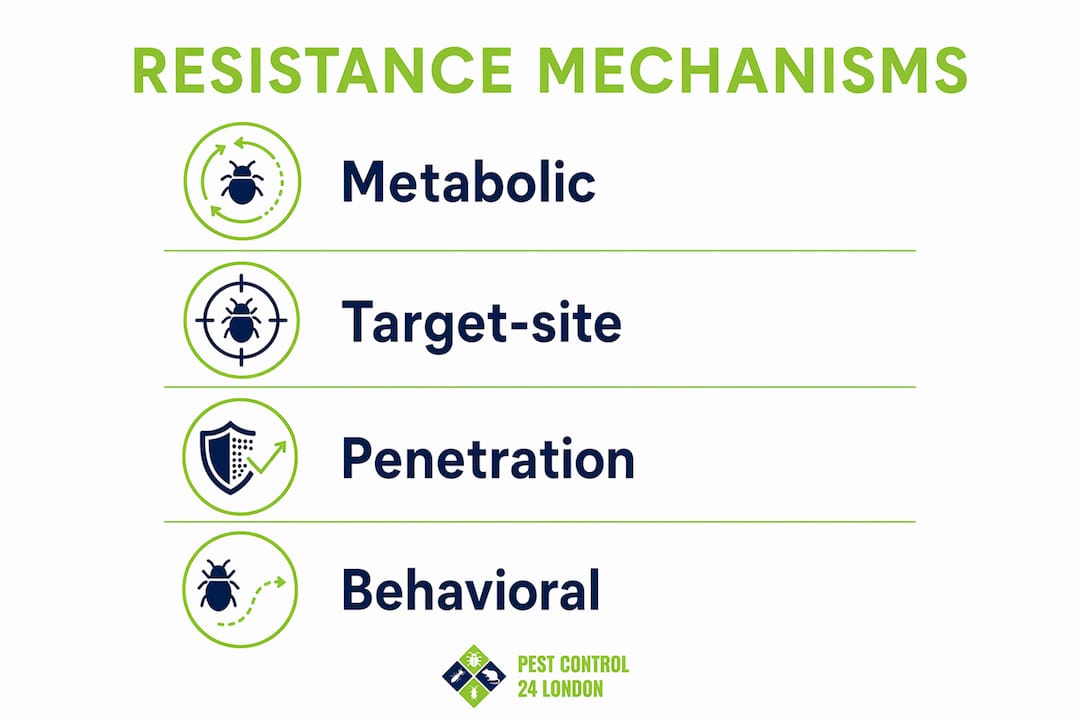
Each mechanism presents a different challenge. Metabolic resistance, for example, is particularly common in cockroaches and houseflies. Target-site resistance is well documented in rodents exposed to anticoagulant rodenticides. Behavioural resistance has been observed in bed bugs, which learn to avoid surfaces treated with certain insecticides.

The key takeaway is that pests develop resistance through mutations, metabolic detoxification, and behaviour changes, and these mechanisms can combine. No single product or approach defeats all of them.
How can homeowners manage and prevent pest resistance?
Integrated Pest Management, known as IPM, is the most effective framework for preventing and slowing resistance. IPM combines monitoring, targeted treatment, and non-chemical controls to reduce selection pressure on pest populations. The goal is not total eradication by a single method, but long-term population management through diverse strategies.
Practical steps homeowners and gardeners can follow:
- Monitor before treating. Identify the pest accurately before reaching for any product. Misidentification leads to wrong treatments and wasted selection pressure.
- Use economic thresholds. Treat only when pest numbers reach a level that justifies intervention. Not every sighting requires a chemical response.
- Rotate products by mode of action. Switch between products that work differently. Using the same chemical class repeatedly accelerates resistance. Check product labels for mode of action group numbers.
- Apply non-chemical controls first. Sanitation and physical barriers often disrupt pest life cycles before pesticide use is needed. Sealing entry points, removing food sources, and reducing moisture are highly effective first steps.
- Time treatments accurately. Apply products when pests are most vulnerable, such as during larval stages, for maximum impact with minimum chemical use.
Emerging tools such as biopesticides and nanobiopesticides show genuine promise. Biopesticides and nanotechnologies improve environmental impact and reduce resistance pressure when combined with evidence-based strategies. They are not standalone solutions. They work best as part of a broader IPM plan, not as replacements for it.
For practical guidance on implementing pest barriers at home, physical exclusion remains one of the most reliable and resistance-proof methods available to homeowners.
Pro Tip: Never increase the dose of a failing pesticide. If a product stops working, it is a sign of resistance. Switching to a different mode of action is the correct response, not applying more of the same chemical.
What does the future hold for pest resistance management?
Researchers are increasingly focused on understanding the evolutionary biology of resistance rather than simply developing new chemicals. The recognition that resistance is biologically inevitable has shifted the conversation towards sustainable, evidence-based management.
Nanobiopesticides represent one of the more promising developments. They deliver active ingredients more precisely, reducing the dose required and therefore the selection pressure placed on pest populations. However, researchers caution clearly against viewing new technologies as standalone fixes. Integration into a broader IPM plan is essential for long-term success.
“Resistance is an inevitable biological response. The focus must shift to long-term population management through diverse strategies, avoiding the pursuit of total eradication by a single method.” — University of Florida IFAS Extension, Pesticide Information Office
Ecosystem health is also a growing concern. Overuse of pesticides harms beneficial insects, soil organisms, and natural predators that help keep pest populations in check. Sustainable pest control that limits pesticide reliance protects these natural allies. For homeowners, this means that eco-friendly pest solutions are not just environmentally responsible choices. They are also strategically sound ones that reduce long-term resistance risk.
Key takeaways
Pest resistance is an evolutionary certainty, and the most effective response is a diverse, integrated approach that combines monitoring, rotation, non-chemical controls, and professional guidance.
| Point | Details |
|---|---|
| Resistance is evolutionary | Resistant genes spread naturally when susceptible pests are removed by repeated pesticide use. |
| Four key mechanisms | Metabolic, target-site, penetration, and behavioural resistance can all coexist in one population. |
| IPM is the gold standard | Monitoring, rotating modes of action, and non-chemical controls slow resistance development effectively. |
| Sanitation reduces reliance | Physical barriers and good hygiene often remove the need for pesticides before resistance becomes an issue. |
| New technologies need context | Biopesticides and nanobiopesticides are useful additions to IPM, not replacements for it. |
My view on pest resistance after a decade in the field
Resistance is the part of pest control that most homeowners never think about until a product stops working. By then, the problem is already established. What I have seen consistently over the years is that the homeowners who struggle most with persistent infestations are those who reach for the same spray every time, often the cheapest option on the shelf, without considering whether it is still effective.
The biology here is not complicated. Pests evolve. Chemicals do not. Every time you apply the same product without rotation, you are selecting for the survivors. Those survivors breed. Their offspring are harder to kill.
The most effective approach I have seen combines professional identification, targeted treatment, and genuine attention to the environment around the property. Sealing gaps, removing food sources, and reducing moisture do more lasting work than any single pesticide. Professional guidance matters too, not because homeowners cannot manage pests themselves, but because qualified pest control brings the knowledge of resistance patterns, product rotation, and timing that makes treatments last.
Resistance is not a reason to panic. It is a reason to think more carefully about how you manage pests over time.
— Dan
How Pestcontrol24london approaches pest resistance in London homes
Pestcontrol24london has been managing pest infestations across London since 2015, working with residential properties, hotels, restaurants, and commercial premises. The team is BPCA fully qualified and applies Integrated Pest Management principles to every job, including product rotation, accurate pest identification, and non-chemical controls where appropriate.

If you are dealing with a pest problem that keeps returning despite repeated treatments, resistance may be a factor. Pestcontrol24london offers domestic pest control services built around responsible, evidence-based strategies that account for resistance. Contact the team for a free quote and a treatment plan designed to work long-term, not just short-term.
FAQ
What is the pest resistance definition?
Pest resistance is a significant decrease in a pest population’s sensitivity to a pesticide, caused by the survival and reproduction of individuals with naturally resistant genes. The US EPA classifies it as an evolutionary arms race between pest populations and the chemicals used to control them.
Why is pest resistance important for homeowners?
Pest resistance means that products which previously worked may become ineffective, leading to persistent infestations. Understanding resistance helps homeowners choose treatments that remain effective and avoid practices that accelerate the problem.
How can I tell if pests have become resistant?
If a pesticide that previously controlled a pest population stops working at the recommended dose, resistance is a likely cause. Switching to a product with a different mode of action is the correct response.
What types of pest resistance exist?
The four main types are metabolic resistance, target-site resistance, penetration resistance, and behavioural resistance. Multiple types can occur simultaneously in the same pest population, making control more difficult.
Does IPM actually prevent pest resistance?
IPM, which includes monitoring, rotating products, and using non-chemical controls, is the most effective approach for preventing or delaying resistance. It does not eliminate resistance entirely, but it slows its development significantly.