

Invoices tell you a treatment happened. Pest control documentation tells you whether it worked, what was used, and whether you can prove it to a health inspector. Many property managers and business owners are surprised to learn that a stack of invoices does not constitute a compliant pest management record. What is pest control documentation, exactly? It is the structured, detailed record of every pesticide application made at your property, covering the who, what, where, when, and how of each treatment. Getting this right protects your licence, your tenants, and your reputation.
Table of Contents
- Key takeaways
- What is pest control documentation?
- Why pest control documentation matters
- Common mistakes in pest documentation
- How to implement good documentation practices
- My perspective on documentation’s real value
- How Pestcontrol24london supports your compliance
- FAQ
Key takeaways
| Point | Details |
|---|---|
| Invoices are not records | Regulatory bodies treat invoices and treatment records as separate documents with different requirements. |
| Records must be detailed | Compliant pest control records include applicator name, pesticide brand, active constituent, rate, and environmental conditions. |
| Retention periods vary | Depending on jurisdiction, records must typically be kept for two to five years and made available on request. |
| Gaps cause non-compliance | Missing data on even one field can render a record non-compliant, even if treatment was properly carried out. |
| Digital tools reduce errors | Capturing records on-site with mandatory digital fields significantly improves accuracy and audit readiness. |
What is pest control documentation?
Pest control documentation refers to the complete set of records that capture every detail of a pesticide application at a given property. It goes well beyond a receipt or a confirmation email. These are formal treatment records, and they carry legal weight.
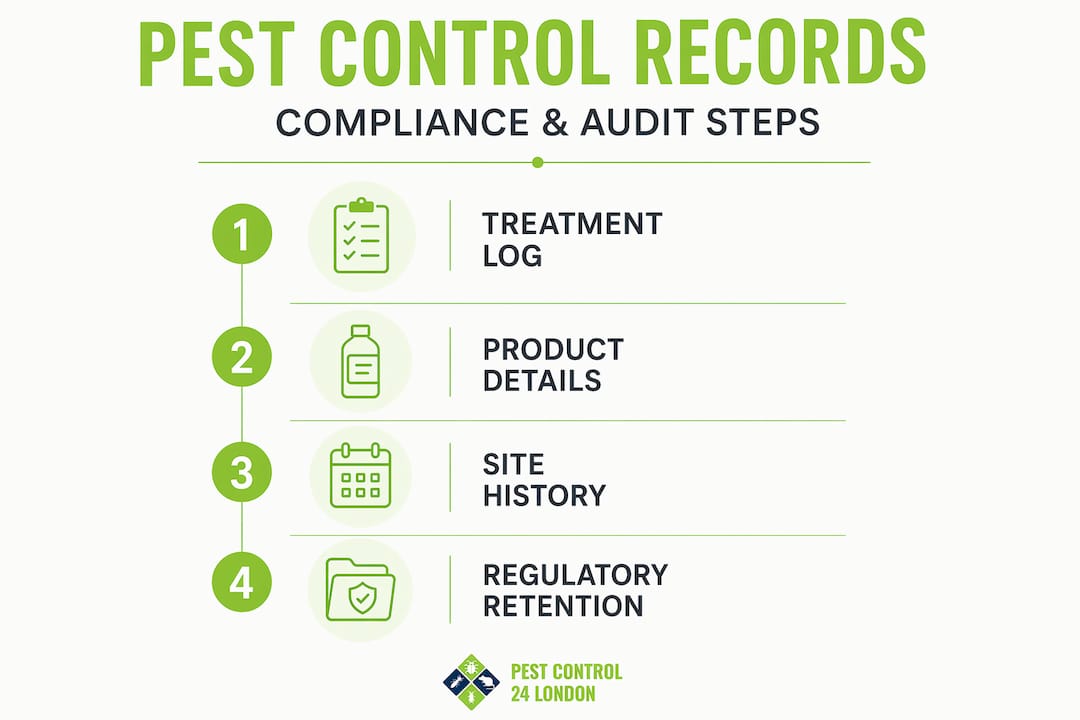
The core elements that constitute a proper pest management record include:
- Date and time of the treatment
- Full address of the treatment site
- Technician name and licence or certification number
- Pesticide product name (brand name and active constituent)
- Application rate and total amount used
- Target pest and specific treatment areas
- Application method (spray, bait, dust, or fumigation)
- Environmental conditions at the time of application (temperature, wind, weather)
- Any follow-up actions required or recommended
This level of detail is not optional. Pest management businesses in Western Australia must create treatment records within two business days and retain them for three years, covering all the data points above. California requires records kept for two years and made available immediately during inspections or emergencies. New Jersey goes further, requiring records kept for three to five years and accessible to emergency medical personnel if needed.
It is also worth understanding what pest control documentation is not. Invoices and customer quotes cannot substitute for treatment records. Regulatory guidance is explicit on this point. A quote outlines what was planned. An invoice confirms payment. Neither proves what product was applied, at what rate, or by whom.
| Document type | What it shows | Counts as a treatment record? |
|---|---|---|
| Invoice | Services charged and payment received | No |
| Quote | Planned treatment and price | No |
| Treatment record | Full application details and technician info | Yes |
| Inspection report | Pest evidence and recommended actions | Partial, must accompany treatment records |
Pro Tip: When reviewing your pest control contracts, confirm that your provider is contractually obligated to supply you with treatment records after every visit, not just invoices.
Why pest control documentation matters
The role of documentation in pest control extends across three distinct areas: legal compliance, audit readiness, and operational performance.

From a legal standpoint, accurate records demonstrate that pesticides were applied safely and lawfully. Falsifying records is a legal offence carrying serious penalties, and incomplete records carry their own risks. A food business that cannot produce compliant documentation during a health inspection can face closure orders, even if the treatment itself was performed correctly.
From an audit perspective, inspectors do not simply check whether a pest controller visited. They compare pest evidence found, pesticides applied, and documented corrective actions. Missing any one of those three elements can cause the entire pest management programme to be deemed ineffective, regardless of what was actually done on the ground.
Keeping a history of pesticide applications is not only a legal requirement but the best defence against disputes, and it supports continuous improvement in your pest management approach. University of Florida IFAS
Operationally, good pest control records help you identify patterns. If treatments at a particular location keep recurring for the same pest, a well-maintained record history shows exactly what was tried, what failed, and what needs to change. This transforms your pest management from reactive to genuinely preventative.
For businesses in the food and hospitality sector, the importance of pest control documentation is amplified further. Environmental health officers and food safety auditors will expect to see dated, signed treatment records as part of any commercial pest compliance review.
Common mistakes in pest documentation
Most compliance failures do not happen because treatment was skipped. They happen because records were incomplete, late, or based on a misunderstanding of what constitutes a valid document.
The most common errors include:
- Confusing invoices with records. This is the most widespread mistake. An invoice confirms a payment. It does not confirm what product was used or at what concentration.
- Delayed record creation. Waiting days or weeks to write up a treatment record increases the risk of missing details and, in many jurisdictions, creates an automatic compliance breach.
- Missing product information. Omitting the pesticide registration number, active constituent, or application rate leaves the record non-compliant, even if everything else is correct.
- No environmental conditions logged. Temperature, wind speed, and weather affect how pesticides behave. Failing to record these omits data that regulators consider material.
- No follow-up actions noted. If a technician recommends proofing work or a return visit, that recommendation should appear in the record. Without it, there is no documented link between the pest problem and its resolution.
Incomplete spray logs and missing product details create direct compliance exposures. Capturing data on-site during the treatment is the only reliable way to avoid these gaps.
Pro Tip: Ask your pest control provider to share a sample treatment record before committing to a contract. If the sample does not include product registration numbers and applicator licence details, it will not pass an inspection.
How to implement good documentation practices
Setting up a documentation routine that meets pest control documentation requirements does not need to be complicated. The following steps will put you in a reliable position regardless of your property type.
- Define what records you need. Work with your pest control provider to confirm which regulatory framework applies to your business and what fields each treatment record must contain.
- Choose your record-keeping format. Paper records are still acceptable in most jurisdictions, but digital tools with mandatory fields significantly reduce the risk of incomplete entries. Digital records are also easier to retrieve during an inspection.
- Set a completion deadline. Agree with your provider that records will be delivered within 24 to 48 hours of each treatment. This matches regulatory timelines and keeps your records current.
- Create a secure, accessible file. Keep records organised by date and location. A filing system that requires 20 minutes to retrieve a single record is a liability during an unannounced inspection.
- Audit your records periodically. Review a sample of recent records every quarter to check for completeness. Look specifically for missing product details, unsigned entries, or treatments without follow-up notes.
- Brief your team. If you manage multiple sites, your facilities or operations team should understand pest management documentation standards well enough to spot a non-compliant record when one arrives.
Building documentation into daily workflows with mandatory fields produces measurably better records and stronger audit outcomes. The University of Florida IFAS recommends retaining records for at least two years, including equipment used, application rates, and any restrictions in place at the time.
My perspective on documentation’s real value
I have worked in pest control across London for over a decade, and the most common frustration I hear from property managers is this: they did everything right, had the treatment done, and still failed an inspection. Almost every time, the problem was documentation.
What surprises people is how straightforward good record keeping actually is once it is built into the workflow. The resistance usually comes from treating it as an afterthought rather than part of the service itself. In my experience, properties that demand detailed records from their pest controller from day one never face this problem.
There is also a subtler benefit that rarely gets discussed. Detailed records make it far easier to challenge a supplier who is not performing. If your records show that the same infestation has been treated four times in six months with the same product and the same outcome, you have documented evidence to require a different approach. Without records, you only have suspicion.
Regulators in the UK are increasingly focused on documentation quality, not just treatment frequency. The expectation is shifting toward proof of effectiveness, not just proof of attendance. Properties that build rigorous records now will be ahead of that curve.
— Dan
How Pestcontrol24london supports your compliance
Pestcontrol24london has been delivering professional pest management across London since 2015, working with hotels, restaurants, commercial properties, and residential clients. Every treatment carried out by our BPCA-qualified technicians is supported by detailed treatment records that meet professional standards, giving you the documentation you need for audits, inspections, and ongoing management.
Whether you need commercial pest management for a food business or a hospitality venue, or you are managing a residential block and need clear, compliant records for your property portfolio, Pestcontrol24london provides a complete service from first survey through to post-treatment documentation. Contact us today to discuss a tailored pest management plan that keeps your property protected and your records inspection-ready.
Visit Pestcontrol24london to request a free quote.
FAQ
What is pest control documentation?
Pest control documentation is the formal record of every pesticide application carried out at a property, including the pesticide used, the applicator’s details, the application rate, and the date and time of treatment. It is distinct from invoices or quotes.
How long must pest control records be kept?
Retention requirements vary by jurisdiction. Most regulations require records to be kept for two to five years, with some jurisdictions requiring immediate access for emergency or inspection purposes.
Are invoices sufficient as pest control records?
No. Regulatory guidance explicitly separates invoices from treatment records. An invoice confirms a payment, not the specific pesticide applied, the rate used, or the technician’s credentials.
What happens if pest control records are incomplete?
Incomplete records can result in non-compliance findings during inspections, even if the treatment itself was carried out correctly. Inspectors assess records alongside pest evidence and corrective actions taken.
What should a compliant pest control record include?
A compliant record should include the date and time of treatment, the property address, the technician’s name and licence number, the pesticide brand and active constituent, the application rate and method, environmental conditions, and any recommended follow-up actions.