

Localized pest treatment is the targeted application of pest control measures to specific areas where pests are confirmed, rather than treating an entire property. The NPIC describes this approach as tailoring control to specific pests or problem areas, such as cracks, nests, or entry points. This method sits at the heart of Integrated Pest Management (IPM), a framework endorsed by the EPA that prioritises minimal pesticide use, evidence-based decisions, and protection of occupants and the environment. For homeowners and business owners in London, understanding this approach is the first step towards managing pest issues more safely and cost-effectively.
What is localized pest treatment and how does it fit within IPM?
Localized pest treatment, known in professional practice as targeted or spot treatment, means applying control measures only where pest activity has been confirmed through inspection and monitoring. The NPIC confirms that correct pest identification is the cornerstone of this approach, because treating the wrong area wastes resources and leaves the actual problem unresolved. Professionals use inspection records, monitoring traps, and threshold assessments to determine precisely where and when intervention is needed.
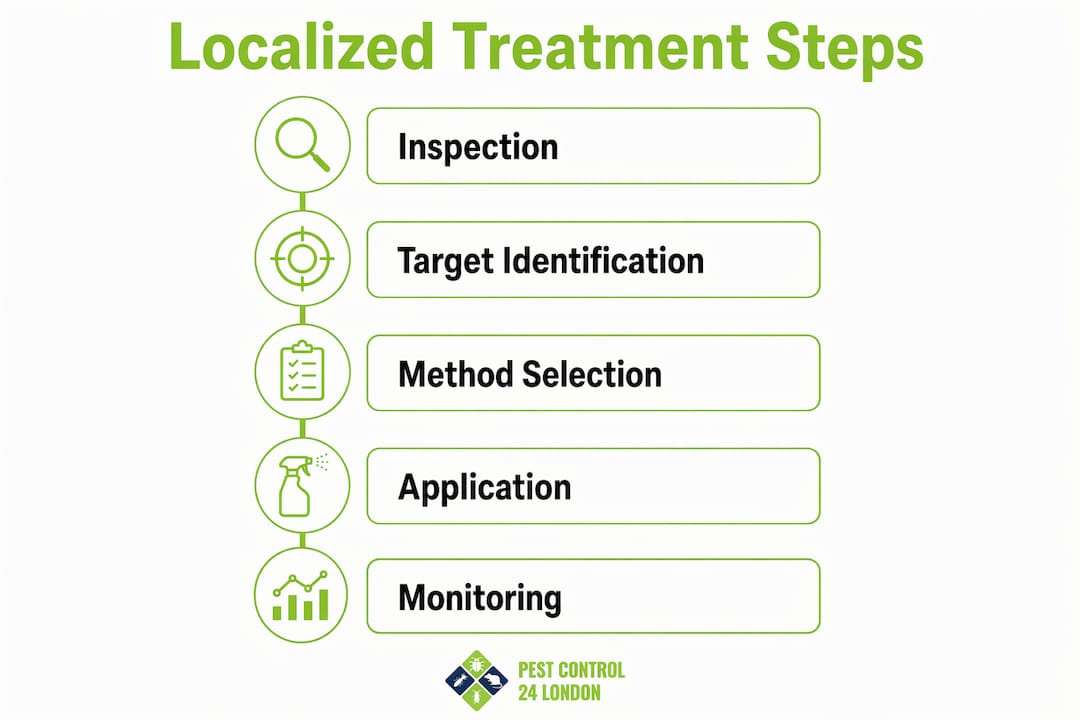
Within an IPM framework, targeted treatment follows a clear sequence:
- Inspect and identify. A qualified technician surveys the property, documents pest activity, and identifies the species involved. No treatment begins without this step.
- Set action thresholds. Not every sighting warrants treatment. IPM uses thresholds to determine when pest populations reach a level that justifies intervention.
- Apply non-chemical controls first. Sanitation improvements, physical exclusion, sealing entry points, and removing food or water sources are addressed before any pesticide is considered.
- Use targeted chemical controls as a last resort. If pesticides are required, they are applied only to the confirmed problem area, such as a bait station inside a wall void or a gel treatment along a specific run.
- Monitor and document. Follow-up inspections confirm whether the treatment worked and guide any adjustments. IPM stresses documenting findings and adjusting control areas based on ongoing monitoring.
Pro Tip: Ask your pest control provider to show you their inspection report before any treatment begins. If they cannot identify the specific pest and location, they are not practising targeted control.
What are the benefits of localized pest treatment?
Targeted pest control outperforms blanket treatments across several measurable dimensions. The advantages are not marginal. They affect health, cost, and long-term effectiveness in ways that matter directly to property owners.
- Greater effectiveness. Treatments applied to confirmed pest locations deliver higher concentrations of control exactly where they are needed. Spreading the same product across an entire property dilutes its impact and misses the source.
- Reduced health risks. Limiting pesticide application to specific spots significantly lowers occupant, pet, and non-target organism exposure. Localized treatments align with sustainability by protecting beneficial insects and reducing chemical load in the wider environment.
- Lower costs. Fewer chemicals, smaller treatment areas, and less frequent applications reduce the overall spend. Businesses such as hotels and restaurants that adopt targeted approaches avoid the disruption and expense of whole-property treatments.
- Less disruption. Occupants rarely need to vacate the premises when treatment is confined to a specific zone, such as a kitchen void or a basement corner.
- Supports eco-conscious management. Routine pesticide applications without confirmed infestations are actively discouraged by the EPA. Targeted treatment keeps chemical use proportionate and justifiable.
The EPA advises that pesticides should be applied only when pests are present and other methods have failed. This means any provider offering scheduled, blanket spray treatments regardless of pest activity is not following best practice.
What localized pest control methods and products are commonly used?
Professionals draw on a range of tools depending on the pest, the location, and the severity of the problem. The table below summarises the main categories used in targeted pest management.
| Method | How it works | Best used for |
|---|---|---|
| Mechanical traps | Physical capture without chemicals | Rodents, insects in specific zones |
| Exclusion and proofing | Sealing gaps, installing barriers | Preventing entry at confirmed access points |
| Biological controls | Introducing natural predators or parasites | Garden pests, certain fly species |
| Bait stations | Targeted chemical delivery in enclosed units | Cockroaches, ants, rodents |
| Spot or crack-and-crevice treatments | Pesticide applied directly to harbourage sites | Cockroaches, bed bugs, stored product pests |
| Gel formulations | Precise application inside voids and joints | Cockroaches in commercial kitchens |
Physical removal and preventive cultural practices such as hand-picking, mulching, and habitat modification are applied before chemical options are considered. This sequencing is not optional under IPM. It is the defining principle that separates targeted management from reactive spraying.
Effective localized pest control integrates multiple tactics including barrier installation, habitat modification, and targeted pesticide application, all coordinated through a management plan that evolves with each inspection. A single visit rarely resolves a problem permanently. The plan must adapt as monitoring data changes.

Pro Tip: For commercial kitchens and food businesses, gel bait formulations applied to crack-and-crevice sites are far more effective than aerosol sprays. They target cockroach harbourage directly and carry no airborne contamination risk.
How to choose a pest control service for targeted treatments
Selecting the right provider determines whether localized pest management actually delivers results. The EPA advises that service contracts should include periodic inspections and that pesticides should only be applied when pests are confirmed present. A provider who cannot meet this standard is not offering genuine targeted control.
When evaluating a pest control company, ask the following:
- Does the technician conduct a written inspection before recommending any treatment?
- Can they identify the specific pest species and confirm its location?
- Do they explain which non-chemical methods will be used first?
- Is the treatment plan tailored to your property, or is it a standard package applied to every client?
- Do they provide follow-up monitoring as part of the service?
- Are they accredited by a recognised body such as the British Pest Control Association (BPCA)?
Choosing a credible pest control company that documents inspections and treatment areas leads to better, safer outcomes. Understanding pest control contracts before signing also protects you from paying for treatments that are not evidence-based. Providers who rely on routine blanket applications without justification are not only less effective. They are also exposing your property to unnecessary chemical use.
Key takeaways
Localized pest treatment is the most effective and responsible approach to pest management because it targets confirmed pest locations, reduces chemical exposure, and produces better long-term results than blanket treatments.
| Point | Details |
|---|---|
| Definition of targeted treatment | Pest control applied only to confirmed pest locations, not entire properties. |
| IPM is the framework | Localized treatment follows Integrated Pest Management principles, using chemicals only as a last resort. |
| Multiple methods work together | Traps, exclusion, biological controls, and spot treatments are combined based on inspection data. |
| Provider credentials matter | Choose BPCA-accredited companies that document inspections and justify every treatment applied. |
| Routine blanket spraying is discouraged | The EPA advises against pesticide applications without confirmed pest presence. |
Why targeted treatment is the only approach worth taking
After more than a decade working in pest control across London, I have seen the same mistake repeated by property owners who opt for the cheapest or most convenient option available. They pay for a blanket spray, the technician is in and out in twenty minutes, and three weeks later the cockroaches are back. The problem was never the product. It was the absence of any real inspection.
Targeted treatment requires more time upfront. A proper inspection of a commercial kitchen or a residential property with a rodent problem takes thirty to sixty minutes. That time investment is what separates a treatment that works from one that temporarily suppresses visible activity. I have seen hotels with persistent bed bug problems that had been treated repeatedly with whole-room sprays. Once we switched to a targeted approach, inspecting each room individually and treating only confirmed harbourage sites, the problem was resolved within two service visits.
The technology available to pest control professionals is also improving. Thermal imaging, digital monitoring traps, and data-driven reporting now allow technicians to build a precise picture of pest activity across a property over time. This makes pest population management far more accurate than it was even five years ago. My recommendation is straightforward: if your current provider cannot show you a written inspection report and a specific treatment justification, find one who can.
— Dan
Professional localized pest control in London
Pestcontrol24london has delivered targeted, evidence-based pest control across London since 2015, working with hotels, restaurants, takeaways, and residential properties. Every treatment begins with a thorough inspection, and no pesticide is applied without a confirmed pest presence and a documented justification.

Whether you are managing a commercial premises or a family home, Pestcontrol24london offers professional pest control services available 24 hours a day, seven days a week, with free quotes and BPCA-qualified technicians. For businesses requiring ongoing protection, the commercial pest management programme provides scheduled inspections, targeted treatments, and full documentation. Homeowners can access domestic pest control services tailored to the specific pest and property layout. Contact Pestcontrol24london today to arrange an inspection and receive a treatment plan built around your actual pest problem.
FAQ
What is localized pest treatment in simple terms?
Localized pest treatment means applying pest control only to the specific areas where pests have been confirmed, such as a nest, a crack, or an entry point, rather than treating an entire property. It is the standard approach within Integrated Pest Management.
How does localized pest treatment differ from blanket spraying?
Blanket spraying applies pesticide across an entire area regardless of where pests are active, while localized treatment targets only confirmed pest locations. The targeted approach reduces chemical exposure, costs less, and produces more reliable results.
Is localized pest treatment safe for children and pets?
Targeted treatments significantly reduce the amount of pesticide used and confine it to specific sites, which lowers exposure risk for occupants, children, and pets compared to whole-property applications.
How do I know if a pest control company uses targeted methods?
Ask whether the technician conducts a written inspection before treatment and whether they can identify the specific pest and its location. The EPA advises that pesticides should only be applied when pests are confirmed present.
Can localized pest control methods handle serious infestations?
Targeted methods are effective even for serious infestations when combined correctly. A thorough inspection sets the action threshold, and a combination of exclusion, baiting, and spot treatments addresses the source rather than masking the symptoms.