

Heat treatment for pests is defined as a thermal pest control method that raises the temperature of an infested space to lethal levels, killing insects and their eggs without chemical sprays. Also known as thermal remediation, it is the preferred choice for homeowners and businesses seeking a residue-free solution. Pestcontrol24london, a BPCA-qualified provider operating across London since 2015, uses this method to tackle infestations in hotels, restaurants, and residential properties. Demand for non-toxic pest control has grown steadily, particularly in settings where children, pets, or food safety are a concern.
How does heat treatment work to eliminate pests?
Thermal remediation works by sealing the infested area and using industrial mobile heaters to raise the temperature gradually to lethal levels. Technicians monitor the process with sensors placed throughout the space to confirm uniform heat distribution. The goal is to reach every corner, crack, and void where pests hide.
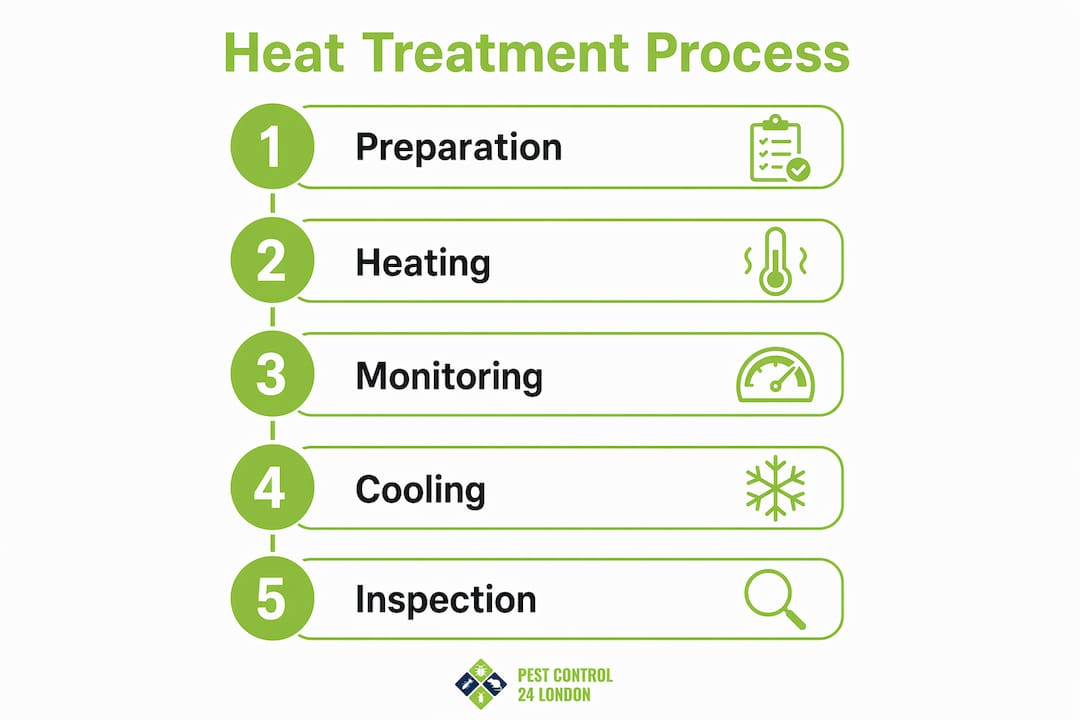
The process follows a clear sequence:
- Seal the treatment area. Doors, windows, and gaps are closed to contain the heat and prevent pests from escaping to cooler zones.
- Deploy industrial heaters. Electric or diesel-powered mobile heaters push hot air throughout the space, raising the ambient temperature steadily.
- Reach target temperatures. Temperatures between 49°C and 66°C are maintained for several hours to guarantee lethality at all pest life stages.
- Monitor with sensors. Probes placed in furniture, wall voids, and floor cavities confirm that heat penetrates every hiding spot.
- Confirm eradication. A post-treatment inspection checks that temperatures were sustained long enough for complete kill.
The science behind this is straightforward. Sustained heat denatures the proteins and enzymes inside pest bodies, causing death. This biological breakdown occurs across all life stages, including eggs that chemical sprays routinely fail to reach.
Heat also penetrates wall voids and furniture interiors that liquid treatments cannot access. That physical reach is what makes thermal remediation so effective against elusive pests like bed bugs, which tuck their eggs deep inside mattress seams and skirting boards.

Pro Tip: Ask your technician to share the sensor log after treatment. A reputable provider will have a temperature record confirming every zone reached the lethal threshold.
What are the benefits of heat treatment compared to chemical pest control?
Thermal remediation offers several clear advantages over conventional chemical treatments, particularly for London properties with specific safety or environmental requirements.
Key benefits include:
- No toxic residues. Heat treatment is non-toxic and residue-free, meaning residents can return to a treated space without waiting for chemicals to dissipate.
- Kills all life stages. Eggs that resist chemical treatments are destroyed in a single application, reducing the need for repeat visits.
- Safe for sensitive environments. Homes with young children, pets, or allergy sufferers benefit from a method that leaves no chemical trace.
- Preferred by food businesses. Restaurants, takeaways, and food processing sites increasingly request thermal management because it carries no contamination risk to food surfaces or equipment.
- Eco-friendly. Demand for chemical-free pest control continues to rise across London, and heat treatment aligns with that preference without compromising effectiveness.
There are limitations to acknowledge. Heat treatment carries a higher upfront cost than a standard chemical spray visit. Very large buildings or poorly insulated structures can be harder to heat uniformly, which may reduce effectiveness. Some pest species or specific infestation scenarios also respond better to an integrated approach combining heat with targeted chemical or physical methods.
“Thermal management ensures comprehensive eradication, critical for pests like bed bugs whose eggs resist chemicals. Professional pest control experts note that killing all pest life stages in one application often prevents the repeat visits that chemical programmes require.”
For homeowners weighing their options, the role of pest control methods in different settings is worth understanding before committing to a treatment plan.
What to expect during a professional heat treatment service?
A professional heat treatment visit is a structured, single-day process. Knowing what to prepare for makes the experience straightforward and the outcome more reliable.
Before the treatment:
- Remove or protect heat-sensitive items such as candles, aerosols, vinyl records, and certain plastics.
- Seal or remove food, medicines, and cosmetics.
- Clear access routes for heater equipment, particularly in hallways and doorways.
- Arrange to vacate the property for the duration of the treatment, along with any pets.
Full preparation guidance for London homes covers each of these steps in detail and is worth reviewing before your appointment.
During the treatment:
Treatment typically completes within one day, with technicians managing heater placement and sensor monitoring throughout. The property is kept sealed to maintain temperature. Technicians remain on site to adjust equipment and confirm readings.
After the treatment:
A post-treatment inspection checks that all zones reached the required temperature. Your technician will advise on steps to prevent re-infestation, such as sealing entry points and maintaining good housekeeping. Ongoing pest protection for your home is the most reliable way to keep an infestation from returning.
Pro Tip: Schedule your treatment early in the morning. Starting at 8AM gives technicians the full day to reach and sustain target temperatures, particularly in larger properties.
Are there situations where heat treatment may not be suitable?
Heat treatment is highly effective but not universally applicable. Understanding its limitations helps you choose the right approach for your specific situation.
| Scenario | Suitability | Recommended approach |
|---|---|---|
| Bed bug infestation | Excellent | Thermal remediation as primary method |
| Large, poorly insulated building | Reduced | Combined heat and chemical treatment |
| Outdoor or garden pest problem | Not suitable | Physical or chemical methods |
| Pest species with burrowing habits (e.g. rodents) | Not suitable | Trapping, proofing, and baiting |
| Food processing facility with active infestation | Good | Thermal remediation with post-treatment sanitation |
Some pest species are simply not addressed by heat alone. Rodents, for example, will leave a heated space before temperatures reach lethal levels. Outdoor infestations present obvious containment challenges. In these cases, an integrated pest management approach, combining heat with physical proofing or targeted chemical application, delivers the best outcome.
Cost is also a practical consideration. Heat treatment requires specialist equipment and trained technicians, which places it at a higher price point than a single chemical spray visit. For persistent or widespread infestations, however, the cost of a single thorough treatment often compares favourably to multiple chemical visits over several months. Consulting a professional before committing to any method is always the right first step.
Key takeaways
Heat treatment is the most thorough single-visit pest control method available, killing all life stages including chemical-resistant eggs by sustaining temperatures between 49°C and 66°C throughout the infested space.
| Point | Details |
|---|---|
| Core mechanism | Industrial heaters raise temperatures to 49°C–66°C, denaturing pest proteins across all life stages. |
| Chemical-free advantage | No toxic residues remain, making it safe for homes with children, pets, and food businesses. |
| Single-visit effectiveness | Thermal remediation typically eradicates an infestation in one day, reducing repeat treatment costs. |
| Limitations apply | Large or poorly insulated buildings and outdoor infestations may require combined methods. |
| Preparation matters | Removing heat-sensitive items and clearing access routes directly affects treatment success. |
Why heat treatment has changed how I approach pest control in London
After more than a decade working in pest control across London, I have seen thermal remediation shift from a niche option to a first-choice method for a growing number of clients. The feedback I hear most often is surprise at how thorough it is. Clients who have struggled with recurring bed bug infestations after multiple chemical treatments are frequently the ones who see the most dramatic results.
What I find most telling is the demand from commercial clients. Hotels, restaurants, and food businesses in London are under real pressure to avoid chemical residues near guests and food preparation areas. Thermal remediation solves that problem cleanly. The upfront cost concern is real, but most clients who have paid for two or three chemical treatments that did not fully resolve the problem quickly recognise the value of getting it right the first time.
My honest advice: always verify that your provider uses calibrated sensors and provides a temperature log. Any reputable technician will offer this without hesitation. If they cannot show you the data, that is a warning sign worth taking seriously.
— Dan
Professional heat treatment services across London
Pestcontrol24london has delivered professional pest control across London since 2015, serving residential properties, hotels, restaurants, and commercial premises with BPCA-qualified technicians available 24 hours a day, seven days a week.

Thermal remediation is one of the most requested services, and the team brings the equipment, expertise, and post-treatment support to handle it properly. Whether you are dealing with a bed bug infestation in a family home or a commercial pest problem that cannot tolerate chemical residues, Pestcontrol24london offers free quotes and same-day assessments. For businesses with ongoing requirements, the commercial pest control service provides scheduled programmes tailored to your premises and industry. Contact the team today to arrange a consultation.
FAQ
What is thermal remediation in pest control?
Thermal remediation is the professional term for heat treatment, a method that raises temperatures in an infested space to between 49°C and 66°C to kill all pest life stages, including eggs resistant to chemical sprays.
What pests can heat treatment eliminate?
Heat treatment is most effective against bed bugs, stored product insects, and certain mites. It is not suitable for rodents or outdoor infestations, which require physical proofing and targeted baiting.
How long does a heat treatment visit take?
A professional heat treatment typically completes within one day, with technicians monitoring temperatures throughout to confirm the entire space reaches lethal levels.
Is heat treatment safe for my family and pets?
Heat treatment leaves no chemical residues, making it safe for homes with children, pets, and allergy sufferers. Occupants and pets must vacate the property during treatment and may return once the space has cooled.
How does heat treatment compare to chemical pest control?
Heat treatment kills all life stages in a single visit and leaves no toxic residue, whereas chemical treatments may require multiple applications and can miss eggs embedded deep in furniture or wall voids.