

Urban pest management is defined as the science-based research, control, and strategic services used to manage pest populations thriving in densely populated environments. The industry term for this practice is Integrated Pest Management (IPM), and it covers insects, rodents, and birds that pose risks to health, hygiene, and property in cities, towns, and commercial spaces. For property managers and urban planners, understanding this definition is not academic. It directly shapes how you commission services, allocate budgets, and protect occupants. Pestcontrol24london has delivered science-backed urban pest control across London since 2015, working with hotels, restaurants, and residential properties to apply exactly these principles.
What is urban pest management, and why does it matter in cities?
Urban pest management is the structured, science-based process of controlling pest populations that share human habitats in densely built environments. Unlike rural pest control, which focuses largely on crop protection, the urban version must account for human health, building integrity, and public perception all at once. The stakes are high. Cockroaches spread Salmonella and E. coli. Rodents gnaw through electrical cables, causing fire risks. Bed bugs trigger significant psychological distress and reputational damage for hospitality operators.
Cities create conditions that accelerate pest activity. High human density means abundant food waste. Fragmented green spaces push wildlife into buildings. Ageing infrastructure provides countless entry points for rodents and insects. These factors make urban pest control a continuous discipline rather than a one-off intervention.
The common urban pest species that property managers encounter include:
- Cockroaches (German and Oriental species): thrive in warm, humid kitchens and service areas
- Rodents (rats and mice): exploit gaps in pipework, cavity walls, and drainage systems
- Bed bugs: spread rapidly through multi-unit residential buildings and hotel rooms
- Mosquitoes: breed in standing water on flat roofs and in drainage channels
- Ants (black garden and pharaoh species): infiltrate food storage and catering areas
Pro Tip: Inspect utility entry points, pipe chases, and waste storage areas during every routine building inspection. These are the primary access routes for rodents and cockroaches in urban properties.
How does integrated pest management (IPM) define urban pest management strategies?
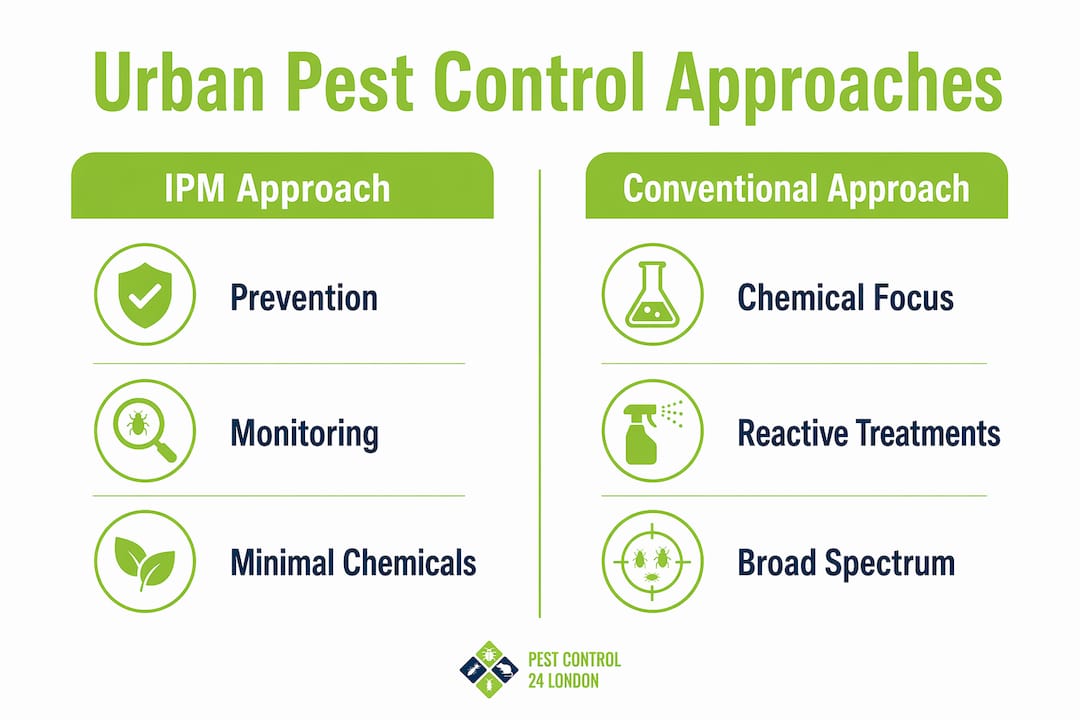
IPM is the gold standard for urban pest control, endorsed by environmental agencies worldwide for its emphasis on proactive, non-chemical prevention before any chemical intervention. The framework works in four stages: monitoring, threshold setting, intervention, and evaluation. Each stage informs the next, creating a feedback loop that improves outcomes over time.
The priority under IPM is always structural and hygiene-based prevention. Sealing gaps around pipework, improving waste management, and eliminating standing water remove the conditions pests need to establish themselves. Chemical controls are the last resort, used sparingly and only when monitoring confirms that pest numbers have crossed an agreed threshold.
The practical difference between IPM and conventional chemical-only approaches is significant:
| Criterion | IPM approach | Conventional chemical approach |
|---|---|---|
| Primary method | Prevention and monitoring | Reactive pesticide application |
| Chemical use | Minimal, targeted, last resort | Routine and broad-spectrum |
| Environmental impact | Low, preserves beneficial species | Higher, risks non-target harm |
| Long-term effectiveness | High, addresses root causes | Lower, pests often return |
| Regulatory alignment | Endorsed by the EPA and UK agencies | Increasingly restricted |
IPM in urban areas must also balance pest suppression with the conservation of beneficial predators, such as spiders and ground beetles, to maintain ecosystem health in city green spaces. This is a consideration that purely chemical programmes ignore entirely.
Pro Tip: Ask any pest control contractor to show you their monitoring records and threshold criteria before they apply any treatment. A professional operating under IPM principles will have both documented.
Urban IPM also demands a faster response than agricultural IPM. Urgency in urban settings means professionals must respond reliably even to a single pest sighting, because public expectations in cities are far less tolerant than in farming contexts. That speed requirement shapes how urban pest management contracts are structured and why 24/7 availability matters for property managers.
What are pest thresholds and how do they vary by sector?
Pest thresholds define the point at which a pest population requires active intervention. Thresholds vary widely by sector and reflect risk tolerance and societal expectations rather than purely biological factors. This is one of the most misunderstood aspects of urban pest management for property managers new to commissioning pest control services.
In healthcare and hospitality, the threshold is effectively zero. A single cockroach in a hospital ward or a hotel kitchen triggers immediate, documented action. Regulatory inspections in these sectors treat any pest evidence as a critical failure. In residential settings, thresholds are more variable and often shaped by human cultural values and personal perception rather than measurable risk.
The practical implications for property managers are clear:
- Hospitality and food service: zero-tolerance policy, with monthly monitoring contracts and same-day response clauses written into service agreements
- Healthcare facilities: regulatory compliance drives threshold decisions, with pest activity logged and reported to infection control teams
- Residential blocks: thresholds require clear communication with occupants, who may underreport sightings or resist preventative measures
- Commercial offices: thresholds sit between hospitality and residential, with quarterly inspections typically sufficient unless food preparation areas are present
Understanding which threshold applies to your property type allows you to specify the right level of service and avoid paying for over-treatment or under-treatment.
How can property managers apply urban pest management techniques effectively?
Coordinated whole-building treatment is the single most important principle for property managers overseeing multi-unit residential or commercial buildings. Treating one flat while adjacent units remain untreated simply displaces pests rather than eliminating them. Effective urban pest management requires building-wide access agreements and resident cooperation from the outset.
A practical approach for property managers follows this sequence:
- Commission a baseline survey: a qualified technician maps all pest activity, entry points, and harbourage sites across the entire building before any treatment begins
- Establish a written pest management plan: document thresholds, monitoring schedules, and agreed intervention methods for each area of the property
- Communicate with occupants: brief residents or tenants on their role in prevention, covering waste disposal, food storage, and reporting sightings promptly
- Schedule coordinated treatments: arrange access to all units simultaneously where treatment is required, avoiding the piecemeal approach that allows pests to migrate
- Review and monitor continuously: pest management is not a one-off event; quarterly reviews and monitoring trap checks sustain control over time
Limited on-site storage for pest control materials in urban properties creates response delays that can worsen infestations. This is a logistical reality that property managers should factor into their service contracts, specifying that contractors hold materials off-site and can deploy within agreed timeframes.
Resident communication is frequently underestimated. Many occupants misunderstand or resist non-chemical preventative measures, seeing them as inconvenient rather than effective. A brief written guide on waste management and hygiene, distributed at the start of a pest management programme, reduces resistance and improves outcomes. Pestcontrol24london provides preventative pest control guidance that property managers can share directly with occupants.
Pro Tip: Include a pest reporting mechanism, such as a dedicated email address or a simple form, in your occupant communications. Early reporting prevents minor sightings from becoming full infestations.
Climate change is also reshaping the urban pest management picture. Shifting pest ranges and changing disease epidemiology mean that species previously uncommon in the UK are appearing with greater frequency. Property managers and urban planners should factor this into long-term maintenance planning, working with contractors who hold formal scientific training rather than relying solely on experience. For urban greenspaces, preventative tree care also plays a role in reducing pest habitats around buildings.
Key takeaways
Effective urban pest management requires a coordinated, science-based approach that combines IPM principles, sector-specific thresholds, whole-building treatment, and continuous monitoring to protect health and property in city environments.
| Point | Details |
|---|---|
| IPM is the gold standard | Prioritise prevention, monitoring, and minimal chemical use over reactive spraying. |
| Thresholds vary by sector | Hospitality and healthcare demand zero tolerance; residential settings require clear occupant communication. |
| Whole-building coordination | Treating individual units without building-wide access displaces pests rather than eliminating them. |
| Resident communication matters | Occupants who understand preventative measures actively reduce infestation risk. |
| Climate change is a factor | Shifting pest ranges require contractors with formal scientific training, not experience alone. |
Dan’s perspective on urban pest management in 2026
The aspect of urban pest management that most practitioners underestimate is the social dimension. The biology of cockroaches or rodents is well understood. What is harder to manage is the gap between what residents believe pest control involves and what it actually requires. I have seen well-funded programmes fail because occupants refused access for coordinated treatments, or because building managers assumed a single visit would resolve a bed bug infestation spread across twelve floors.
Climate change is making this more complex, not less. Species that were rare in London a decade ago are now appearing in central postcodes. That demands contractors who hold genuine scientific training, not just years of spraying the same products. The shift toward IPM is the right direction, but property managers need to hold contractors accountable to it. Ask for monitoring data. Ask what threshold triggers treatment. Ask what non-chemical measures were applied first. Those questions separate professional urban pest management from a van and a spray can.
The role of housekeeping and sanitation in pest prevention is also chronically undervalued in property management budgets. Structural proofing and hygiene protocols prevent more infestations than any chemical treatment ever will.
— Dan
Pestcontrol24london: professional urban pest management for London properties
Property managers and urban planners across London trust Pestcontrol24london for science-backed pest control that aligns with IPM principles and the demands of complex urban environments. Established in 2015 and BPCA fully qualified, the team has worked with hotels, restaurants, residential blocks, and commercial premises to deliver coordinated, sustainable pest management programmes.

Pestcontrol24london offers 24/7 commercial pest control across London, including emergency response services and free quotes. Whether you manage a single building or a portfolio of properties, the team can develop a written pest management plan tailored to your sector and threshold requirements. Contact Pestcontrol24london to arrange a baseline survey and put a programme in place that protects your occupants, your reputation, and your property.
FAQ
What is the urban pest management definition?
Urban pest management is the science-based research, control, and strategic service delivery used to manage pest populations in densely populated human environments, covering insects, rodents, and birds that threaten health, hygiene, and property.
What does IPM stand for in urban pest control?
IPM stands for Integrated Pest Management. It is the gold standard framework endorsed by environmental agencies, prioritising prevention and monitoring over chemical treatments, with pesticides used only as a last resort.
Why do pest thresholds differ between sectors?
Thresholds reflect risk tolerance and societal expectations rather than purely biological factors. Hospitality and healthcare sectors operate on zero tolerance, while residential thresholds are often shaped by occupant perception and cultural values.
How does whole-building treatment differ from single-unit treatment?
Single-unit treatments displace pests into adjacent units rather than eliminating them. Coordinated whole-building treatment, with simultaneous access across all units, is the only approach that achieves lasting control in multi-unit buildings.
How does climate change affect urban pest management?
Climate change is shifting pest ranges and disease epidemiology, introducing species to urban areas where they were previously uncommon. This increases the need for pest management professionals with formal scientific training and up-to-date knowledge of emerging species.