

Retail stockrooms harbour six main pest groups: rodents (house mouse and brown rat), cockroaches (German and Oriental), flies (large filth flies, drain flies and fruit flies), stored-product insects (Indianmeal moths, flour beetles, grain beetles and tobacco beetles), clothes moths and carpet beetles, and occasional invaders including ants, wasps, spiders and birds. The most commonly reported pest in food retail is the house mouse, and a single sighting photographed by a customer can cause immediate reputational damage. When you spot any sign of pest activity, your first action is to isolate suspect stock, photograph the evidence, and restrict staff access to the affected zone.
On first sighting, do these three things:
- Contain: move suspect stock to a sealed quarantine area and restrict access to the zone.
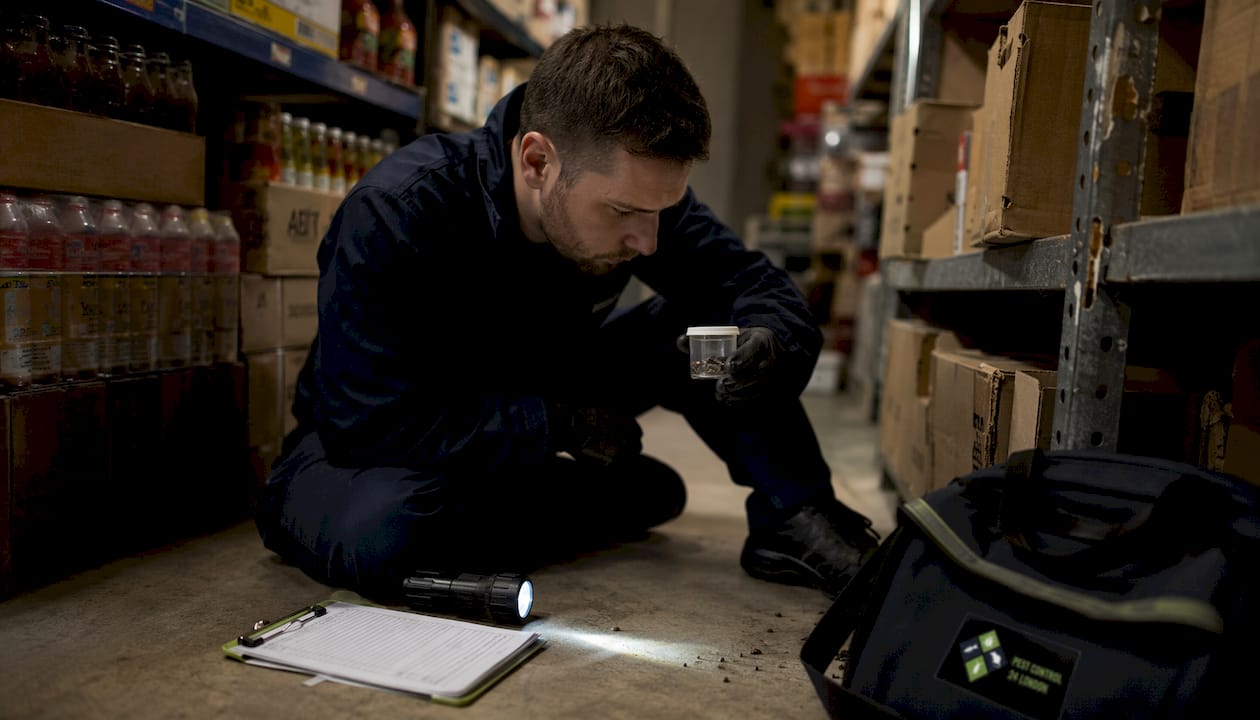
- Record: photograph droppings, gnaw marks, webbing or live sightings; note the exact location, time and stock affected.
- Escalate: log the find in your pest record and contact a BPCA-qualified contractor if contamination is suspected or the sighting is repeated.
Table of Contents
- What types of pests are found in retail stockrooms?
- Why stockrooms and loading bays attract pests
- How to detect infestations before they spread
- Practical prevention and control for retail stockrooms
- What does research show about pheromone trap monitoring?
- When should you call a professional pest controller?
- Key takeaways
- The stockroom problem most managers underestimate
- Pestcontrol24london: professional pest control for London retailers
- Useful resources for retail managers
What types of pests are found in retail stockrooms?
The table below gives you a rapid identification reference for the species most commonly found in UK retail stockrooms. Each entry covers what you will see, where to look and the immediate on-site action to take.
| Pest | Key identification signs | Where to look first | Immediate action |
|---|---|---|---|
| House mouse | Droppings (3–6 mm, tapered), gnaw marks, grease rubs on skirting | Behind pallets, under shelving, wall voids | Snap traps at run edges; photograph droppings; log location |
| Brown rat | Droppings (12 mm, capsule-shaped), burrows, strong ammonia odour | Loading bay, drain covers, floor-level voids | Bait stations at perimeter; seal entry points; notify manager |
| German cockroach | Faecal specks (pepper-like), shed skins, musty odour | Warm electrical equipment, cardboard stacks, under sinks | Gel bait in harbourage zones; remove cardboard; deep clean |
| Oriental cockroach | Larger, darker; prefers cool damp areas; oily odour | Drains, basement areas, mop cupboards | Drain treatment; residual insecticide in voids |
| Large filth flies | Cluster near waste, windows; maggots in spillages | Waste areas, loading dock, drain surrounds | Remove waste; fit fly screens; UV trap placement |
| Drain/fungus gnats | Small, weak fliers; larvae in drain slime | Floor drains, mop sinks, wet areas | Clean drain with enzymatic gel; reduce standing moisture |
| Fruit flies | Tiny, red-eyed; hover near fermentation sources | Damaged produce, recycling bins, spilled sugary goods | Remove source; clean bins; sticky traps near foci |
| Indianmeal moth | Webbing in product, larvae, small adult moths | Grain-based goods, pet food, dried fruit | Quarantine affected stock; pheromone traps; check adjacent bays |
| Flour/grain beetles | Tiny reddish-brown beetles in product dust | Flour, cereals, spilled grain under shelving | Remove infested stock; vacuum frass; pheromone trap |
| Tobacco beetle | Small, rounded; attacks dried goods and tobacco | Dried herbs, spices, pet food, tobacco products | Quarantine; inspect adjacent stock; contact contractor |
| Clothes moth | Webbing, larvae, adult moths near natural fibres | Textile storage, carpet offcuts, staff lockers | Isolate affected goods; pheromone trap; reduce humidity |
| Carpet beetle | Larvae (woolly bears), shed skins, adult beetles | Natural fibre products, dusty corners, bird nests | Remove larvae; vacuum; inspect roof voids for bird nests |
| Ants | Foraging trails, small soil deposits near entry points | Door thresholds, wall junctions, near food spillages | Gel bait on trails; seal gaps; remove food sources |
| Wasps | Live wasps, papery nest material near eaves or voids | Roof voids, external eaves, loading bay ceiling | Do not disturb; call contractor; restrict staff access |
| Spiders | Webs, egg sacs; usually incidental | Undisturbed corners, ceiling voids, behind racking | Remove webs; check for insect prey species driving presence |
Rodents and various types of flies together account for a significant proportion of pest control interventions in food retail, making them the highest-priority group for any stockroom monitoring programme.
Rodents: what the signs actually tell you
Droppings, gnaw marks, grease rubs and rub marks are more reliable indicators of rodent presence than live sightings. A mouse produces up to 80 droppings per day, so a cluster in one location points directly to a harbourage or run. Grease marks on skirting boards and pipe runs show where rodents travel repeatedly; fresh marks are dark and moist, older ones are pale and flaky. If you find droppings at the same spot on consecutive days, the harbourage is close. For detailed guidance on managing an active rodent problem, the rodent outbreak response guide covers immediate trapping, documentation and proofing steps.
Cockroaches: harbouring in heat and cardboard
German cockroaches prefer warm, humid micro-environments near electrical equipment and cardboard stacks. They are nocturnal, so daytime sightings suggest a significant population. The faecal specks they leave resemble ground pepper and accumulate at harbourage entry points. Oriental cockroaches gravitate toward cooler, damper conditions such as drains and basement areas. Both species spread bacteria including E. coli and salmonella, making rapid sanitation and targeted gel baiting the correct first response rather than broad-spectrum spraying.
Stored-product insects: introduced with the goods
Indianmeal moths and multiple beetle species are frequently captured in retail stores, and infestations often originate from infested inbound product and spillage accumulating under shelving. Look for webbing inside packaging, larvae in product dust and adult moths or beetles flying near affected bays. Quarantine suspect stock immediately, label it clearly and do not return it to the shelf until a contractor has assessed it.
Pro Tip: When you find a stored-product insect, check the two bays either side of the affected product before assuming the infestation is contained. Moths and beetles disperse quickly along shelving runs, and a single infested bag can seed several adjacent bays within days.
Why stockrooms and loading bays attract pests
Sales floors can look spotless while stockrooms, loading docks and utility rooms harbour active infestations that go undetected for weeks. The structural and operational conditions in back-of-house areas create near-ideal pest habitat.
Structural risk factors:
- Cardboard boxes and wooden pallets provide insulation, nesting material and harbouring voids for rodents and insects.
- Low light levels and cluttered shelving reduce the chance of staff noticing early signs.
- Ceiling voids and wall cavities give rodents and cockroaches undisturbed travel routes.
- Open delivery doors and unscreened external vents create direct entry points.
- Floor drains and mop sinks, when poorly maintained, breed drain flies and attract cockroaches.
Operational risk factors:
- Slow-moving or quarantined stock left undisturbed for weeks becomes prime harbourage.
- Poor stock rotation (not following first-in, first-out) allows infested goods to remain on shelves long enough for populations to establish.
- Damaged packaging on receipt introduces stored-product insects directly into the stockroom.
- Inconsistent waste handling, particularly cardboard and food waste, sustains fly and rodent populations.
- Mop sink leaks and standing water accelerate cockroach and drain fly breeding.
Understanding pallet sourcing and packaging types is useful context here: pallets sourced from multiple suppliers or overstock channels can arrive with a varied history of storage conditions, which increases the risk of harbouring insects in seams and crating.
Pro Tip: Brief receiving staff to inspect every pallet at the point of delivery. Check packaging seams, wooden crating and the underside of pallets before they enter the stockroom. A two-minute check at the dock is far less costly than a stored-product insect infestation traced back to a single unchecked delivery.
How to detect infestations before they spread
Early detection is the single most effective way to limit the cost and disruption of a pest problem. A structured monitoring routine, rather than reactive checks after a sighting, is what separates well-managed stockrooms from those that face repeated infestations.
Signs to look for on every inspection:
- Droppings or frass (insect excrement, often resembling fine dust or pepper)
- Webbing inside or around product packaging
- Shed wings or insect skins near shelving edges
- Gnaw marks on packaging, cables or structural materials
- Grease tracks or rub marks on skirting and pipe runs
- Live sightings of any pest species
- Unusual odours (musty, ammonia, oily)
- Dead insects or rodents
A practical monitoring routine does not need to be complex. Weekly visual checks of the receiving area, under shelving, behind pallets, drain lids and staff rest areas take around 20 minutes and catch the majority of early-stage infestations. Monthly targeted trap checks then give you quantitative data to act on. The role of inspection in pest control explains how to structure these checks and what to record.
Daily and weekly staff checklist:
- Daily: clear spillages immediately; remove waste to sealed external bins; check drain covers are seated correctly.
- Weekly: visual inspection of receiving area, under-shelf spaces, drain surrounds and staff areas; check and reset sticky traps; photograph and log any finds.
- Monthly: review trap catch data; inspect ceiling voids and external entry points; update pest log.
The table below shows the fields every pest log entry should capture to satisfy a Food Standards Agency or local authority audit.
| Field | What to record |
|---|---|
| Date and time | Exact date and time of observation or trap check |
| Location | Store map grid reference or written description (e.g. “Bay 7, north wall, floor level”) |
| Species or sign | Pest species if identified, or type of sign (droppings, webbing, live sighting) |
| Quantity | Number of droppings, insects or rodents observed |
| Stock affected | SKU, product name and batch code if contamination is possible |
| Photograph reference | File name or number of supporting photograph |
| Action taken | Immediate steps: quarantine, trap reset, sanitation, escalation |
| Staff name | Name of person recording the find |
Retain completed log sheets and trap catch records for at least 12 months. Auditors and local authority inspectors will ask for them.
Practical prevention and control for retail stockrooms
Prevention in a retail stockroom works in a clear hierarchy: housekeeping first, then storage protocols, then proofing, then monitoring, and targeted treatment only where monitoring data shows it is needed. Broad-spectrum chemical application without prior monitoring wastes resource and rarely resolves the root cause.
Housekeeping regime:
- Clear spillages immediately; do not allow food debris to accumulate under shelving or pallets.
- Remove cardboard waste daily; do not allow broken-down boxes to accumulate in corners.
- Clean under shelving and behind racking weekly with a vacuum rather than sweeping, which disperses frass and insect eggs.
- Maintain drains with enzymatic cleaner monthly to remove the biofilm that sustains drain flies.
- Empty and clean waste bins before they overflow; use bins with close-fitting lids.
Storage protocols:
- Rotate stock using first-in, first-out (FIFO) discipline so older stock does not sit undisturbed.
- Quarantine and clearly label any goods with damaged packaging on receipt; do not shelve until inspected.
- Keep stock off the floor on racking or sealed shelving; floor-level storage creates rodent harbourage.
- Store susceptible goods (grains, dried fruit, pet food, natural fibres) in sealed rigid containers where possible.
- Dispose of unsaleable or expired stock promptly; do not allow it to accumulate in a corner.
Proofing and exclusion:
- Fit door sweeps to all external-facing stockroom doors.
- Seal pipe and cable penetrations through walls with appropriate filler or mesh.
- Cover external air vents with fine mesh (maximum 6 mm aperture for rodent exclusion).
- Inspect incoming pallets and reject or quarantine those with visible damage, insect activity or unusual odours.
Monitoring plan:
Place rodent bait stations at the perimeter of the stockroom and at known entry points such as loading bay doors. Use pheromone moth traps in bays holding grain-based goods, pet food and dried produce. Sticky traps near drains and waste areas capture flies and crawling insects. Check and record trap catches weekly; use the data to identify foci before escalating to treatment.
Pro Tip: Minimise pesticide use by treating only where monitoring data shows a focus. A single bay with elevated moth trap catches warrants targeted treatment of that zone; it does not justify spraying the entire stockroom. This approach protects product integrity, reduces chemical exposure for staff and gives you a defensible audit trail.
For a broader view of pest management for retailers and an operational checklist, the 2026 guide covers seasonal patterns and maintenance scheduling.
What does research show about pheromone trap monitoring?
Targeted pheromone and trap arrays identify infestation foci faster than visual inspection alone and reduce the need for blanket chemical treatments. A study published in the Journal of Economic Entomology by the USDA Agricultural Research Service demonstrated this directly in retail environments: a monitoring procedure using moth and beetle traps with spatial (contour) analysis identified clear infestation centres in department and pet stores and helped evaluate the effectiveness of subsequent interventions.
Key finding: Trap arrays combined with contour mapping located infestation foci in retail stores, allowing managers to direct treatment to specific zones rather than applying broad-spectrum pesticides across the whole premises.
The practical implication for stockroom managers is straightforward. Spacing traps every 5–10 metres in high-risk aisles and near suspected foci yields location data within days. When catch numbers are plotted on a simple store map, the highest-catch zones become visible as foci. Treatment is then directed at those zones only.
| Monitoring element | Detail |
|---|---|
| Trap type | Pheromone traps for moths; sticky traps for beetles and flies |
| Spacing | Every 5–10 metres in high-risk aisles; closer near suspected foci |
| Check frequency | Weekly during active infestation; monthly for routine surveillance |
| Data recorded | Trap ID, location, species caught, catch count, date |
| Output | Catch map showing foci; basis for targeted treatment decisions |
| Audit value | Catch records provide defensible evidence for FSA or local authority review |
Monitoring data provides defensible decisions: managers can point to trap catch records and maps when choosing targeted control, which is far more useful for audit trails than a record of broad-spectrum spraying with no supporting data.
When should you call a professional pest controller?
Some situations require professional intervention rather than in-house management. Knowing the escalation triggers prevents a contained problem from becoming a regulatory incident.
Call a BPCA-qualified contractor when you observe any of the following:
- Repeated rodent sightings or droppings at the same location on consecutive days.
- Evidence of product contamination: gnaw marks on sealed packaging, frass inside product, or cockroach faecal specks on food-contact surfaces.
- A customer complaint about pest sightings in the retail area.
- Discovery of a nest, natal site or active wasp nest.
- Trap catches above your agreed threshold on two or more consecutive checks.
- Any pest activity in a zone subject to FSA inspection or local authority licensing.
A professional commercial pest controller will carry out a site survey, identify harbourage and entry points, recommend proofing works, apply targeted treatments based on monitoring data and provide a written service report. Commercial pest control services include trap maps, catch logs and proofing records suitable for FSA or local authority enquiries. For urgent rodent or contamination events, a reputable contractor should be able to attend within 24 hours; many offer same-day emergency response.
Pro Tip: Before the contractor arrives, have your pest log, photographs, trap catch sheets and a list of affected SKUs ready. This cuts survey time significantly and means the contractor can move directly to treatment planning rather than spending the first visit gathering information you already hold.
For guidance on commercial rodent control and proofing best practice specific to London businesses, the dedicated guide covers exclusion methods and contractor selection criteria.
Key takeaways
Retail stockrooms face persistent pest pressure from six main groups, and the most effective response combines structured monitoring with targeted treatment rather than reactive spraying.
| Point | Details |
|---|---|
| Isolate on first sighting | Move suspect stock to a sealed quarantine area and photograph the evidence immediately. |
| Monitor with traps, not just eyes | Pheromone and sticky trap arrays locate infestation foci faster than visual checks alone. |
| Housekeeping drives prevention | Daily spill clearance, weekly under-shelf cleaning and prompt waste removal remove the conditions pests need. |
| Keep a dated, photographic pest log | Record location, species, quantity and action taken; retain trap catch sheets for at least 12 months for audit readiness. |
| Pestcontrol24london for professional escalation | When contamination is suspected or sightings repeat, a BPCA-qualified contractor provides survey, targeted treatment and written audit evidence. |
The stockroom problem most managers underestimate
The conventional wisdom in retail pest management focuses heavily on the sales floor: fly screens on customer entrances, rodent stations near the front door, regular cleaning of customer-facing areas. That focus is understandable, but it misses where most infestations actually begin.
Back-of-house areas are repeatedly where problems start and where they grow undetected longest. A stockroom that looks orderly from the aisle end can have active rodent runs behind the racking, a thriving drain fly population in a neglected mop sink and a stored-product insect infestation spreading through three bays of pet food, all invisible to anyone who does not look behind the pallets.
The piece of advice managers rarely act on, but which has the highest impact per unit of effort, is training receiving staff to document and photograph every suspect pallet at the point of delivery. Not after it has been moved into the stockroom. Not when someone notices something a week later. At the dock, before it crosses the threshold. A photograph of damaged packaging or insect activity on a pallet, timestamped at receipt, gives you both an early warning and a defensible record if a supplier dispute follows. It also creates a culture where receiving staff understand that pest prevention is part of their role, not an afterthought for the facilities team.
The stores that manage pest risk well are not necessarily the ones with the most sophisticated treatment programmes. They are the ones where the receiving dock is treated as the first line of defence.
Pestcontrol24london: professional pest control for London retailers
Retail stockroom pest problems rarely resolve themselves, and the gap between a first sighting and a confirmed infestation is shorter than most managers expect. Pestcontrol24london has been delivering commercial pest control across London since 2015, working with shops, food retailers and warehouse operations that need fast, discreet and fully documented responses.

The service covers emergency rodent response, cockroach and stored-product insect treatments, pheromone monitoring programmes, post-infestation sanitisation and full written audit reporting including trap maps, catch logs and proofing records. Every operative is BPCA-qualified, and commercial callouts are available 24 hours a day, seven days a week.
Before requesting a visit, gather your pest log, photographs and a note of the affected stock. Then contact Pestcontrol24london directly through the commercial pest control page to request a site survey or emergency callout. For urgent situations, the 24/7 emergency line connects you to a qualified operative without delay.
Useful resources for retail managers
The following authoritative sources support the guidance in this article and are worth bookmarking for policy formation, staff training and audit preparation.
- British Pest Control Association (BPCA): The UK’s leading industry body for professional pest management. Use the BPCA member finder to verify contractor qualifications and access guidance documents relevant to commercial premises.
- Food Standards Agency (FSA): The FSA publishes guidance on food hygiene regulations, pest contamination reporting obligations and what inspectors expect to see in pest records. Relevant for any retailer handling food or food-contact packaging.
- ARS / Journal of Economic Entomology: pheromone trap monitoring study: The primary research behind the trap array and contour analysis methodology described in this article. Useful if you want to present the evidence base for a monitoring programme to senior management.
- Pest Evidence: retail store pest control: UK-focused reference covering pest risk by retail site type, with guidance on inspection priorities and documentation.
- Pestcontrol24london: commercial pest control services: Survey, monitoring, proofing, treatment and audit reporting for London retail and commercial premises, available 24/7.
- Types of commercial pests: the business owner’s guide: A broader reference covering pest species, signs and control approaches across commercial property types.