

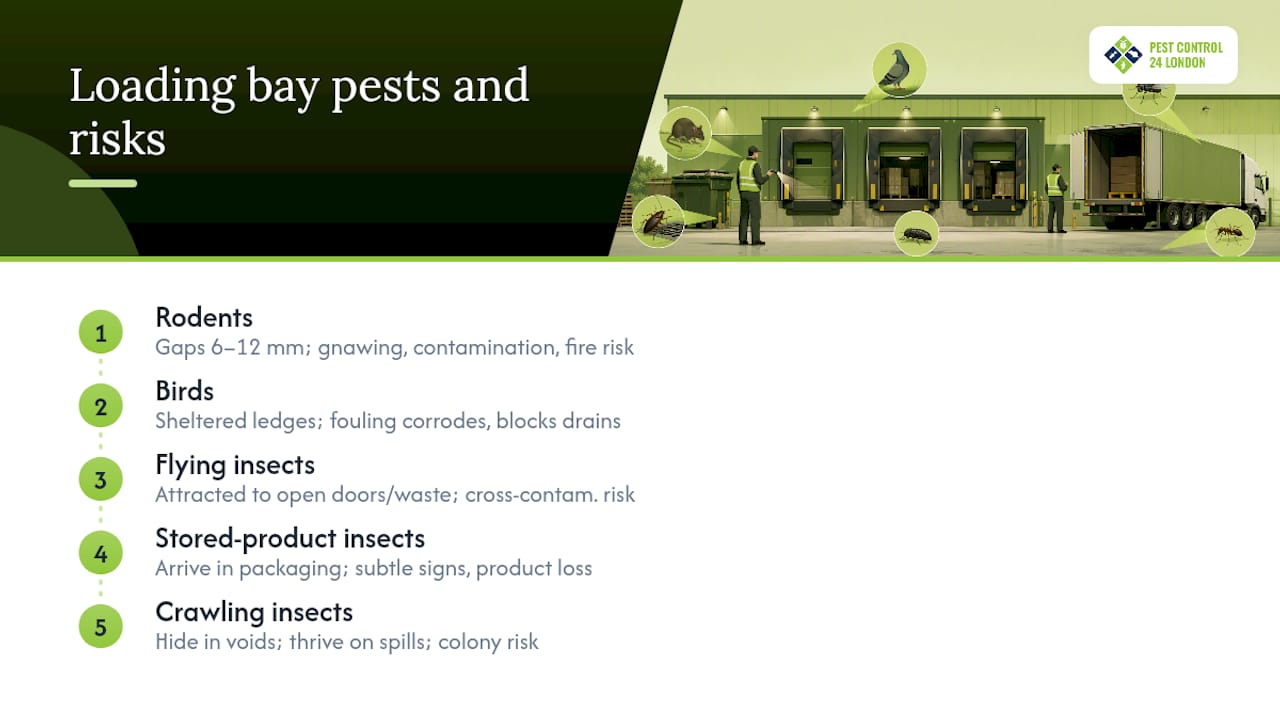
Rodents, birds, flying insects, stored-product insects and crawling insects such as cockroaches and ants account for almost every infestation reported in loading bays. If you manage a bay, your first move today is simple: inspect the dock seals, levelers and any incoming pallets for gaps or damage, then secure anything you find. It matters because rodents can squeeze through gaps as small as 10 mm, roughly the width of a pencil, which is why so many “sealed” bays are not sealed at all.
The pest groups you need to watch for are:
- Rodents — Norway rats and house mice, drawn by warmth, food waste and dark voids.
- Birds — pigeons, gulls and starlings nesting in canopies and roof steels.
- Flying insects — houseflies, blowflies and midges attracted to open doors and bins.
- Stored-product insects and moths — arriving hidden inside packaging and pallets.
- Crawling insects — cockroaches and ants exploiting spills, cracks and standing waste.
Quick fact: a gap of just 10 mm is enough for a mouse to enter your facility, and most worn dock seals exceed that tolerance within months of installation.
Key Takeaways
Loading bays draw a predictable set of pests, rodents, birds, flying and stored-product insects, and crawling insects, almost entirely through structural gaps and unchecked incoming shipments.
| Point | Details |
|---|---|
| Know the five pest groups | Rodents, birds, flying insects, stored-product insects and crawling insects each need different signs and controls. |
| Seal to the 10 mm rule | Check dock seals and levelers against the 10 mm rodent entry threshold, not visual estimation. |
| Treat pallets as a checkpoint | Inspect incoming pallets and containers for hitchhiker pests before they reach storage. |
| Specify better seal materials | Vinyl-encapsulated foam seals outperform brush seals alone on levelers exposed to daily wear. |
| Run a tiered inspection routine | Daily visual sweeps, weekly seal checks and monthly pit/roofline reviews catch problems before audits do. |
Table of Contents
- Common types of pests in loading bays and the risks they carry
- Why loading bays attract pests in the first place
- Spotting the signs and knowing what they mean for your business
- Proofing loading bays: what to fix first and what to schedule
- Building a loading-bay inspection routine that actually works
- What BPCA-qualified technicians see that standard checklists miss
- Why most loading bay pest programmes fail before they start
- Frequently asked questions
- Sources
Common types of pests in loading bays and the risks they carry
Identifying the pest correctly changes everything that follows: the proofing material you specify, the treatment method, and how you explain the finding to an auditor. Loading bays draw a narrower, more predictable range of pests than the wider warehouse floor, largely because the same conditions (traffic, waste, structural gaps) repeat at every dock door.
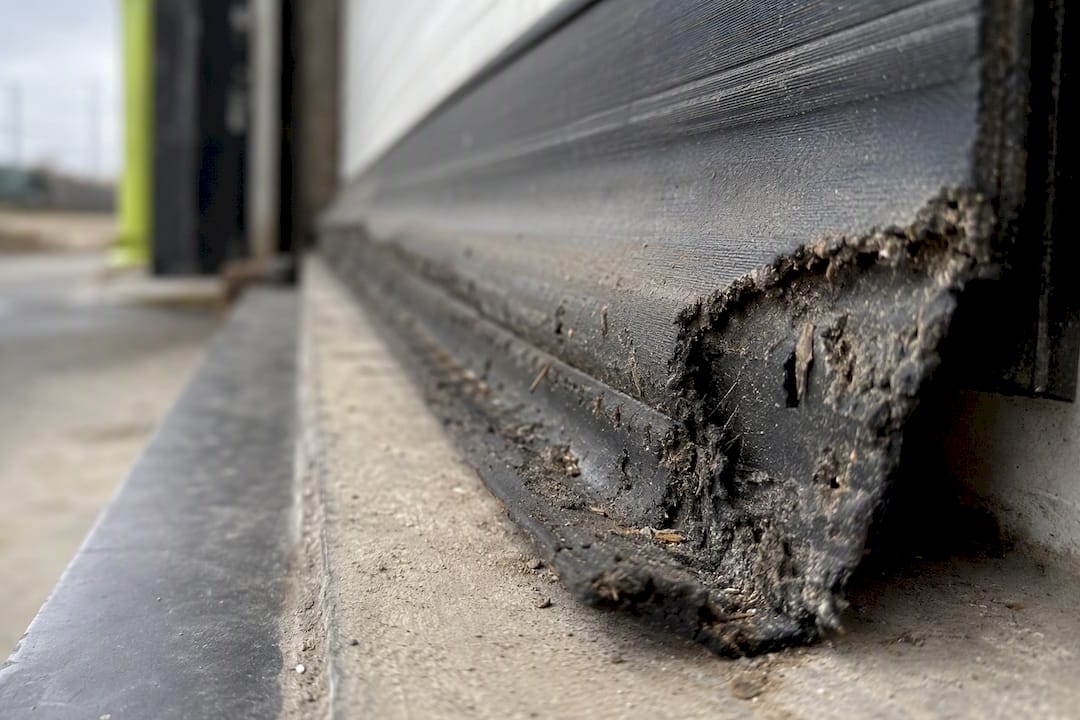
Rodents cause the most severe operational damage. Norway rats need a gap of only around 12 mm and house mice can pass through openings closer to 6 to 10 mm, so entry points as small as 10 mm are routinely exploited around worn dock seals and pit edges. Beyond contamination through droppings and urine, gnawing damages electrical cabling, creating a genuine fire risk alongside the hygiene one. Rodents also feature high on the list of pests that UK distribution centres report most frequently, alongside flying insects, stored-product insects and birds.
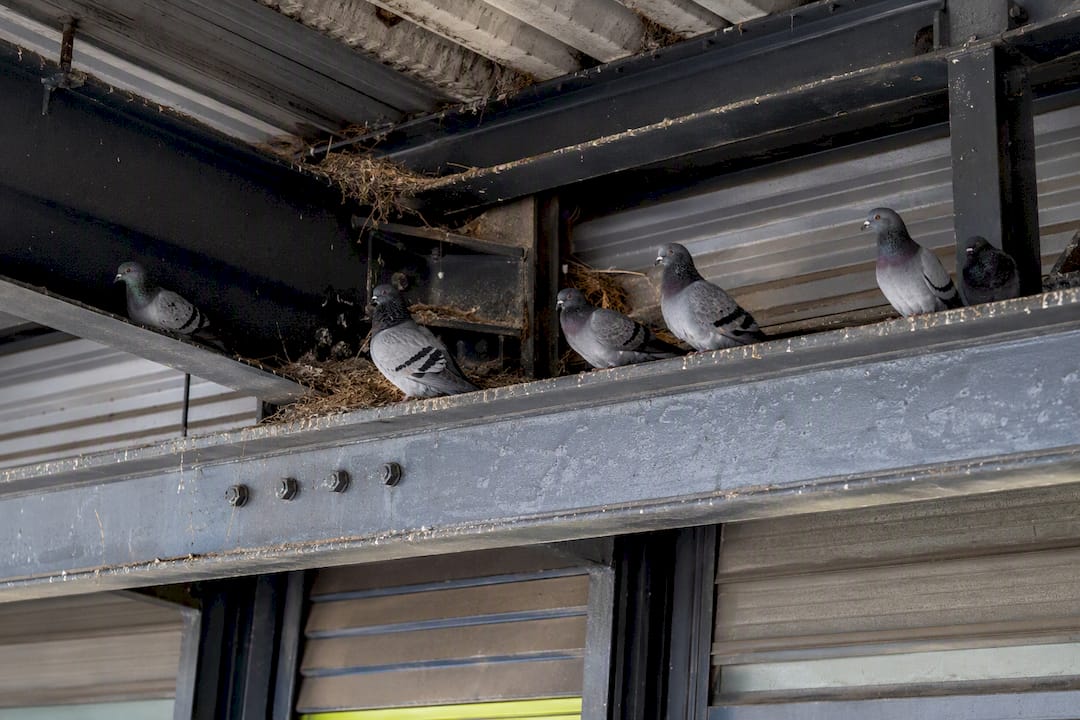
Birds, particularly pigeons, gulls and starlings, favour the sheltered ledges and canopy steelwork above dock doors. Fouling is not just unsightly. It corrodes metalwork, blocks drainage, and creates slip hazards on walkways and yard surfaces that fall squarely under general health and safety duties. Nesting material also carries its own insect passengers, including mites and beetles that spread once a nest is disturbed.
Flying insects, houseflies, blowflies and midges, are pulled in by the constant door movement and any waste sitting near the bay. They are less destructive to stock but carry real cross-contamination risk on food or pharmaceutical sites, landing on exposed product after visiting a bin or a drain.
Stored-product insects and moths rarely walk in. They arrive inside the goods themselves, hidden in cardboard, timber pallets or packaging seams, then spread quietly through a stockroom before anyone notices. Signs are subtle: fine webbing inside packaging, small exit holes, a faint musty smell, or product that seems to be losing weight without an obvious cause.
Crawling insects, cockroaches and ants, hide in the smallest voids: behind pallet stacks, under leveler pits, inside cracked skirting. Spills and unmanaged waste amplify the risk sharply, since both species can sustain a colony on very little food if it is left accessible overnight. A combination of exclusion materials and consistent housekeeping, particularly fast spill response, tends to outperform either approach used alone.
Why loading bays attract pests in the first place
Loading bays sit at the exact point where a building’s defences are weakest and its temptations are strongest. Dock levelers, worn seals and pit edges are the classic rodent entry route, and it takes very little wear before that 10 mm gap threshold is crossed. Frequent door cycling adds to the problem: every time a shutter lifts, light, warm air and gaps appear together, and pests read that as an invitation.
Loading docks are widely regarded as a primary audit weak point in food and logistics operations, precisely because frequent door openings, leveler gaps and incoming shipments create multiple pest pathways at the same location.
Add the usual attractants, spilled product, damaged pallets, overflowing bins, standing water near drains, and a bay becomes genuinely difficult to defend through cleaning alone.
The pathway that catches most managers out is the hitchhiker route. Pests are frequently introduced on incoming vehicles, containers and pallets rather than walking in under their own power, which means your goods-in process is a pest control checkpoint whether you have designed it that way or not.
Spotting the signs and knowing what they mean for your business
Some signs are unmistakable. Others get explained away until an auditor asks the difficult question.
- Direct evidence: droppings, gnaw marks, nesting material, live sightings or insect casings near pallets and skirting.
- Indirect evidence: stock damage with no clear cause, pallets rejected on arrival, unusual odours, or vents that seem blocked.
- The real risk: each of these can trigger product contamination, a failed BRCGS or ISO 22000 audit, damaged wiring or plant, and costly downtime while a bay is deep cleaned.
- Escalation point: routine housekeeping can manage a single spill or an isolated dropping. Recurring sightings, nesting evidence or anything inside sealed packaging means it is time to bring in professional pest control.
Proofing loading bays: what to fix first and what to schedule
Not every fix costs the same, and not every fix needs to happen this week. Start with exclusion, because sealing gaps is nearly always cheaper than treating an established colony.
- Dock levelers: replace worn brush seals with vinyl-encapsulated open-cell foam seals, which hold a compression seal even when the outer edge takes wear.
- Doors and vents: fit robust door seals and stainless-steel mesh over vents, with reinforced brush seals as a secondary barrier, not the primary one.
- Birds: install netting or spikes at roosting and nesting points, using lawful deterrent methods suited to the species present.
- Insects: flyscreens on open doors, LED UV fly units positioned away from direct daylight, sealed waste containers, and spills cleared the moment they happen.
- Monitoring: legally sited rodent bait stations, pheromone traps for stored-product insects, and a log that is actually reviewed, not just filed.
Pro Tip: Before booking any netting or leveler work, walk the bay looking specifically for secondary gaps, chain pull holes, transition-plate edges, cable penetrations. These cost almost nothing to seal but get missed constantly because inspections focus on the obvious door line.
Prioritise in that order: repair seals and clear waste this week, then schedule netting, leveler seal replacement and monitoring contracts once you know the scale of the problem. Costs scale with the extent of proofing required. A handful of seal replacements is a modest job; full bird netting across several bay canopies is a larger, planned expense.
Building a loading-bay inspection routine that actually works
A checklist only earns its keep if someone follows it. Here is a workable rhythm for most sites:
- Daily (5 to 15 minutes per bay): a visual sweep for live pests, fresh droppings, spills and any waste left out overnight.
- Weekly (20 to 45 minutes depending on throughput): check seals, brush condition, leveler gaps, and inspect a sample of incoming pallets for hitchhiker pests.
- Monthly or quarterly: inspect pits and roofline areas, review the monitoring log for trends, and service bait stations and traps.
- Call a professional when activity persists after housekeeping fixes, when an audit turns up evidence, when structural proofing is needed, or when you suspect a hidden nest.
The 10 mm rodent gap threshold is worth measuring against directly during the weekly seal check, not estimating by eye. Our pest inspection procedure guide sets out a fuller version of this routine for London sites.
What BPCA-qualified technicians see that standard checklists miss
The gaps that cause real problems are rarely the obvious ones. Chain pull holes on levelers and the edges of transition plates go unnoticed on most walkthroughs, yet they allow pest ingress even when the main perimeter seal looks fine.
Vinyl-encapsulated foam seals are worth specifying over brush seals alone because the compression seal keeps working even after the outer brush takes damage from daily leveler cycling.
The other recurring gap is procedural, not physical: without a joined protocol between goods-in, housekeeping and security, hitchhiker pests slip through on pallets that everyone assumed someone else had checked.
Why most loading bay pest programmes fail before they start
The industry’s advice on this topic is not wrong so much as incomplete. Most checklists fixate on the visible door line, brush seals, obvious gaps, the odd bait station, while ignoring the two things that actually decide whether a bay stays clean: secondary voids and inbound goods discipline.
Chain pull holes and transition-plate gaps do more damage than a worn main seal ever will, precisely because nobody looks there. And no amount of structural proofing solves a hitchhiker problem if goods-in is not treating every pallet as a potential carrier.
If you take one thing from this guide, prioritise the inbound inspection over the annual proofing contract. A perfectly sealed bay still gets infested if the pallets rolling through it were never checked. Get that habit right first, then invest in the materials.
Frequently asked questions
What are the most common types of pests in loading bays?
Rodents, birds, flying insects, stored-product insects and moths, and crawling insects such as cockroaches and ants make up the overwhelming majority of loading bay infestations.
How do rodents get into a loading bay?
Mainly through worn dock seals, leveler gaps and pit edges. Norway rats and house mice can exploit gaps as small as 10 mm.
Can pests arrive on incoming deliveries even in a well-proofed bay?
Yes. Hitchhiker pests travel on pallets, containers and vehicles, which is why inspecting incoming stock matters as much as sealing the building itself.
How often should a loading bay be inspected for pests?
A daily visual sweep, a weekly seal and pallet check, and a monthly or quarterly review of pits, rooflines and monitoring logs covers most sites adequately.
When should I call a professional instead of relying on in-house checks?
Bring in commercial pest control once activity persists, an audit flags evidence, or you suspect a hidden nest that housekeeping cannot reach safely.
If your loading bay is showing any of these signs, or you would rather get ahead of an audit than react to one, Pestcontrol24london fields BPCA-qualified technicians across London who carry out documented site surveys built for BRCGS and ISO 22000 compliance. Get in touch for a tailored inspection before a small gap becomes a large problem.
Sources
- Pest Management at the Loading Dock Leads to Big Benefits | Food Logistics
- Pest control – Food Standards Agency