

Food waste attracts flies, ants, cockroaches, rodents, and scavenging birds. Remove the food source and you break the chain. The types of pests attracted to food waste span both indoor and outdoor settings, and in London’s dense urban environment, an exposed bin or a split bag can trigger an infestation within hours. Whether you manage a restaurant kitchen, a communal bin store, or a domestic wheelie bin, the pest groups are broadly the same, but what changes is the scale and speed of the problem.
The fastest actions to take the moment food waste is exposed:
- Seal or remove exposed waste immediately, double-bagging meat and dairy before binning.
- Rinse food containers before placing them in recycling or general waste.
- Wash the inside of bins with hot water and a disinfectant after any spillage.
- Move outdoor bins away from doors and windows, and check that lids close fully.
- Clear any standing liquid or food residue from bin areas.
Pro Tip: Double-bag raw meat and fish scraps before they go in the bin. Flies can detect the odour of decomposing protein within minutes and will lay eggs through the thinnest gaps in a bag.
Key takeaways
Food waste attracts flies, ants, cockroaches, rodents, and scavenging birds, and the fastest way to reduce risk is to remove the food source, seal bins, and call a BPCA-qualified professional when signs of an established infestation appear.
| Point | Details |
|---|---|
| Main pest groups | Flies, ants, cockroaches, rodents, pigeons, gulls, and foxes are all drawn to exposed food waste. |
| Flies arrive fastest | Flies can detect decomposing organic matter within minutes and lay eggs within hours in warm conditions. |
| Bin hygiene is the priority | Sealed lids, weekly cleaning, and double-bagging meat and dairy prevent the majority of infestations. |
| Businesses face legal risk | Food businesses must manage waste under the Food Safety Act 1990 or risk hygiene rating reductions and enforcement action. |
| Call a professional early | Persistent cockroach sightings, rodent droppings in multiple locations, or maggot outbreaks require BPCA-qualified treatment. |
Table of Contents
- What types of pests are attracted to food waste?
- How quickly do pests appear after food waste is exposed?
- Why are food-waste pests a health and property risk?
- How to prevent pests in food waste areas
- When should you call a BPCA-qualified pest controller?
- A 10-step checklist for when you spot pests around waste
- A field perspective on food waste and pest control in London
- Sources
What types of pests are attracted to food waste?
Understanding which pests target which wastes helps you identify an infestation early and respond correctly. Kitchen and household bins with food residue or poor seals commonly attract house mice, Norway rats, cockroaches, house flies, and fruit flies, and each pest group leaves its own distinctive signs.
Flies
House flies (Musca domestica), blow flies (Calliphoridae), flesh flies (Sarcophagidae), and fruit flies (Drosophila spp.) are the most common flies that infest food waste in UK homes and businesses. House flies and blow flies are drawn to wet, decaying organic matter — particularly meat, fish, and dairy — while fruit flies target fermenting fruit, vegetable peelings, and sugary liquids. Flies breeding in garbage prefer wet, decaying organic matter, and some species can disperse several miles from their breeding sites, which means a poorly managed bin store can affect an entire street.
Signs: Clusters of adult flies around bins or kitchen surfaces, maggots (larvae) in bin bases or on exposed waste, and a persistent sour odour even after waste is removed.
Breeding behaviour: A female house fly can lay up to 150 eggs at a time directly onto decaying material. In warm weather, those eggs hatch into larvae within 24 hours.
Most attractive food types:
- Raw or cooked meat and fish
- Dairy products
- Overripe or rotting fruit and vegetables
- Wet food residue in bin bases
Ants
Black garden ants (Lasius niger) and, in heated buildings, pharaoh ants (Monomorium pharaonis) are the species most commonly found around food waste indoors. Ants are drawn primarily to sugary residues — spilled juice, sweet wrappers, and fruit peelings — but will also exploit grease and protein sources. Cockroaches and ants are especially attracted to grease, oils, and sugary residues, making bin hygiene and grease removal the most effective preventive measures for both.
Signs: Visible trails of worker ants leading from a wall gap or skirting board to a bin or food source, small sandy deposits near nest entry points, and winged ants (alates) during summer swarm periods.
Most attractive food types:
- Sugary drinks residue and fruit peelings
- Grease and cooking oil residue
- Bread and cereal scraps
- Pet food left in open containers
Cockroaches
German cockroaches (Blattella germanica) and Oriental cockroaches (Blatta orientalis) are the two species most frequently encountered in London kitchens and commercial food premises. They are nocturnal, hide in warm, moist harbourage points close to food sources, and can exploit gaps as small as a few millimetres in bin lids and bag seams. Moisture is as important an attractant as food itself — a damp bin base with food residue is ideal harbourage.
Signs: Dark, pepper-like droppings on bin rims and shelving, a distinctive musty odour, shed skins near harbourage points, and smear marks along walls where cockroaches travel regularly.
Most attractive food types:
- Grease and cooking fat residue
- Starchy foods (bread, pasta, rice)
- Meat scraps and protein waste
- Any moist organic material
Rodents
Norway rats (Rattus norvegicus) and house mice (Mus musculus) are the principal rodents attracted to food waste in the UK. Rats are bolder foragers and will gnaw through plastic bin lids and bags to access waste; mice are more cautious but can squeeze through a gap the width of a pencil. Both species are attracted to virtually any organic food waste, with a preference for high-calorie items such as cereals, meat scraps, and cooking fat. For homeowners, a mice prevention checklist is a practical starting point for securing food storage and bin areas.
Signs: Gnaw marks on bin lids and bags, dark cylindrical droppings, with rat droppings larger than mouse droppings, grease smear marks along walls and skirting boards, and scratching sounds at night.
Most attractive food types:
- Cereals, grains, and bread
- Meat and fish scraps
- Cooking fat and grease
- Fruit and root vegetables
Pigeons, gulls, foxes, and urban wildlife
Outdoors, food waste in open or damaged bins attracts feral pigeons (Columba livia), herring gulls (Larus argentatus) in coastal and urban areas, and red foxes (Vulpes vulpes) across London. Food businesses commonly encounter rodents, insects, and birds as the three main pest groups, each requiring different control and documentation under food safety guidance. Pigeons and gulls are opportunistic scavengers drawn to any exposed food waste, while foxes are particularly active around bin collection days when bags are left on pavements.
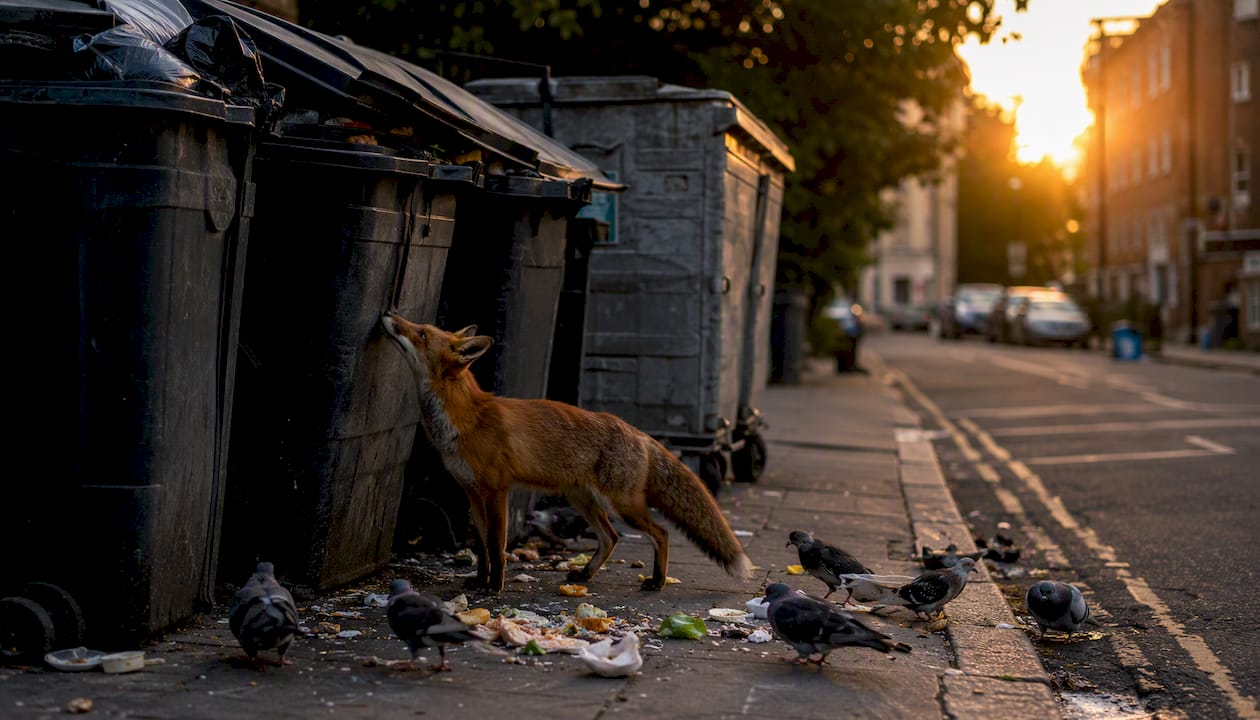
Signs: Scattered waste around bin areas, feathers and droppings near bins, claw or bite marks on bin bags, and nocturnal disturbance sounds.
Most attractive food types:
- Cooked food scraps and takeaway waste
- Bread and bakery products
- Meat and fish packaging
- Fruit and vegetable peelings
**
How quickly do pests appear after food waste is exposed?
Speed matters. Flies are often the first responders to exposed food waste, detecting the odour of decomposing protein within minutes in warm conditions. The timeline below reflects typical arrival and establishment patterns in UK urban settings.
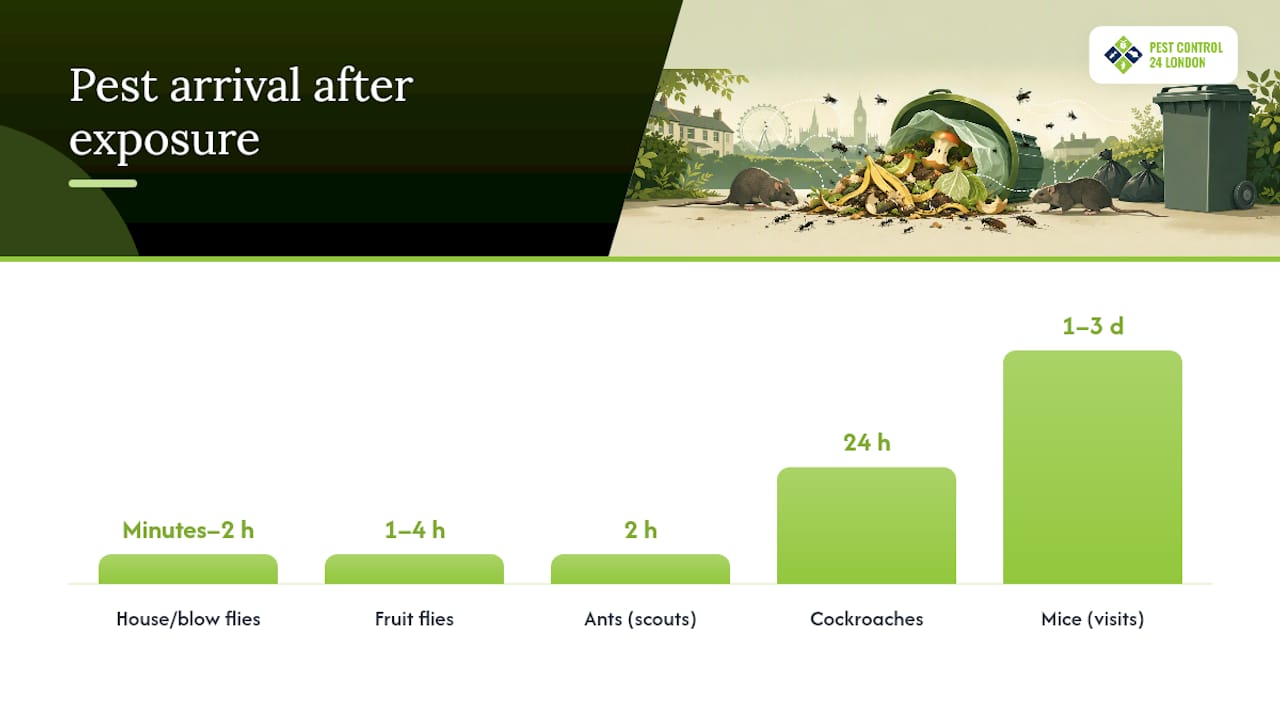
| Pest | Typical arrival after exposure | Development / establishment notes | Peak season |
|---|---|---|---|
| House flies / blow flies | Minutes to 1–2 hours | Eggs laid within hours; larvae hatch in 24 hours in warm weather | May–September |
| Fruit flies | 1–4 hours | Breed rapidly in fermenting fruit and liquids | July–October |
| Ants | 2 hours (scout trails) | Colony foraging established within 24 hours | April–September |
| Cockroaches | 24 hours to begin foraging | Establish harbourage near waste within days | Year-round (heated buildings) |
| Mice | 1–3 days for regular visits | Nesting near food source within 1–2 weeks | October–March (peak indoors) |
| Norway rats | 2–7 days for regular activity | Burrows or harbourage established within weeks | Year-round; peak autumn |
| Pigeons / gulls | Hours to days | Roosting near reliable food source within days | Year-round; gulls peak summer |
| Foxes | 1–3 nights | Regular patrol routes established quickly | Year-round; peak breeding spring |
Summer is the highest-risk period for flies and ants. Warm, humid conditions accelerate fly egg development dramatically — what takes several days at 15°C can complete in under 24 hours at 30°C. Rodents shift behaviour in autumn and winter, moving indoors as outdoor food sources diminish, which is why pest control trends for property managers consistently flag October to March as the critical window for rodent proofing.
Poorly managed communal bin stores are particularly vulnerable because the combination of warmth, moisture, and continuous food supply allows multiple pest species to establish simultaneously. Landfill and unmanaged organic waste create hotspots for diverse insect pests, with Dipteran flies frequently dominating density and posing local health risks — the same principle applies at a smaller scale to any bin store where organic matter accumulates unchecked.
Key seasonal risk points:
- Spring: Ant colonies become active; fox cubs increase scavenging pressure near bins.
- Summer: Fly populations peak; maggot outbreaks most likely in meat-containing waste.
- Autumn: Rodents move indoors; cockroach activity increases in warm commercial kitchens.
- Winter: Rats and mice concentrate around heated buildings and indoor food waste.
Why are food-waste pests a health and property risk?
The health risks from pests attracted to food waste are well-documented and, in commercial settings, carry direct regulatory consequences. Pest control in kitchens is not simply a hygiene preference — it is a legal obligation for food businesses and a genuine public health concern for households.
Disease and contamination risks:
- Flies carry pathogens including Salmonella, E. coli, and Campylobacter on their legs and mouthparts, transferring them to food surfaces within seconds of landing.
- Cockroaches are vectors for Salmonella, Staphylococcus aureus, and Clostridium perfringens, and their shed skins and droppings trigger asthma and allergic reactions.
- Rodents spread Leptospirosis (Weil’s disease) through urine contamination of food and water, and hantavirus through dried droppings disturbed during cleaning.
- Pigeons and gulls deposit Salmonella-contaminated droppings near food preparation areas and bin stores.
Property and business risks:
- Rats gnaw through electrical cables, water pipes, and structural materials, creating fire and flood risks.
- A single cockroach sighting in a food business can trigger a hygiene inspection and, if evidence of infestation is found, a Food Hygiene Rating reduction or temporary closure.
- Fixed-penalty notices and improvement notices can be issued by local authority environmental health officers where waste management is inadequate under the Food Safety Act 1990 and associated regulations.
Communal and commercial settings need documented waste-management routines and proofing because business risks include hygiene-rating impacts and potential enforcement by local authorities. For food businesses, a food safety pest control guide sets out the proofing and documentation requirements that satisfy environmental health inspectors.
Regulatory note: Under the Food Safety Act 1990 and the Food Hygiene (England) Regulations 2006, food business operators are legally required to implement pest control measures and maintain records. Local authority environmental health officers have powers to inspect, issue improvement notices, and prosecute where pest infestations pose a risk to public health.
How to prevent pests in food waste areas
Prevention is always more cost-effective than treatment. The measures below are drawn from professional integrated pest management (IPM) practice and are grouped by setting.
Home kitchens
- Use a pedal-operated bin with a tight-fitting lid; empty it daily during warm months.
- Rinse all food containers before binning — even a thin film of sauce or fat is enough to attract flies and ants.
- Double-bag raw meat, fish, and dairy before disposal; never leave them in an open bin overnight.
- Clean the bin interior weekly with hot water and a disinfectant, paying attention to the base where liquid accumulates.
- Store dry goods (cereals, flour, rice) in sealed containers rather than open packets.
- Fix any gaps around pipes, skirting boards, and under doors to deny rodent entry.
Pro Tip: Place an absorbent layer (newspaper or a bin liner with a base of bicarbonate of soda) at the bottom of your kitchen bin to soak up liquid food waste. This reduces the odour that attracts flies and slows bacterial decomposition.
Communal bin stores and estate managers
- Inspect bin lids weekly and replace any that are cracked or no longer seal properly.
- Schedule bin cleaning at least monthly; more frequently in summer.
- Ensure waste collection schedules match the volume of waste generated — overfull bins with lids propped open are the single most common cause of communal fly and rodent problems.
- Install rodent-proof bait stations at the perimeter of the bin store as a monitoring measure.
- Post clear guidance for residents on what can and cannot go in each bin, including a reminder not to leave bags outside the bin.
- Wet garden waste and poorly managed compost contribute to seasonal increases in fly populations — keep any communal composting area covered and away from building entrances.
Commercial food businesses
- Implement a documented waste-management schedule with signed records for each collection and cleaning cycle.
- Use commercial-grade, lidded, wheeled bins with intact seals; inspect them as part of daily opening checks.
- Store food waste in a designated, sealed area away from food preparation zones.
- Brief all staff on correct waste segregation and the importance of not leaving open bags in service corridors overnight.
- Commission a drain survey to identify any entry points rodents may be using via the drainage system.
- Review your pest management contract to confirm it covers waste areas, not just internal treatment zones.
For hospitality operators, the restaurant pest control strategies guide covers the specific proofing and documentation steps that satisfy food safety inspectors.
What not to do:
- Do not leave organic waste in open sacks outside overnight, even on collection eve.
- Do not put cooked meat or dairy into a standard home compost bin unless you are hot-composting at temperatures above 55°C.
- Do not use fly spray as a substitute for removing the breeding source — it kills adults but leaves larvae untouched.
- Neglected organic matter in outdoor areas, including decaying stumps and yard debris, can also support pest populations close to your property.
When should you call a BPCA-qualified pest controller?
DIY measures address surface activity but rarely eliminate an established infestation. Call a professional pest controller if you observe any of the following:
- Rodent droppings in more than one location, or gnaw marks on structural materials, cables, or bin lids.
- Cockroach sightings during daylight hours (a sign of a large, established population).
- Maggots present in bins or waste areas despite regular cleaning.
- A persistent fly problem that returns within days of cleaning.
- Bird roosting or nesting at a building frontage, with droppings accumulating near entrances or food areas.
- Any pest activity in a food business that could trigger a hygiene inspection.
What to expect from a professional callout
A BPCA-qualified technician will follow a structured process:
- Inspection: A thorough survey of the affected area, waste storage points, drainage, and potential entry routes.
- Identification: Confirmation of the species involved and assessment of the infestation’s extent.
- Targeted treatment: Application of appropriate methods — rodenticide bait stations, insecticide treatments, fly control units, or bird proofing — matched to the pest and setting.
- Proofing recommendations: Written advice on structural repairs, bin upgrades, and waste-management changes to prevent re-entry.
- Follow-up visit: A return inspection to assess treatment efficacy and adjust if needed.
- Sanitisation: Post-treatment cleaning of contaminated areas to remove droppings, larvae, and pathogen residues.
BPCA qualification matters. The British Pest Control Association sets the training and competency standards for pest control technicians in the UK. A BPCA-qualified technician carries professional indemnity insurance, uses approved products correctly, and can provide the documentation food businesses need for compliance. Pestcontrol24london is BPCA fully qualified, with over ten years of operational experience across London’s domestic and commercial sectors, offering 24/7 emergency callouts, proofing installations, drain surveys, and post-treatment sanitisation.
Questions to ask a pest controller before booking:
- Are you BPCA-qualified and fully insured?
- Which treatment methods do you use, and are they safe around children and pets?
- Does the treatment include a follow-up inspection?
- Will you provide a written report for food safety compliance purposes?
- What proofing work do you recommend alongside the treatment?
For an indication of typical treatment costs, the pest control cost guide for the UK provides a useful pricing overview for both domestic and commercial callouts.
A 10-step checklist for when you spot pests around waste
Act quickly and methodically. The steps below apply whether you have found maggots in a bin, rodent droppings in a kitchen, or evidence of cockroaches near a waste area.
- Put on disposable gloves before touching any waste, droppings, or contaminated surfaces.
- Photograph the evidence — droppings, gnaw marks, maggots, or fly activity — with a timestamp. This is valuable information for a pest controller.
- Do not disturb nests or harbourage until a professional has assessed the situation; disturbing a rodent nest can scatter animals and spread contamination.
- Remove and double-bag all exposed waste immediately, sealing the bags tightly before placing them in an outdoor bin.
- Clean the affected area with hot water and a disinfectant; pay particular attention to bin bases, corners, and any cracks where residue accumulates.
- Seal any obvious entry points temporarily — gaps under doors, holes around pipes — using wire wool or a sealant as an interim measure.
- Log the sighting with the date, time, location, and what you observed. For recurring issues, a written log is essential evidence for a professional and, in commercial settings, for regulatory compliance.
- Isolate food in the affected area by moving it to sealed containers or a separate room until the infestation is assessed.
- Contact a BPCA-qualified pest controller if the signs suggest an established infestation rather than a single stray insect or animal.
- Preserve samples safely where possible — a sealed container with a dead insect or a photograph of droppings helps the technician confirm the species before the visit.
Avoid direct skin contact with maggots, rodent droppings, or bird faeces. If you need to clean an area with heavy contamination, wear a disposable mask as well as gloves, and ventilate the space thoroughly before and during cleaning.
A field perspective on food waste and pest control in London
One pattern that comes up repeatedly when servicing London properties is how often a persistent pest problem traces back not to the building itself, but to a single weak point in the waste-management routine.
A communal bin store in a residential block had been experiencing recurring Norway rat activity for several months. Residents had reported gnawing on the bin lids and droppings along the perimeter wall. The initial assumption was that the rats were entering via the drainage system — a common route in older London properties. A drain survey found no significant entry points. The actual cause was simpler: two of the six communal bin lids had cracked hinges and could not close fully, leaving a consistent gap that rats had learned to exploit. Replacing the lids and adding a perimeter bait station programme resolved the activity within three weeks.
The lesson is straightforward. If birds are scavenging daily at your bin area, or if rodents keep returning despite treatment, the waste schedule or the physical condition of the bins is almost always the weak point. Treatment without fixing the source is a short-term measure. The most durable results come from combining professional treatment with a structural fix — whether that is a new bin lid, a sealed drain, or a revised collection schedule.
Sources
The following UK and technical sources provide authoritative guidance on food waste pest management, regulatory obligations, and the ecology of waste-associated insects.
- Landfill garbage and insect ecology (ScienceDirect)
- Bugs & mice in trash cans: Garbage can pests prevention (PestWorld)
- Garbage & manure-breeding flies IPM plan (Pestec)
- Food safety awareness: pest control (Torbay Council)