

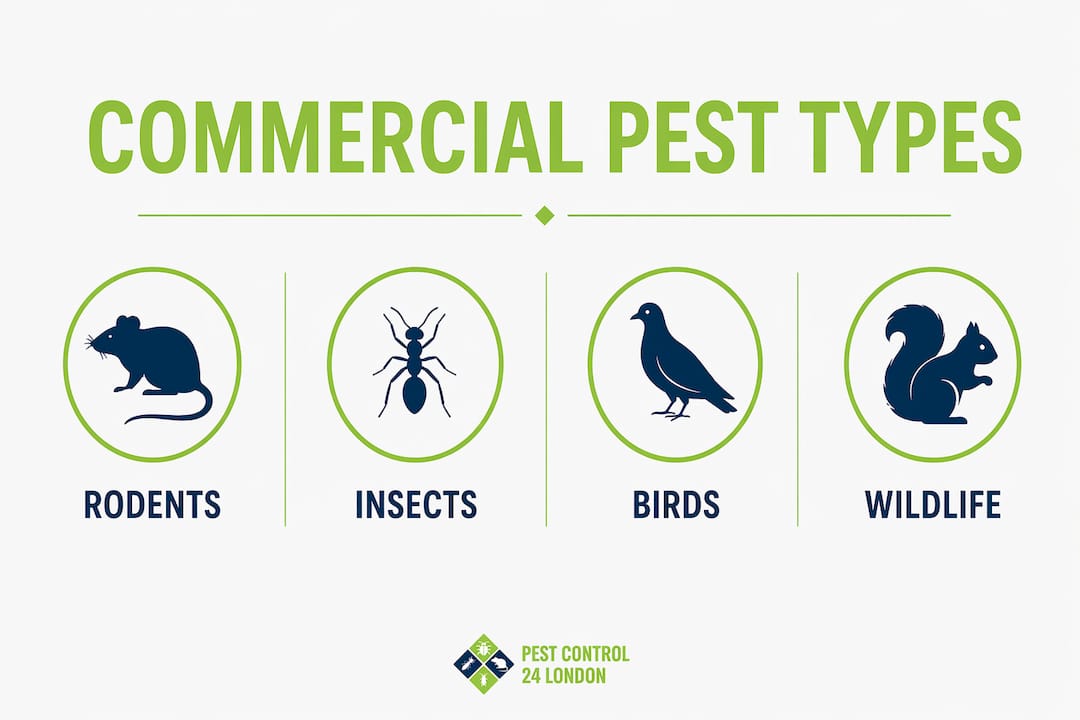
Commercial pest management is defined as the identification, monitoring, and control of organisms that threaten the hygiene, safety, and operations of business premises. The four primary types of commercial pests are rodents, insects, birds, and wildlife. Each category behaves differently, exploits different vulnerabilities in your building, and demands a distinct control approach. Recognising which pest type you are dealing with is the foundation of any effective response. Acting within 24–48 hours of detecting pest signs prevents minor sightings from escalating into widespread infestations.
What are the main types of commercial pests?
Rodents, insects, birds, and wildlife are the four recognised categories of pests in commercial settings. Industry bodies including the British Pest Control Association (BPCA) and the National Pest Management Association classify pests this way because each group requires a fundamentally different control strategy. A cockroach infestation calls for sanitation and targeted insecticide application. A pigeon problem calls for physical deterrents and proofing. Treating them the same way wastes time and money.

Understanding pest type also determines your compliance obligations. Under FDA FSMA rules (21 CFR Part 117), food manufacturing facilities must maintain documented pest control programmes with formal prerequisites for food safety compliance. That regulation applies specifically because different pest types carry different contamination risks. Knowing your pest is not just good practice. It is a legal requirement in many commercial sectors.
Which rodents most commonly affect commercial properties?
Rats and mice are the dominant rodent pests in UK commercial environments. Brown rats (Rattus norvegicus) favour ground-level harbourage near waste areas, drains, and loading bays. House mice (Mus musculus) are smaller, more agile, and can squeeze through gaps as narrow as 6mm, making them particularly difficult to exclude from food storage areas.
Poor waste management strongly attracts rodents by providing food, moisture, and shelter. This is the single most common driver of rodent infestations in restaurants, warehouses, and retail premises. Rodents gnaw through electrical wiring, contaminate food stocks with urine and droppings, and cause structural damage to insulation and pipework.
Key signs of rodent activity include:
- Droppings near food storage, behind equipment, or along skirting boards
- Gnaw marks on packaging, cables, or wooden fixtures
- Grease marks along walls and pipes, indicating regular travel routes
- Nesting material such as shredded paper or fabric in concealed spaces
- Scratching sounds at night, particularly in ceiling voids or wall cavities
Pro Tip: Fit bristle strip door seals and metal kick plates to external doors. Rodents rarely gnaw through metal, and most entry points are at ground level.
What insect pests are most common in commercial settings?
Cockroaches, flies, ants, and stored product insects are the most frequently encountered insect pests in commercial premises. German cockroaches (Blattella germanica) and American cockroaches (Periplaneta americana) are the two species most likely to appear in food businesses. Cockroaches are nocturnal, reproduce rapidly, and thrive in moist conditions near waste, making early detection difficult yet critical.
Flies present a separate but equally serious problem. Fly lifecycles can be as short as eight days from egg to adult under warm conditions. Fruit flies and houseflies breed in decomposing organic matter, and their presence signals a waste containment failure rather than a random occurrence. Stored product insects, including Indian meal moths and grain beetles, target dry goods in warehouses and food production facilities. Pheromone traps are the standard monitoring tool for these species.
| Insect pest | Primary habitat | Key indicator |
|---|---|---|
| German cockroach | Kitchen voids, drains | Egg cases, musty odour |
| Housefly | Waste areas, drains | Clustering near bins |
| Indian meal moth | Dry goods stores | Webbing in grain or flour |
| Grain beetle | Cereal storage | Damaged packaging, frass |
| Ant | Wall cavities, foundations | Foraging trails to food |
Pro Tip: Spider activity inside a commercial building is a reliable secondary indicator of insect infestation. Spiders follow their prey. If you spot webs in unusual areas, investigate for an underlying insect population.
Sanitation is the primary control lever for all insect pests. Pest activity in waste areas risks regulatory violations, and managing waste is the frontline of prevention. Cleaning schedules, sealed bins, and prompt removal of food residues reduce the conditions that allow insect populations to establish.
What bird pests affect commercial premises?
Pigeons, gulls, and starlings are the three bird species most likely to become pests on commercial properties. Pigeons are the most widespread urban pest bird in the UK. They roost on rooftops, ledges, and in loading bay canopies, and their droppings are acidic enough to corrode metal and stonework over time.
Bird species such as pigeons and gulls contaminate surfaces with droppings and nesting material, posing health and operational risks. Droppings carry pathogens including Salmonella and Listeria, both of which are notifiable concerns in food businesses. Nesting in ventilation systems blocks airflow and creates fire hazards from accumulated debris.
Common risks from bird pests include:
- Surface contamination from droppings on loading areas, fire escapes, and air handling units
- Blocked drainage from nesting material accumulating in gutters and downpipes
- Noise disturbance from large roosting flocks, particularly gulls
- Attraction of secondary pests such as bird mites and feather beetles
Bird proofing through netting, spike systems, and wire deterrents is the most effective long-term solution. Lethal control of most bird species requires a licence under the Wildlife and Countryside Act 1981, so professional intervention is the appropriate route.
How does wildlife become a commercial pest problem?
Wildlife pests in commercial settings include squirrels, foxes, bats, and occasionally stray cats or other small mammals. Squirrels and bats can become commercial pests due to their nesting habits and building access, requiring humane and legal control methods. Grey squirrels enter roof spaces through damaged soffits and fascias, where they gnaw structural timbers and strip cable insulation.
Foxes are a growing problem for commercial premises with outdoor waste storage. They tear open bin bags, scatter waste, and can become aggressive near food sources. Bats are a protected species under UK law, and any control work affecting bats or their roosts requires a Natural England licence. This makes professional assessment non-negotiable before any remedial work begins.
The key distinction with wildlife pests is that exclusion and habitat modification take priority over lethal methods. Sealing entry points, securing waste storage, and removing attractants are the primary tools. Expert intervention is required whenever protected species are involved.
How does pest type shape your control strategy?
Integrated pest management (IPM) focuses on population control through exclusion, sanitation, and monitoring rather than total eradication. This is especially relevant in food processing and healthcare environments where chemical use is restricted. The pest type determines which IPM tools apply.
| Pest category | Primary control method | Monitoring tool |
|---|---|---|
| Rodents | Exclusion, baiting, trapping | Bait station records, track pads |
| Insects | Sanitation, insecticide, proofing | Pheromone traps, sticky boards |
| Birds | Physical deterrents, netting | Visual inspection, droppings surveys |
| Wildlife | Exclusion, habitat modification | Entry point surveys, camera traps |
Inspection frequency should match sector risk: offices quarterly, retail monthly, food service weekly or bi-weekly, and healthcare weekly with continuous monitoring. Matching inspection frequency to actual risk level prevents both under-detection and unnecessary expenditure.
Waste collection schedules must be adapted seasonally, with increased frequency in warmer months proving more cost-effective than reactive insecticide use. This is a practical example of how environmental management reduces pest pressure before chemical intervention becomes necessary.
Pro Tip: Maintain a pest activity log for every inspection. Regulatory auditors in food businesses expect documented evidence of monitoring, not just treatment records. A log also reveals seasonal patterns that help you anticipate problems before they escalate.
Key takeaways
Effective commercial pest control begins with accurate identification. Without knowing which pest category you face, no control strategy can be properly targeted.
| Point | Details |
|---|---|
| Four pest categories | Rodents, insects, birds, and wildlife each require distinct control approaches. |
| Waste management is critical | Poor waste containment attracts rodents, cockroaches, and flies simultaneously. |
| Regulatory compliance matters | Food businesses must maintain documented pest control programmes under FSMA and BPCA standards. |
| Inspection frequency varies by sector | Food service requires weekly checks; offices can operate on a quarterly schedule. |
| IPM over chemical reliance | Exclusion, sanitation, and monitoring outperform reactive chemical treatments in the long term. |
Why pest identification is the step most businesses skip
From my experience working across commercial sites in London, the most common mistake I see is businesses jumping straight to treatment without confirming what they are dealing with. A manager spots droppings and calls for rodent bait stations. Three months later, the problem persists because the culprit was actually a bird mite infestation originating from a pigeon nest in the roof void above. The treatment was entirely wrong for the pest.
Pest identification is not a formality. It is the decision that determines whether your money is spent effectively or wasted. I have seen food businesses fail environmental health inspections not because they had no pest control in place, but because their programme was not matched to the pests actually present on site. Auditors look for evidence that your approach is targeted and documented.
My practical advice is to treat every pest sighting as a diagnostic opportunity. Record what you see, where you see it, and when. That data builds a picture of which pest category is active, which entry points are being used, and which environmental conditions are sustaining the population. You can read more about building a structured approach to ongoing commercial pest management. Early, accurate identification is what separates businesses that resolve pest problems from those that manage them indefinitely.
— Dan
Professional pest control for London businesses
Pestcontrol24london has delivered commercial pest control services across London since 2015, working with hotels, restaurants, retail premises, and food production facilities. The team is BPCA fully qualified and experienced across all four commercial pest categories.
Every engagement begins with a thorough site inspection to confirm pest type before any treatment is recommended. Pestcontrol24london provides tailored service plans that align with your sector’s inspection frequency requirements and compliance obligations. Whether you are managing a single site or a multi-location operation, the team is available 24/7 for both scheduled visits and emergency response. Contact Pestcontrol24london for a free consultation and a programme built around the specific pests affecting your premises.
FAQ
What are the four types of commercial pests?
The four main categories are rodents, insects, birds, and wildlife. Each group requires a distinct control strategy based on its behaviour, harbourage preferences, and legal status.
How do I know if my business has a pest problem?
Common signs include droppings, gnaw marks, grease trails, unusual odours, and visible pest activity near waste areas or food storage. Early detection prevents minor sightings from becoming full infestations.
What insects are most common in food industry businesses?
German cockroaches, houseflies, fruit flies, Indian meal moths, and grain beetles are the most frequently encountered types of food industry pests. Pheromone traps and strict sanitation schedules are the primary control tools.
Are bird pests covered by UK law?
Most bird species in the UK are protected under the Wildlife and Countryside Act 1981. Lethal control requires a licence, so professional assessment is necessary before any bird management work begins.
How often should a commercial property be inspected for pests?
Inspection frequency depends on sector risk. Food service premises require weekly or bi-weekly checks, retail premises monthly, and offices quarterly. Healthcare facilities need weekly inspections with continuous monitoring in high-risk zones.