

The most common types of commercial bird pest issues are roosting congregation, active nesting, guano fouling, aggressive gull behaviour near customers, and indoor incursions by starlings or sparrows. Feral pigeons (Columba livia), herring gulls, and European starlings (Sturnus vulgaris) account for the majority of commercial callouts in the UK. Your immediate first step is a site walkround to document guano accumulation, visible nests, and access points, then score the ‘bird pressure’ level before deciding whether in-house measures are appropriate or a professional survey is needed.
Quick site check before you act:
- Walk the roofline, plant room, and loading bay at dawn or dusk when birds are most active
- Photograph all guano deposits, nests, and entry points with date-stamped images
- Note whether birds are visiting briefly (low pressure), loafing regularly (medium), or roosting and nesting (high)
- If nesting is active or guano covers more than a few square metres, stop DIY attempts immediately
- Arrange a professional survey with a BPCA-qualified contractor before the next breeding season begins
Pro Tip: Document everything photographically from day one. Dated images of bird pressure are invaluable when briefing a contractor, defending an insurance claim, or responding to an environmental health officer.
Pestcontrol24london has been managing commercial bird infestations across London since 2015, working with hotels, restaurants, warehouses, and retail sites to deliver BPCA-qualified, audit-ready solutions.
Table of Contents
- Which UK pest bird species cause the most commercial problems?
- How bird presence damages buildings and disrupts business
- How do you recognise a bird problem and assess its severity?
- What are the most effective commercial bird control methods?
- What UK law says about bird pest control
- When should you call a professional bird control service?
- How Pestcontrol24london approaches commercial bird control
- Key takeaways
- What commercial bird control gets wrong most of the time
- Pestcontrol24london’s commercial bird control services in London
- Useful sources
Which UK pest bird species cause the most commercial problems?
Recognising the species responsible is the foundation of any effective bird pest management solution. Different birds behave differently on buildings, and the control method that works for a pigeon colony on a flat roof will not address a gull nesting on a pitched canopy.
Feral pigeon (Columba livia)
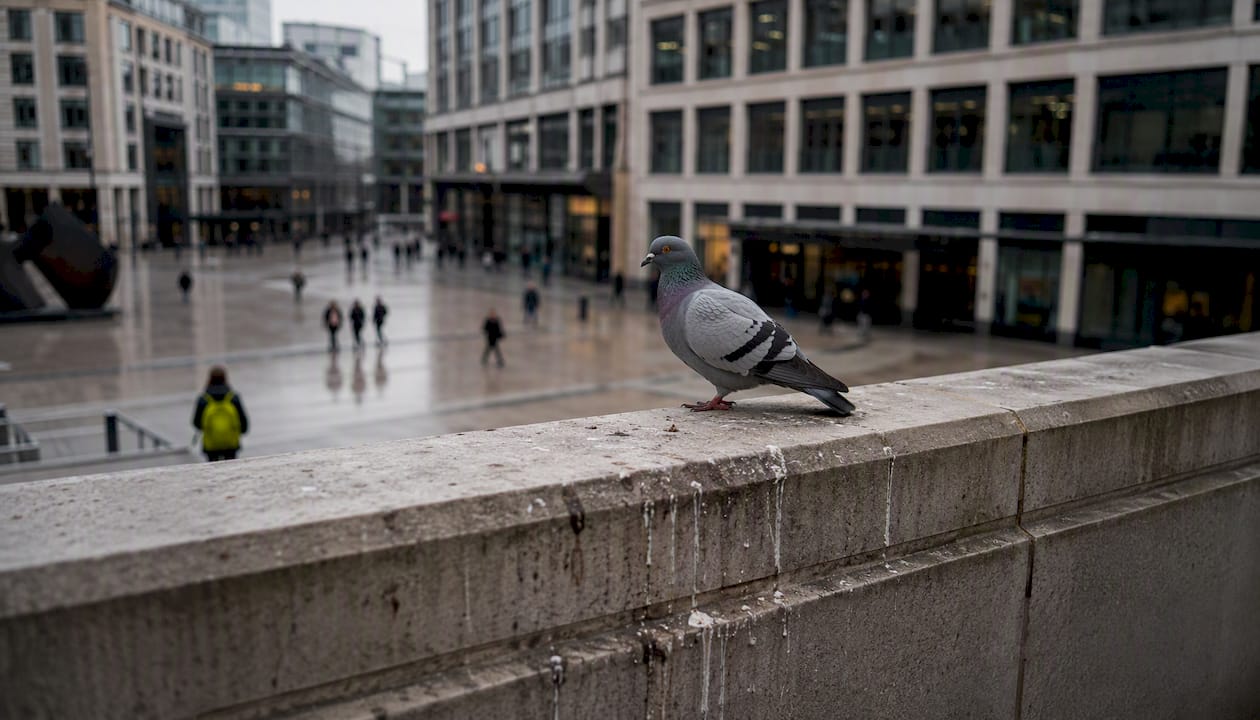
Pigeons are the most widespread commercial pest bird in the UK. They roost and nest on ledges, parapet walls, plant rooms, and under solar panels, producing large volumes of guano year-round. Their tolerance of human activity means colonies grow quickly once a site becomes established.
Herring gull and large gulls (Larus spp.)
Herring gulls, lesser black-backed gulls, and greater black-backed gulls are increasingly nesting on flat commercial roofs, particularly in coastal towns and urban centres. They are aggressive during the breeding season (April to August), dive-bombing staff and customers, and their nests are bulky enough to block drainage channels.
European starling (Sturnus vulgaris)
Starlings roost in enormous flocks and are drawn to warm roof voids, ventilation ducts, and warehouse eaves. Their guano accumulates rapidly in concentrated areas, and their nesting material can block air-handling units. They are also a significant disease vector, carrying pathogens that affect food safety.
House sparrow (Passer domesticus)
Sparrows favour small gaps in fascias, signage, and roof junctions. They are a persistent problem for food retail and hospitality premises because they forage indoors, contaminating food preparation areas and triggering hygiene inspection failures.
Corvids (crows, rooks, magpies)
Corvids are intelligent and adaptable. They exploit waste areas, loading bays, and outdoor dining spaces. Rooks nest colonially in trees adjacent to commercial sites, while carrion crows and magpies are opportunistic scavengers that can damage roof membranes by pecking at sealant strips.
| Species | Typical locations on buildings | Most common commercial impacts |
|---|---|---|
| Feral pigeon | Ledges, parapet walls, plant rooms, solar panels | Guano corrosion, gutter blockage, slip hazards |
| Herring/large gulls | Flat roofs, roof terraces, canopies | Aggressive behaviour, nest-blocked drains, noise |
| European starling | Roof voids, ventilation ducts, warehouse eaves | Duct blockage, rapid guano build-up, disease risk |
| House sparrow | Fascia gaps, signage voids, roof junctions | Indoor contamination, hygiene failures |
| Corvids | Waste areas, loading bays, adjacent trees | Roof membrane damage, scavenging, nest debris |
How bird presence damages buildings and disrupts business
The business risks from bird infestations go well beyond an unsightly roofline. Structural, operational, and health consequences can accumulate quickly, and the cost of remediation almost always exceeds the cost of early prevention.

Structural and material damage
Bird guano is highly acidic, with a pH comparable to vinegar. Left unaddressed, it can halve the service life of tar-based roofing membranes and corrode steel I-beams and fixings. Gutter systems blocked by nesting material and accumulated droppings cause water to back up, leading to roof-deck saturation, internal leaks, and, in severe cases, structural loading failures. Corvids and gulls that peck at EPDM and bitumen membranes create entry points for water ingress that are expensive to locate and repair.
Operational and commercial risks
- Product contamination in food production, storage, and distribution environments
- Failed third-party audits: auditors routinely flag nesting, droppings, and proofing failures as critical control issues
- Slip-and-fall hazards from guano on walkways, fire escapes, and loading bays
- Equipment failure caused by guano fouling of HVAC units, cooling towers, and electrical plant
- Reputational damage from visible fouling on customer-facing areas, outdoor dining spaces, and hotel terraces
Large open commercial spaces such as warehouses, retail arcades, and distribution centres are particularly vulnerable to interior incursions that can halt production lines or spoil stock directly.
Health and hygiene risks
Birds harbour dozens of disease organisms and parasites relevant to human and animal health, including bacterial pathogens such as Salmonella and Campylobacter, and fungal spores from dried guano that pose respiratory risks to workers carrying out cleaning or maintenance. Bird mites, fleas, and ticks can migrate from nesting sites into occupied areas of a building. Accumulated nests and droppings also attract secondary pests including flies and warehouse beetles, compounding the sanitation burden considerably. For food businesses, commercial sanitation risks from organic fouling extend beyond visible contamination to persistent odour and microbial residue that standard cleaning does not eliminate.
Guano corrosivity is not a slow problem. Roof membranes and steel fixings can show measurable degradation within a single season of heavy roosting. Routine monitoring and timely cleaning are the most cost-effective form of structural protection.
How do you recognise a bird problem and assess its severity?
Triaging bird pressure accurately determines whether you need monitoring, deterrents, or immediate exclusion. The following scale gives you a practical starting framework.
Low pressure (visitor birds): Birds land briefly to forage or rest but do not roost overnight. Guano is scattered and light. No nesting material is present. Appropriate response: remove food and water sources, seal minor access points, and monitor monthly.
Medium pressure (regular loafing): Birds return to the same ledges, rooftop plant, or loading bay daily. Guano is accumulating in defined areas. No active nests yet, but the site is becoming established. Appropriate response: install passive deterrents (spikes, slope systems) promptly and arrange a contractor assessment before the next breeding season.
High pressure (roosting and nesting): Birds are present overnight or year-round. Nests are visible or suspected in voids. Guano is deep, widespread, or fouling drainage. Appropriate response: stop DIY attempts, arrange a professional survey immediately, and treat as a health and safety matter pending remediation.
A low-pressure issue can become entrenched within weeks during the spring breeding season. Once birds have nested successfully on a site, they return the following year with greater numbers. Habituation sets in rapidly, and the window for simple deterrence closes. Signs that irreversible habituation has occurred include worn ‘landing strips’ in guano, feather accumulation in voids, and birds that show no response to human presence.
For audit and insurance purposes, photograph every affected area with date and time stamps. Record the species observed, the approximate number of birds, and the location of guano deposits or nests. This documentation supports contractor briefings, insurer notifications, and environmental health responses.
What are the most effective commercial bird control methods?
Bird pest management solutions for commercial sites follow a tiered logic: exclusion first, then passive physical deterrents, then active or technology-based deterrents, and finally population management where lawful. The right tier depends on bird pressure, species, and building type.
The tiered approach
Exclusion (netting and sealing): Heavy-duty polypropylene or stainless-steel netting physically denies access to roof voids, loading bays, and open facades. This is the only reliable solution for high-pressure sites and is the audited expectation in food production and storage environments. Netting must be tensioned and sealed correctly; gaps create sheltered pockets that can become harder to clean and may shelter nests more securely than the original surface.
Passive physical proofing: Anti-roosting spikes (stainless steel or polycarbonate) on ledges, parapets, and signage prevent pigeons and gulls from landing. Slope systems (angled PVC or metal panels) eliminate flat surfaces on ledges. Both are low-maintenance once installed and suit medium-pressure retail and office façades.
Active deterrents: Electric track systems deliver a mild, harmless electric stimulus that conditions birds to avoid treated surfaces. Laser deterrents are effective in large open areas such as warehouses and distribution centres. Sonic and ultrasonic devices have mixed evidence of effectiveness and can generate nuisance complaints from neighbouring properties; they are best used as part of a combined programme rather than as a standalone measure.
Population management: For large, complex pigeon colonies, OvoControl (a contraceptive bait programme) is used on some sites to reduce breeding success over time. This is a long-term measure and supplements, rather than replaces, physical proofing.
Pro Tip: Static visual deterrents such as plastic owls and reflective tape fail quickly because birds habituate to them within days. Combine methods and vary them seasonally. Install proofing before March to avoid the legal and practical complications of active nesting.
| Method category | How it works | Best use case | Pros | Cons | Maintenance | Legal/ethical notes |
|---|---|---|---|---|---|---|
| Exclusion netting | Physical barrier denies access | High-pressure sites, food environments | Highly effective, auditable | Higher upfront cost, installation skill required | Annual inspection | Compliant; must not trap birds |
| Physical proofing (spikes/slopes) | Removes landing surfaces | Ledges, parapets, signage | Durable, low maintenance | Ineffective for large flat areas | Periodic debris clearance | Compliant |
| Electric track | Mild stimulus conditions avoidance | Ornate facades, heritage buildings | Discreet, species-flexible | Requires power supply, periodic inspection | Quarterly check | Compliant |
| Laser deterrent | Automated laser sweeps deter roosting | Warehouses, large open spaces | Wide coverage, no habituation | Requires correct setup; not suitable near public | Minimal | Compliant in most settings |
| Sonic/acoustic | Sound broadcasts deter birds | Open external areas | Low cost | Rapid habituation, nuisance risk | Regular programme changes | Check local planning rules |
| Population management (OvoControl) | Contraceptive bait reduces breeding | Large pigeon colonies, complex sites | Long-term reduction | Slow results, requires ongoing baiting | Monthly bait replenishment | Lawful for pigeons; species-specific |
For food production and warehousing, exclusion is non-negotiable. Deterrents alone will not prevent a motivated bird from entering a climate-controlled environment with food present. For retail façades and office buildings at medium pressure, spikes and slope systems typically suffice, with electric track reserved for heritage or ornate surfaces where spikes are impractical.
What UK law says about bird pest control
The Wildlife and Countryside Act 1981 protects all wild birds, their nests, and eggs in the UK. It is an offence to intentionally damage or destroy an active nest or take or destroy eggs. This has direct practical consequences for commercial bird control: once a bird has begun nesting, removal of that nest is unlawful until the breeding cycle is complete and the nest is no longer in use.
Key compliance points for commercial property managers:
- Prevention is the legal default. Proofing installed before nesting begins is always lawful. Removing an active nest without a licence is not.
- General licences issued by Natural England (and equivalent bodies in Scotland and Wales) permit certain control activities for specific species (including feral pigeons and some gulls) where public health or safety is at risk, but these licences carry conditions and are not a blanket permission.
- Audit consequences: Third-party food safety and hygiene auditors treat bird proofing failures as critical control point issues. A failed audit triggered by bird fouling can result in suspension of trading approval for food businesses.
- Documentation is your defence. Retain all survey reports, risk assessments, proofing specifications, and contractor certificates. Environmental health officers and auditors expect written evidence of a managed programme.
- Choose BPCA-qualified contractors. The British Pest Control Association sets the industry standard for training, ethics, and legal compliance. Using an unqualified contractor exposes you to liability if nest destruction occurs unlawfully.
For further guidance, the BPCA and the RSPB both publish practical advice on lawful bird management. The London commercial pest control compliance guide covers how bird issues interact with health and safety audit requirements in more detail.
This article provides general information, not legal advice. Confirm current licensing conditions with Natural England or a qualified pest control professional before undertaking any control work.
When should you call a professional bird control service?
Some bird pressure can be managed with straightforward in-house measures. These situations cannot.
Active nesting in or near production, food storage, or HVAC areas. The contamination risk is immediate and the legal constraints on removal require professional guidance.
Guano accumulation that creates a slip hazard or covers more than a few square metres. Safe removal requires respiratory protection, specialist cleaning agents, and waste disposal compliance.
Repeated customer complaints or a guest-facing area visibly fouled. Reputational damage compounds quickly; a hotel terrace or restaurant entrance fouled by gulls requires urgent intervention.
A failed or at-risk third-party audit. Auditors expect documented, contractor-delivered proofing programmes, not ad hoc deterrents.
Working-at-height requirements. Any proofing work above ground level requires competent persons, appropriate access equipment, and risk assessments. This is not a DIY task.
Interior incursions in warehouses or retail spaces. Birds inside a building require a different response to birds on the roof; trapping, exclusion, and proofing must be coordinated.
A professional survey typically covers: site walkround and species identification, bird-pressure scoring, photographic risk assessment, a written proofing specification, staged installation (exclusion first, then deterrents), and a follow-up monitoring visit. Most reputable contractors offer a maintenance schedule or warranty period. Cost drivers include the total area to be proofed, access difficulty (cherry picker, scaffold, rope access), species pressure, and the method selected. Exclusion netting for a large warehouse costs more than spike installation on a retail parapet, but the audit and structural protection it delivers justifies the investment.
How Pestcontrol24london approaches commercial bird control
Pestcontrol24london’s commercial methodology begins with a site-specific bird-pressure survey before any specification is written. That survey produces a written risk assessment covering species present, roosting and nesting locations, guano accumulation, access risks, and proximity to food or production areas. The specification that follows is staged: exclusion where the pressure or audit requirement demands it, passive proofing where deterrence is sufficient, and technology-based solutions (electric track, laser) where the building type or species mix requires them.
Clients should expect and request the following from any BPCA-qualified provider:
- BPCA qualification certificate for the operative carrying out the work
- Employer’s liability and public liability insurance documentation
- Written site-specific risk assessment suitable for audit submission
- Photographic record of pre-installation conditions and completed works
- Site-specific warranty covering installation quality and follow-up visits
- Scheduled monitoring at agreed intervals (typically quarterly for high-pressure sites)
- Documented handover pack including method statements and maintenance instructions
Improper netting installation is one of the most common causes of recurring problems on commercial sites. Gaps in netting create sheltered pockets that are harder to clean and can shelter nests more securely than the original unproofed surface. Pestcontrol24london’s installations are tensioned and sealed to specification, with a post-installation inspection before sign-off.
Pro Tip: Ask your contractor for a written maintenance schedule at the point of specification, not after installation. Proofing that is not inspected annually will degrade, and a degraded installation can be worse than no installation at all.
For hospitality managers, the hotel pest control checklist covers bird-specific audit expectations alongside broader pest management requirements.
Key takeaways
Commercial bird pest issues require a structured, species-specific response: document bird pressure first, apply exclusion in food and production environments, and use a BPCA-qualified contractor before nesting season begins.
| Point | Details |
|---|---|
| Identify species and pressure level | Walk the site at dawn or dusk, photograph guano and nests, and score pressure as low, medium, or high before acting. |
| Exclusion is mandatory in food environments | Netting and physical sealing are the audited expectation in food production and storage; deterrents alone will not meet audit standards. |
| Act before March | Installing proofing before the breeding season avoids the legal restrictions on active nest removal under the Wildlife and Countryside Act 1981. |
| Document everything for audits | Retain dated photographs, contractor risk assessments, and proofing certificates to satisfy environmental health and third-party auditors. |
| Pestcontrol24london for commercial sites | BPCA-qualified surveys, tiered exclusion and deterrent installations, and scheduled monitoring for London commercial properties. |
What commercial bird control gets wrong most of the time
The single most common mistake on commercial sites is late action. Managers notice a few pigeons on the roof in autumn, decide it is not urgent, and by the following April they have an entrenched nesting colony, a guano-covered plant room, and a contractor telling them the work cannot start until the birds have finished breeding. That window of easy, low-cost intervention closes fast.
The second most common mistake is overreliance on visual deterrents. Plastic owls, reflective tape, and hawk kites are widely sold as solutions, and they fail reliably. Birds are not fooled for long by a static threat that never moves, never hunts, and is always in the same position. The research is consistent: habituation to static devices is rapid, and integrated measures that alter the environment are far more durable.
Poor netting installation deserves its own mention because it is counterintuitive. A badly tensioned net with unsealed edges does not simply fail to exclude birds; it actively creates sheltered, warm pockets that are more attractive to nesting than the original open ledge. The installation quality matters as much as the decision to install.
On the landlord and tenant side, responsibility for bird proofing is frequently disputed in commercial leases. Tenants assume the landlord will act; landlords assume the tenant’s fit-out created the problem. The practical answer is to address it in the lease at the outset and to treat bird control as part of routine building maintenance, not an emergency response. Early action reduces the chance of failed audits and expensive remedial work later.
Pestcontrol24london’s commercial bird control services in London
Ten years of commercial callouts across London, from hotel rooftops to warehouse loading bays, have given Pestcontrol24london a clear picture of what works and what does not. For property managers who need a solution that holds up under audit scrutiny, the difference between a compliant installation and a recurring problem usually comes down to the quality of the initial survey and the specification that follows it.

Pestcontrol24london offers the full range of commercial bird control services: site survey and bird-pressure risk assessment, heavy-duty netting installation, spike and slope-system proofing, electric track and laser deterrent installation, guano removal and post-treatment sanitisation, and scheduled monitoring contracts. All work is carried out by BPCA-qualified operatives, with written risk assessments and photographic handover packs suitable for audit submission. The service covers London 24/7, including emergency callouts for acute contamination or access incidents.
To arrange a site survey or get a quote, contact Pestcontrol24london directly through the commercial pest control page.
Useful sources
The following authoritative sources were used in preparing this guide and are recommended for further reading and audit support:
- Wildlife and Countryside Act 1981 — the primary UK legislation governing protection of wild birds, nests, and eggs
- Management of birds in commercial buildings (Abell Pest Control white paper) — covers interior incursion risks in warehouses and large commercial spaces
- Wildlife Trusts: how to identify gulls — species identification resource for UK gull species
- BPCA (British Pest Control Association) — the UK industry body for pest control standards, training, and contractor accreditation; use the BPCA member search to verify contractor qualifications
Retain copies of all contractor surveys, risk assessments, and proofing certificates. Auditors and environmental health officers expect documented evidence of a managed programme, not verbal assurances. Verifying BPCA membership before engaging a contractor takes two minutes and protects you from unqualified work.