

The most common types of bird pests in the UK are feral pigeons, herring gulls, lesser black-backed gulls, European starlings, house sparrows, magpies, carrion crows, rooks, collared doves, and rose-ringed parakeets. Each species becomes a nuisance through some combination of droppings, structural nesting, noise, agricultural damage, or infrastructure fouling. If you spot signs of any of them on your property, the right first move is to record what you see, avoid disturbing any active nests, and consider professional proofing or a site survey.
Why this list matters: these are not simply common garden birds. They are species whose behaviour, in the wrong location, creates measurable health risks, property damage, and legal obligations for the people who own or manage the affected buildings.
- Feral pigeon (Columba livia): droppings corrode stonework and block gutters; a recognised urban pest.
- Herring gull (Larus argentatus): aggressive roof-nesting, loud calls, dive-bombing near nests.
- Lesser black-backed gull (Larus fuscus): similar roof-nesting habits; increasing urban presence.
- European starling (Sturnus vulgaris): vast roosts, agricultural crop damage, fouling of food premises.
- House sparrow (Passer domesticus): nests in roof voids and soffits; contaminates feed stores.
- Magpie (Pica pica) / carrion crow / rook (Corvus spp.): crop raiding, bin-raiding, aggressive behaviour near nests.
- Collared dove (Streptopelia decaocto): grain contamination at farms and food businesses.
- Rose-ringed parakeet (Psittacula krameri): growing urban population; orchard and soft-fruit damage.
Pro Tip: Before taking any action, photograph or video the birds and any nests. This evidence record helps a professional assess the species, the scale of the problem, and the licence requirements that may apply.
Key takeaways
The most effective approach to managing common bird pests in the UK combines early identification, physical exclusion, and professional support where the scale or legal complexity exceeds what a property owner can safely handle alone.
| Point | Details |
|---|---|
| Know your species | Feral pigeons, gulls, starlings, sparrows, corvids, collared doves, and parakeets are the main UK pest birds. |
| Act before nesting season | Install proofing before March to avoid legal restrictions on disturbing active nests. |
| Combine methods | Single deterrents fail quickly; effective control requires exclusion plus rotating deterrents and monitoring. |
| Check the law first | The Wildlife and Countryside Act 1981 protects all wild birds; licences are needed for most active control. |
| Call a BPCA professional | Large roosts, food-premise fouling, or infrastructure nesting all warrant a qualified survey before any action. |
Table of Contents
- Profiles of the main pest bird species in the UK
- How to spot a bird problem and the damage it causes
- Practical steps to deter birds and proof your property
- UK legal protections and welfare rules you must follow
- When should you call a professional bird-control service?
- Why DIY alone rarely works: the case for integrated pest management
- A note from the team at Pestcontrol24london
- Sources
Profiles of the main pest bird species in the UK
Understanding which species you are dealing with changes everything: the legal constraints, the deterrents that work, and the urgency of the response. Below is a concise factcard for each species, followed by a comparison table covering nesting sites, primary nuisance, signs to spot, control difficulty, and welfare or legal constraints.
Feral pigeon (Columba livia)
Blue-grey body, iridescent neck feathers, red feet. Feral pigeons nest year-round on ledges, rooftops, gutters, and under solar panels. They are highly adapted to urban environments and breed up to six times per year. Droppings are the primary problem: acidic, corrosive, and a source of pathogens including Salmonella and Cryptococcus. Economic costs of alien birds research identifies Columbiformes as among the most costly introduced bird groups globally, with urban droppings driving significant clean-up expenditure.
Herring gull (Larus argentatus)
Large, pale grey back, pink legs, yellow bill with a red spot. Herring gulls nest on flat roofs and chimney stacks from April to August, and they defend nests aggressively, including dive-bombing pedestrians. The Wildlife Trusts’ gull identification guide explains the key plumage differences between herring and lesser black-backed gulls, which matters because their urban behaviour patterns differ. Herring gulls are on the UK Red List for conservation concern, so any control action requires careful legal consideration.
Lesser black-backed gull (Larus fuscus)
Darker slate-grey back, yellow legs. Slightly smaller than the herring gull but equally capable of roof-nesting in urban areas. Lesser black-backed gulls are migratory, with most birds arriving in spring and departing by autumn, though urban populations increasingly overwinter. Nesting colonies on flat commercial rooftops can number in the dozens, causing persistent fouling and noise complaints.
European starling (Sturnus vulgaris)
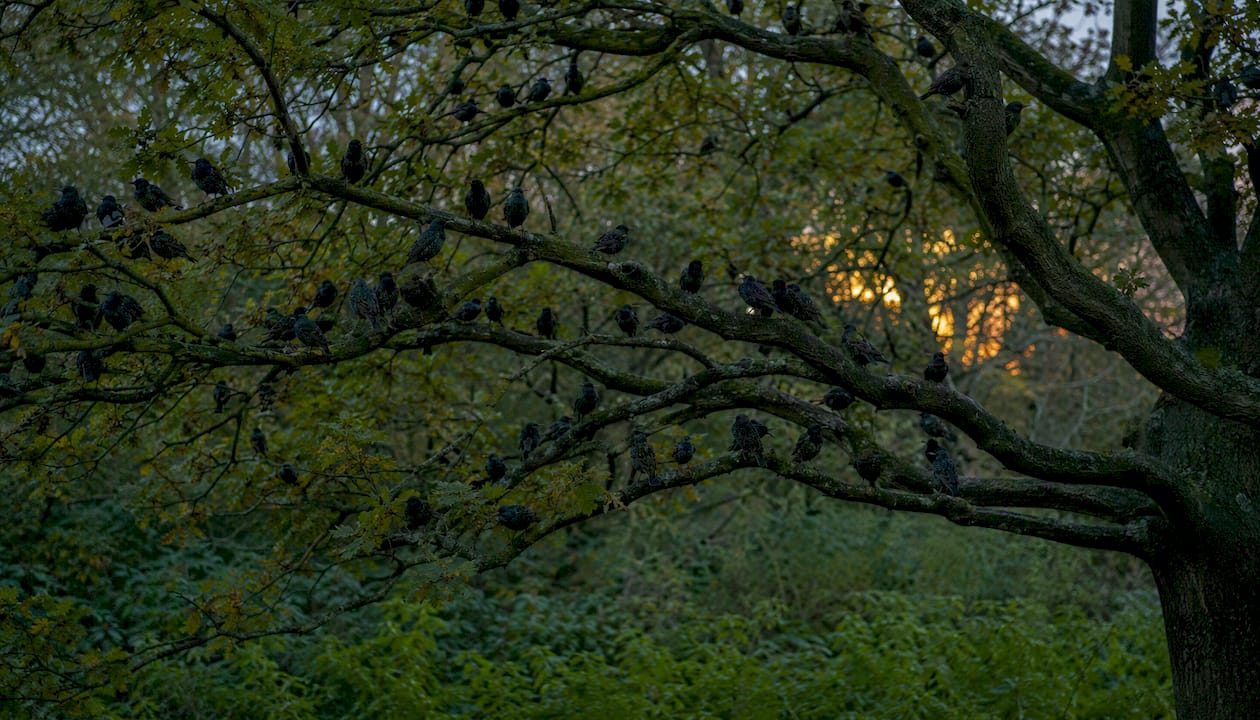
Glossy black plumage with iridescent green and purple sheen, speckled in winter. Starlings are cavity nesters, favouring roof voids, soffits, and ventilation gaps. Their real impact comes from scale: starlings form enormous roosts that can number in the hundreds of thousands, producing concentrated fouling beneath roost sites and significant noise. At farms, they contaminate feed troughs and grain stores.
House sparrow (Passer domesticus)
Small, brown-streaked bird; males have a grey crown and black bib. House sparrows nest in roof voids, under eaves, and in cavity walls, often in loose colonies. They are persistent and adaptable, and their nesting material can block gutters and vents. At food businesses, sparrows entering premises to forage represent a direct hygiene risk. Extension guidance groups house sparrows alongside starlings and pigeons as primary pest birds at farms and urban sites, recommending exclusion as the most effective response.
Magpie (Pica pica), carrion crow, and rook (Corvus spp.)
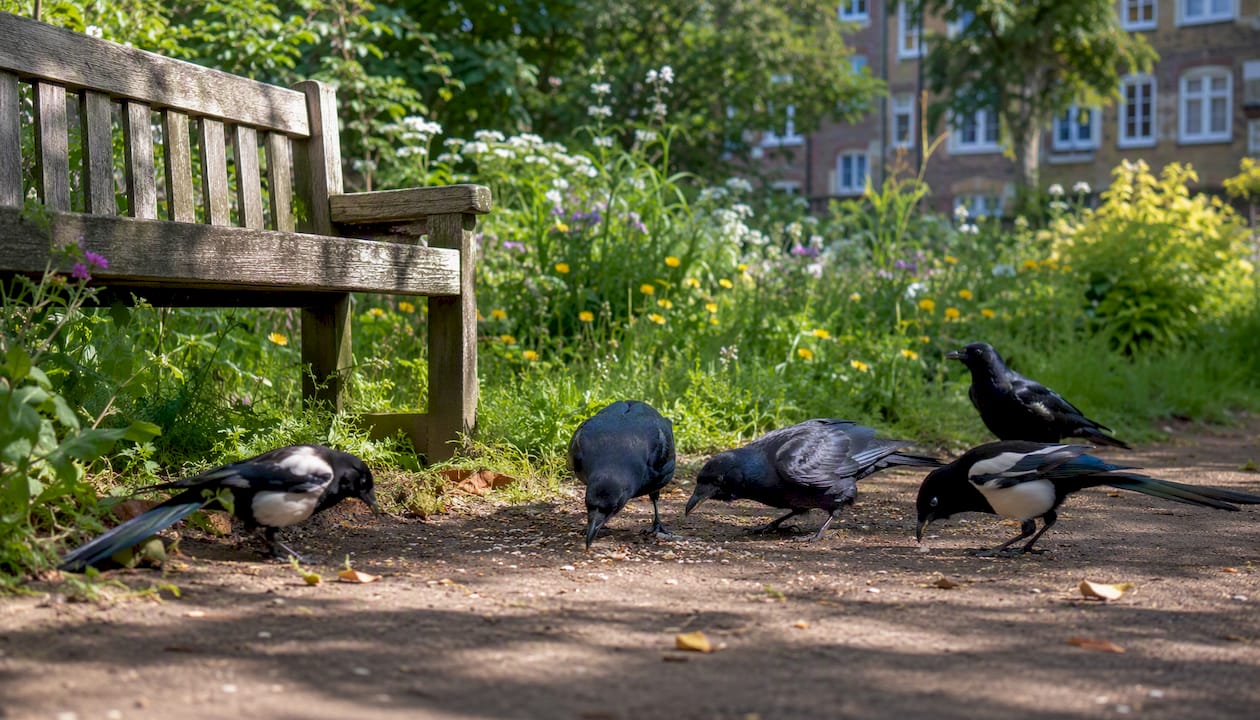
Corvids are intelligent, adaptable, and difficult to deter once established. Magpies are unmistakable: black and white with a long iridescent tail. Carrion crows are all-black; rooks have a pale, bare patch at the base of the bill. All three raid bins, damage crops, and can predate the eggs and chicks of other birds. Rooks nest colonially in tall trees (rookeries), which can become a significant noise and dropping nuisance near residential properties. Corvids habituate to most static deterrents quickly, making them among the hardest pest birds to manage without a combined approach.
Collared dove (Streptopelia decaocto)
Pale sandy-brown, with a thin black collar. Collared doves are quieter than pigeons but still cause problems at grain stores, farms, and food businesses through feed contamination. They nest in trees and on ledges, producing multiple broods per year. Their nuisance impact is generally lower than pigeons or gulls, but persistent presence at food-handling sites warrants attention.
Rose-ringed parakeet (Psittacula krameri)
Bright green, with a long tail and a distinctive red bill. Males have a pink and black neck ring. Rose-ringed parakeets are now established across south-east England, particularly in London and the Home Counties. Their populations have grown steadily, and the same PLOS One review that documents pigeon costs also flags invasive parakeets for infrastructure impacts, including nesting on electrical structures that can cause power outages. Orchard and soft-fruit growers in affected areas report crop losses.
Species at a glance
| Species | Typical nesting/roosting sites | Primary nuisance | Signs to spot | Control difficulty | Welfare/legal constraints |
|---|---|---|---|---|---|
| Feral pigeon | Ledges, rooftops, gutters, solar arrays | Corrosive droppings, disease risk, blocked drains | Droppings, cooing, nesting debris | Moderate | General licence may apply; check Natural England guidance |
| Herring gull | Flat roofs, chimney stacks | Aggression, noise, roof damage | Large nests, loud calls, dive-bombing | Hard | Red List species; licence required for most control |
| Lesser black-backed gull | Flat commercial rooftops | Fouling, noise, nesting debris | Nests, droppings, seasonal noise | Hard | Licence required; check Natural England |
| European starling | Roof voids, soffits, vents | Mass roost fouling, feed contamination | Chattering, droppings under roosts | Moderate | General licence covers some actions |
| House sparrow | Roof voids, eaves, cavity walls | Nest blockages, feed contamination | Chirping in roof, blocked gutters | Moderate | Protected; licence required to disturb nests |
| Magpie / crow / rook | Trees, tall structures | Crop raiding, bin-raiding, noise | Nests in trees, scattered rubbish | Hard | General licence covers some corvid control |
| Collared dove | Trees, ledges | Feed contamination at farms | Cooing, droppings near feed areas | Low to moderate | Protected; avoid nest disturbance |
| Rose-ringed parakeet | Tree cavities, electrical structures | Crop damage, power outages | Loud screeching, green flocks | Moderate to hard | Listed as invasive; check current licence status |
How to spot a bird problem and the damage it causes
Catching a bird problem early reduces both the cost and the complexity of the response. The signs are usually visible before the damage becomes serious.
Signs checklist:
- Fresh droppings on ledges, windowsills, pavements, or parked vehicles directly below a roost or nesting site
- Nests visible in gutters, chimneys, roof vents, or under solar panels
- Fouling around air-handling units, extraction vents, or loading bays at food premises
- Damaged or compressed roof insulation where birds have nested in loft spaces
- Blocked downpipes or overflowing gutters caused by accumulated nesting material
- Persistent noise, particularly early morning calling or chattering from roof voids
- Large numbers of birds gathering at the same location each evening (a roost forming)
- Chewed or displaced materials around vent covers or soffits where birds have forced entry
The damage these birds cause falls into several distinct categories. Droppings are the most immediate concern: pigeon guano is acidic and corrodes stonework, metalwork, and painted surfaces over time. It also creates slip hazards on walkways and carries pathogens that pose a genuine health risk, particularly in food-handling environments. Nesting material in gutters and downpipes causes water to back up, leading to damp penetration and, in some cases, mould growth behind internal walls. For property managers dealing with damp after a bird infestation, understanding how moisture travels through a building is a useful starting point.
At farms and food businesses, the economic impact is direct. Starlings and sparrows contaminate feed stores; pigeons foul grain. A global review of alien bird economic costs identifies Columbiformes as among the most costly groups, with large-scale drooping removal recorded as a significant municipal expense. Nesting in chimneys creates a fire risk from accumulated dry material. Parakeets nesting on electrical infrastructure have caused power outages in parts of south-east England.
Risk callout for food premises and commercial buildings: any bird activity inside or immediately adjacent to a food-preparation or storage area is a potential food-safety breach. Environmental health officers treat bird fouling in food zones seriously, and a documented infestation can result in enforcement action. For a broader look at how commercial bird pest issues affect property managers’ legal responsibilities, the linked guide covers the key obligations.
Practical steps to deter birds and proof your property
Most bird problems can be reduced, if not eliminated, through a combination of habitat modification and physical exclusion. The key is to act before birds establish a nesting habit, because once a site is used for breeding, legal constraints limit what you can do during the active season.
Remove food sources first. Unsecured bin bags, uncovered food waste, and spilled grain are the primary attractants. Secure all waste in lidded bins, clean up spillages promptly, and review how bird feeders are positioned. Feeders placed close to buildings draw sparrows and pigeons into roof spaces. Guidance on pest risks near bird feeders explains how to manage feeders without creating a secondary pest problem.
Proof vents and entry points. Fit appropriate mesh or covers to roof vents, chimney cowls, and gaps in soffits. Birds, particularly starlings and sparrows, exploit surprisingly small gaps. Cavity wall vents are a common overlooked entry point; understanding how cavity wall vents work helps you identify which ones need attention.
Install ledge deterrents where appropriate. Anti-perch spikes on ledges, parapets, and gutters prevent pigeons and gulls from landing. Spikes must be installed correctly to avoid creating entanglement hazards, and they work best as part of a wider proofing plan rather than as a standalone measure.
Use netting for larger exclusion areas. Netting is the most effective physical barrier for courtyards, roof areas, and loading bays. It requires professional installation to avoid gaps that allow birds to enter and become trapped. Poorly installed netting creates both a welfare risk and a maintenance liability.
Apply visual and auditory deterrents selectively. Reflective tape, predator decoys, and distress-call devices can reduce activity at a site, but birds habituate to static devices within days to weeks. These measures work best as a short-term supplement to physical proofing, not as a primary solution.
Time interventions around the breeding season. Most pest bird species breed between March and August. Installing proofing before the season starts prevents birds from establishing nests. Once a nest is active, the Wildlife and Countryside Act 1981 restricts what you can do without a licence.
Modify habitat on flat roofs. Gravel or membrane roofs with standing water attract gulls. Drainage improvements and surface modifications reduce the appeal of flat roofs as nesting sites.
Pro Tip: Static deterrents fail faster than most people expect. Birds, particularly corvids and gulls, assess a threat and ignore it once they learn it poses no real risk. Rotating deterrents, combining them with exclusion, and introducing unpredictable elements (such as moving decoys or varied sound patterns) extends their effectiveness significantly.
UK legal protections and welfare rules you must follow
Before taking any action against pest birds, you need to understand the legal framework. Getting this wrong is not just a welfare issue; it is a criminal offence.
The Wildlife and Countryside Act 1981 protects most wild birds in the UK. It is an offence to intentionally kill, injure, or take any wild bird, or to damage, destroy, or take the nest of any wild bird while that nest is in use or being built. It is also an offence to take or destroy an egg of any wild bird. Certain species, including herring gulls and house sparrows, receive additional protection. Licences issued by Natural England (in England), NatureScot (in Scotland), or Natural Resources Wales allow specific control actions where they are justified on grounds such as public health or safety, but these licences must be obtained before acting, not retrospectively.
In practice, this means several things for property owners and managers. You cannot remove an active nest, even from your own building, without the appropriate licence. You cannot use poisons, traps, or shooting without meeting specific legal criteria and, in most cases, holding or commissioning a licence. General licences issued by Natural England do permit some control of certain species (such as feral pigeons and some corvids) for specific purposes, but the conditions are precise and change periodically. Always check the current position on gov.uk before acting.
Practically, the best approach is to gather evidence before the breeding season begins. Photographs, videos, and written records of the species present, the scale of the problem, and the damage caused all support a licence application if one becomes necessary. A BPCA-qualified professional can advise on which licence route applies to your situation and handle the application on your behalf.
When should you call a professional bird-control service?
Some bird problems are manageable with good housekeeping and basic proofing. Others require specialist equipment, legal knowledge, and professional installation. The following situations consistently warrant a professional assessment.
- Large or established roosts where dozens or hundreds of birds are using the same site regularly, particularly if droppings have accumulated over more than one season.
- Nesting in critical infrastructure such as chimneys, boiler flues, solar panel arrays, or electrical plant, where DIY intervention risks fire, power failure, or structural damage.
- Repeated fouling of food-handling areas, including commercial kitchens, food storage, or outdoor dining areas, where a hygiene enforcement risk exists.
- Aggressive gull behaviour near public entrances, car parks, or outdoor seating, creating a public-safety concern.
- Failed DIY deterrents, where birds have habituated to spikes, decoys, or other measures and the problem has returned or worsened.
When engaging a contractor, ask these questions before agreeing to any work: Are they BPCA-accredited? Do they carry public liability insurance? Will they provide a written survey report and treatment plan? Can they confirm which licences apply to the proposed methods? Do they offer a proofing guarantee and a follow-up inspection? A reputable contractor will survey the site first, propose a written plan covering exclusion and deterrence, carry out the installation, and schedule a follow-up visit to check effectiveness. Red flags include contractors who quote over the phone without a site visit, propose lethal control as the first option, or cannot confirm their licence position.
For professional bird-control services in London, Pestcontrol24london provides BPCA-qualified surveys, proofing installations, and follow-up monitoring for both residential and commercial clients.
Why DIY alone rarely works: the case for integrated pest management
The single most common reason bird problems persist is reliance on one deterrent method. A spike strip on a ledge, a plastic owl on a roof, or a reflective disc in a window may reduce activity for a short period. Birds, particularly the more intelligent species such as corvids and gulls, quickly learn that a static object poses no threat and resume using the site.
Technical bird-control manuals used by public-health and pest professionals are clear on this point: single-method approaches rarely solve long-standing bird problems. Combining habitat modification, physical exclusion, and targeted deterrents, and monitoring the outcome, is the standard professional approach.
Integrated pest management (IPM) for birds works in layers. The first layer is habitat modification: removing food sources, improving drainage, and reducing the features that make a site attractive. The second is exclusion: netting, proofing, and physical barriers that prevent access to nesting and roosting sites. The third is deterrence: visual, auditory, or tactile measures that discourage landing or loitering. Monitoring ties the layers together, identifying where birds are adapting and where the plan needs adjustment.
Professionals reduce habituation by rotating deterrent stimuli, combining exclusion with active deterrence, and revisiting sites to update the approach as bird behaviour changes. Technical installations, including netting systems and specialist ledge products, require accurate surveying and competent fitting. A poorly installed net can trap birds inside the exclusion zone, creating a welfare problem and a legal liability.
BPCA accreditation is the standard benchmark for pest-control professionals in the UK. It covers training, legal knowledge, and method competence. The advantages of BPCA-certified pest control include confidence that the operative understands the legal framework and will not expose you to enforcement risk.
Pro Tip: Ask any contractor to explain specifically how they will prevent habituation over the first three months after installation. A vague answer is a warning sign. A good professional will describe a rotation schedule or a monitoring plan.
A note from the team at Pestcontrol24london
Since 2015, the team at Pestcontrol24london has dealt with bird pest problems across London, from single-property pigeon infestations to multi-building gull colonies on commercial rooftops. As BPCA-qualified operatives, we carry out full site surveys before recommending any treatment, and every installation we complete is backed by a follow-up inspection to confirm it is performing as intended.
The cases that take longest to resolve are almost always ones where a property owner tried several DIY measures first, birds habituated, and the problem became entrenched. Early professional assessment saves time and money. If you are seeing signs of a bird problem, whether droppings, nesting material, or persistent roosting, the most useful first step is a proper survey.
Get in touch with Pestcontrol24london for a free quote and site assessment. Our bird proofing and deterrent services cover residential and commercial properties across London, with 24/7 availability for urgent situations.

This article is general information, not a substitute for advice from a qualified lawyer. Consult a qualified legal professional about your own circumstances before acting on anything here.
Sources
The following sources are the most authoritative starting points for anyone researching pest bird species, legal obligations, or control methods in the UK.
- Wildlife and Countryside Act 1981
- Economic costs of alien birds — PLOS One
- How to identify gulls — The Wildlife Trusts
- European Starling overview — All About Birds (Cornell)
- Nuisance birds: damage management — Iowa State Extension
- Structural pest control programme bird management manual — Illinois Department of Public Health