

Training in pest control is defined as the structured process of equipping technicians and business owners with the qualifications, practical skills, and regulatory knowledge required for safe and effective pest management. Without it, even experienced operatives risk non-compliance, misapplication of pesticides, and reputational damage. The role of training in pest control extends well beyond a one-off qualification. It shapes how professionals diagnose infestations, communicate with clients, and adapt to changing legislation. For pest control businesses operating in London and across the UK, training is the foundation on which compliance, competence, and commercial success are built.
What core training and certification are required for pest control professionals?
The standard entry point for pest control technicians in the UK is the Level 2 Award in Pest Management, awarded by bodies such as the Royal Society for Public Health (RSPH) and the British Pest Control Association (BPCA). Most new technicians begin with on-the-job buddying before completing this formal qualification within 18 months. The programme combines classroom instruction with supervised practical training, covering pest identification, pesticide safety, and legal obligations.
Certification requirements become more stringent when handling Restricted Use Pesticides. Applicators must pass written exams covering safety protocols and legal compliance standards, with regulatory frameworks such as the EPA’s 40 CFR Part 171 setting minimum competency benchmarks in the US, while UK law mandates equivalent standards under the Control of Pesticides Regulations. Passing these exams is not a formality. It is a legal requirement that protects both the technician and the public.
The typical certification pathway for a new technician looks like this:
- Begin buddying with an experienced technician on live jobs
- Complete a recognised Level 2 Award in Pest Management within 18 months
- Sit and pass written exams on pesticide safety and legal compliance
- Progress to specialist modules covering rodents, insects, or stored product pests
- Work towards Level 3 qualifications for supervisory or advisory roles
Pro Tip: Register with the BPCA or RSPH early in your career. Both bodies provide structured learning pathways, CPD frameworks, and access to industry networks that accelerate professional development far beyond what self-study alone can achieve.
How does ongoing CPD benefit pest control businesses?
Continuing professional development is the mechanism by which pest control businesses stay current with evolving legislation, updated pesticide regulations, and advances in integrated pest management (IPM). A technician certified five years ago may be unaware of new restrictions on rodenticides or revised guidance on proofing standards. CPD closes that gap before it becomes a liability.
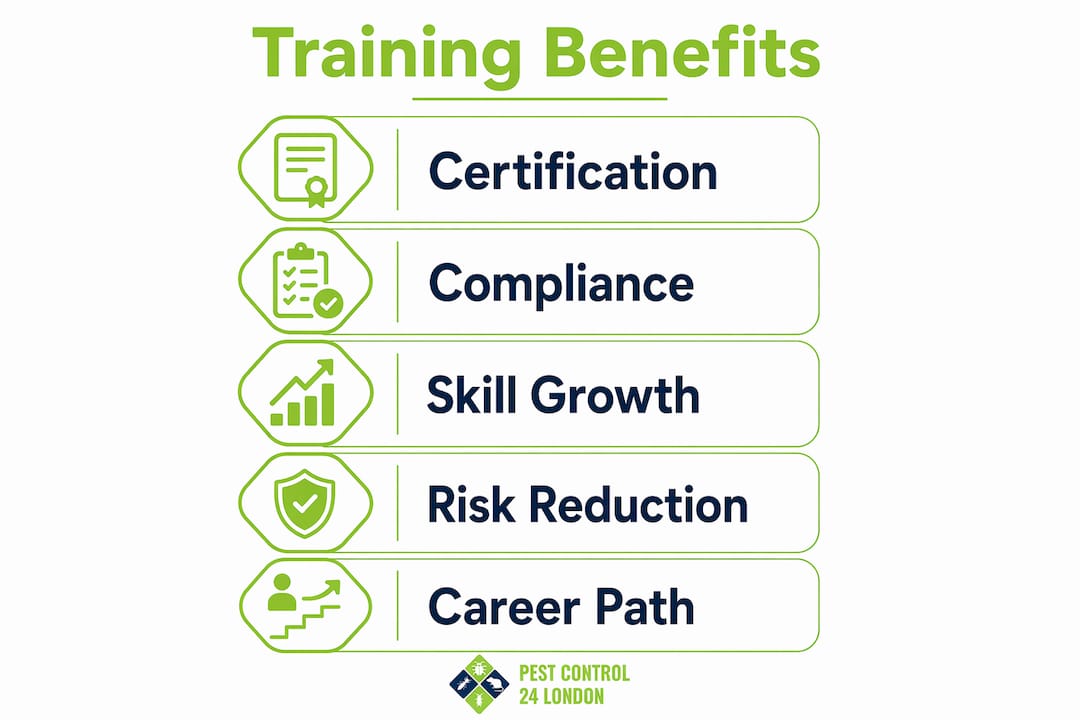
The commercial stakes are significant. Failing to document annual CPD can result in the loss of major contracts, particularly in the food, hospitality, and healthcare sectors where clients routinely audit supplier competency records. A hotel group or restaurant chain will not retain a pest control provider that cannot produce a current training matrix. This is not a soft consideration. It is a hard commercial reality.
The business benefits of a structured CPD programme include:
- Regulatory compliance: Technicians remain current with pesticide legislation and Health and Safety Executive (HSE) guidance
- Risk reduction: Proper training prevents improper pesticide handling, reducing the risk of legal and environmental liability
- Client retention: Commercial clients in food and hospitality sectors require documented proof of ongoing competency
- Reputation building: A business with a visible training culture attracts higher-value contracts and commands greater client trust
- Staff retention: Technicians who receive structured development are more likely to remain with the business long term
Pro Tip: Maintain a training matrix for every technician on your team. Record qualification dates, CPD hours, and renewal deadlines in a single document. Clients in regulated sectors will ask for it, and having it ready signals operational maturity.
What training methods are most effective in modern pest control?
Not all training delivers equal results. The most effective approaches blend theoretical instruction with hands-on, participatory methods. Scenario-based simulations and mock inspections consistently outperform theory-only learning because they replicate the unpredictable conditions technicians face on real sites. A technician who has practised a mock rodent survey in a commercial kitchen is far better prepared than one who has only read about it.

The table below compares the most common training formats used in the industry:
| Training method | Strengths | Limitations |
|---|---|---|
| Classroom and theory | Covers legislation, pesticide chemistry, and identification | Limited real-world application without follow-up practice |
| Online and e-learning | Flexible, cost-effective, accessible for remote teams | Cannot replicate physical inspection or product handling |
| Scenario simulations and mock inspections | Builds decision-making and problem-solving under realistic conditions | Requires experienced facilitators and suitable training environments |
| Mentoring and buddying | Develops site survey skills and infestation root-cause analysis | Dependent on mentor quality; high-turnover businesses often fail to deliver this consistently |
Mentoring deserves particular attention. The critical skill of site survey is primarily acquired through mentoring, not formal coursework. Businesses with high staff turnover frequently produce certified technicians who can pass an exam but cannot reliably identify the root cause of a recurring infestation. Certification confirms knowledge. Mentoring builds judgement. Both are necessary, and neither replaces the other.
For pest control businesses looking to apply current IPM best practices across domestic and commercial sites, training method selection is as important as qualification choice.
How does advanced training shape career progression in pest management?
The transition from Level 2 to Level 3 training represents a fundamental shift in how a technician thinks about their work. At Level 2, the focus is on executing treatments correctly. At Level 3, the focus moves to designing pest management strategies, conducting formal risk assessments, and advising clients on structural and behavioural changes that prevent reinfestation.
Advanced training produces technicians who can take on supervisory and client-facing roles that a business cannot fill with entry-level staff. The skills developed at this level include:
- Formal documentation of pest activity, treatment records, and site risk assessments
- Conducting and interpreting site surveys for complex commercial environments such as food production facilities and healthcare premises
- Advising clients on proofing, waste management, and environmental modifications
- Technical oversight of junior technicians and quality assurance of treatment programmes
- Acting as a public health partner rather than simply a reactive treatment operative
For a pest control business, having staff trained to Level 3 and above is a direct commercial advantage. It enables the business to tender for contracts in regulated sectors, respond to client queries with authority, and reduce dependence on external consultants. Advanced technical roles require training in documentation, risk assessment, and strategic client advice. Businesses that invest in this level of development retain staff longer and win higher-value work.
Key takeaways
Structured training is the single most important factor in determining whether a pest control business operates safely, legally, and competitively in the UK market.
| Point | Details |
|---|---|
| Core certification is mandatory | Level 2 Award in Pest Management and pesticide licensing are legal requirements, not optional credentials. |
| CPD protects commercial contracts | Documented annual CPD is required by food, hospitality, and healthcare clients to retain supplier status. |
| Mentoring builds judgement | Site survey skills and root-cause analysis are developed through mentoring, not formal exams alone. |
| Advanced training opens new revenue | Level 3 qualifications enable supervisory roles, regulated sector contracts, and client advisory services. |
| Training is a business investment | Proper training reduces legal and environmental liability while supporting long-term business growth. |
Training as the backbone of a credible pest control business
From my experience working in and around the pest control industry in London, the businesses that struggle most are not those with the worst equipment or the smallest teams. They are the ones that treat training as a box-ticking exercise rather than a genuine operational priority. A technician with a certificate but no mentoring behind them will misread an infestation nine times out of ten. They will treat the symptom, not the source.
What I have observed at Pestcontrol24london, and what I believe separates credible operators from the rest, is a commitment to embedding training into the culture of the business. That means pairing new starters with experienced technicians from day one, maintaining CPD records without being prompted by a contract renewal, and actively encouraging staff to progress beyond Level 2. The businesses that do this do not just pass audits. They win the contracts that others cannot.
The uncomfortable truth is that many operators underestimate how quickly the industry changes. Pesticide regulations shift. New pest pressures emerge. Client expectations in sectors like hospitality and food retail rise every year. Training is not a one-time event. It is the mechanism that keeps a business relevant, compliant, and trusted.
— Dan
How Pestcontrol24london delivers trained, compliant pest management
Pestcontrol24london has been providing professional pest control across London since 2015, serving hotels, restaurants, takeaways, and residential properties with a team of BPCA fully qualified technicians.

Every technician at Pestcontrol24london operates with current certification and documented CPD, meeting the compliance standards that commercial clients in regulated sectors require. Whether you manage a food business, a hospitality venue, or a residential portfolio, you need a pest control partner whose training credentials are beyond question. Our commercial pest control services are backed by years of hands-on experience and a genuine commitment to ongoing professional development. Contact Pestcontrol24london today to discuss how our trained team can protect your business and your reputation.
FAQ
What qualifications do pest control technicians need in the UK?
The standard entry qualification is the Level 2 Award in Pest Management, awarded by bodies such as the RSPH or BPCA. Technicians handling pesticides must also hold a recognised Certificate of Competence, which requires passing formal written assessments.
Why is CPD important for pest control businesses?
CPD maintains compliance with current legislation and pesticide regulations, and commercial clients in food and hospitality sectors routinely require documented proof of ongoing training before awarding or renewing contracts.
What is the difference between Level 2 and Level 3 pest control training?
Level 2 covers treatment execution and pesticide safety. Level 3 develops strategic skills including risk assessment, formal documentation, and client advisory roles, enabling technicians to take on supervisory and management responsibilities.
How does mentoring improve pest control competency?
Mentoring develops the ability to identify infestation root causes through direct site experience, a skill that formal certification alone does not reliably produce. High-turnover businesses that skip structured mentoring often produce technicians who are certified but not fully competent.
How does training reduce risk for pest control businesses?
Proper training prevents improper pesticide handling, reducing exposure to legal and environmental liability. It also protects businesses from contract loss and reputational damage caused by non-compliant or ineffective treatments.