

Most homeowners only think about pest control after they spot a mouse or find ants trailing across the kitchen counter. That reactive mindset is one of the most costly mistakes a property owner can make. The role of ongoing pest protection goes far beyond treating visible infestations. It is about preventing them from taking hold in the first place, protecting your property’s structure, safeguarding your family’s health, and avoiding the far greater expense of dealing with a full-blown problem after the fact. This article explains exactly why continuous protection matters and what it looks like in practice.
Table of Contents
- Key takeaways
- The role of ongoing pest protection and IPM
- What the research tells us about long-term control
- Practical prevention strategies for homeowners
- Why professional pest control contracts pay off
- My perspective on long-term pest prevention
- Protect your property with Pestcontrol24london
- FAQ
Key takeaways
| Point | Details |
|---|---|
| Prevention beats reaction | Sustained protection stops infestations before they develop, saving significant time and money. |
| IPM is the modern standard | Integrated pest management combines sanitation, exclusion, monitoring, and targeted treatment for lasting results. |
| Evidence backs long-term programmes | Research shows area-wide pest control over 16 to 24 months achieves complete elimination with no re-emergence. |
| Resident cooperation matters | Homeowners and property managers play an active role in keeping preventive measures effective year-round. |
| Professional contracts add measurable value | Certified pest control services provide documentation, compliance support, and customised monitoring that one-off treatments cannot. |
The role of ongoing pest protection and IPM
The industry term for what most people call “ongoing pest protection” is Integrated Pest Management, or IPM. It is the recognised framework used by professional pest controllers and public health authorities worldwide. Rather than reaching for a spray every time a pest appears, IPM addresses the conditions that allow pests to enter, survive, and multiply in the first place.
The core components of a well-run IPM programme include:
- Sanitation: Removing food sources, clearing clutter, and managing waste so pests have no reason to stay.
- Exclusion: Sealing gaps around pipes, doors, vents, and foundations to physically block entry points.
- Structural maintenance: Repairing damaged rooflines, deteriorating wood, and leaking pipes that create harbourage opportunities.
- Environmental monitoring: Regular inspections and recordkeeping to detect early signs of activity before populations grow.
- Targeted treatment: Using chemical controls only when monitoring data justifies it, and selecting the least disruptive option appropriate for the situation.
Relying solely on pesticides without addressing entry points or sanitation is the equivalent of mopping the floor while the tap is still running. Exclusion techniques and structural maintenance are now recognised as indispensable in reducing pest risk, not optional extras. IPM works because it targets the reasons pests are present, not just the pests themselves.
Pro Tip: Keep a simple log of where and when you spot pest activity. Even a basic record helps your pest controller identify patterns and adjust treatment plans more precisely.
What the research tells us about long-term control
The evidence for sustained pest management is compelling, and it goes well beyond anecdote. One of the most persuasive datasets comes from termite research. A study published in Scientific Reports found that area-wide baiting programmes achieved complete termite elimination across a 4.25 km² area within 16 to 24 months, with no re-emergence recorded for at least 15 months afterwards. That result was only possible because the programme was maintained consistently, not abandoned after the first signs of improvement.

The same principle applies to vector pests. Singapore’s Project Wolbachia, which deployed ongoing coverage and surveillance against mosquito populations, delivered dengue risk reductions of over 70% at project sites and 45% in adjacent areas. A one-off intervention would never have produced those results.
| Approach | Typical outcome |
|---|---|
| Reactive treatment only | Short-term reduction; re-infestation common within weeks or months |
| Ongoing professional programme | Sustained elimination; re-emergence prevented through continued monitoring |
| One-off DIY treatment | Partial knockdown; underlying conditions remain unchanged |
| Long-term IPM contract | Documented prevention, compliance support, and adapted strategies over time |
Australia’s updated public health guidance equally stresses pest management as a continuous responsibility, not a seasonal task. The message across all these sources is consistent: sustained prevention and monitoring campaigns produce outcomes that reactive approaches simply cannot match.
Practical prevention strategies for homeowners
Knowing why continuous pest management matters is one thing. Knowing what to actually do is another. The following steps reflect best practice for residential and managed properties throughout the year.
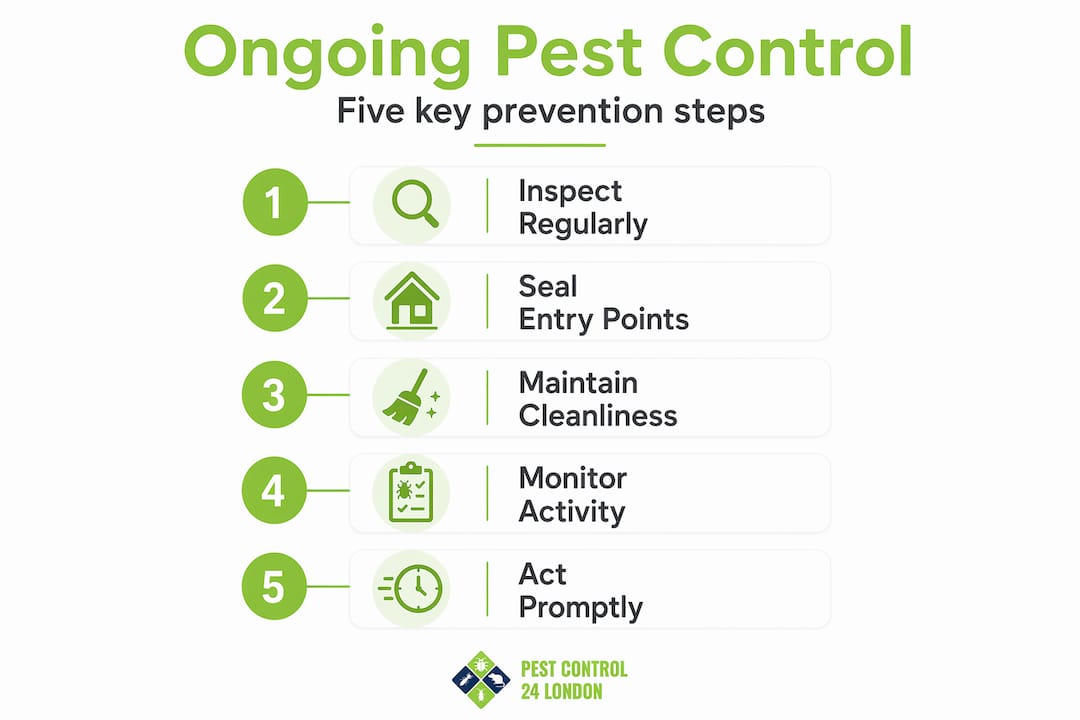
Conduct routine inspections. Walk the perimeter of your property every two to three months. Look for new gaps around pipework, damaged weather seals on doors, and any signs of gnawing, droppings, or larvae. Early detection prevents minor issues from escalating.
Manage waste and food storage rigorously. Keep bins sealed, clean up food debris promptly, and store dry goods in airtight containers. Pests do not remain where there is nothing to eat.
Install and monitor bait stations or traps. These tools serve as an early warning system. If activity is detected, you can respond before a colony or population becomes established. Documented preventive actions and trend analysis are required for compliance in food environments, but the same discipline benefits any property.
Adapt your approach to seasonal risks. Rodents seek warmth in autumn and winter. Wasps peak in late summer. Understanding these cycles lets you focus your efforts when and where they count most. You can find practical guidance on year-round pest management tailored to London properties.
Coordinate with all residents or tenants. Resident cooperation is critical for long-term success. One tenant leaving food waste uncovered or propping open a fire door can undo weeks of professional work. Clear communication about responsibilities makes a measurable difference.
Consistent outdoor maintenance also reduces pest pressure at the property boundary. Preventative landscaping reduces harbourage areas and entry opportunities, complementing the work done inside the building.
Why professional pest control contracts pay off
There is a persistent misconception that professional pest control contracts are an unnecessary expense for properties that are “not that bad.” In reality, the cost of a reactive emergency callout almost always exceeds what a regular preventive programme would have cost over the same period.
A well-structured contract from a certified provider delivers several things that a one-off visit cannot:
- Customised monitoring plans tailored to your property type, pest history, and local risk factors.
- Scheduled visits that catch problems before they become infestations, rather than after.
- Full documentation of inspections, treatments, and outcomes. This is particularly important for landlords, food businesses, and commercial property managers who need to demonstrate compliance.
- Adapted strategies as pest pressures change across seasons or as new risks emerge in your area.
For food businesses and commercial properties, documented IPM compliance is not optional. It is a condition of operating legally. But even for residential properties, having a documented history of preventive treatment protects you if a dispute arises with a tenant or buyer. Understanding pest control contracts before you sign one helps you ask the right questions and choose a provider genuinely suited to your needs.
Pro Tip: When evaluating a pest control provider, ask specifically about their monitoring and documentation process. A professional who cannot explain how they record and review findings is unlikely to deliver sustained results.
My perspective on long-term pest prevention
I have seen the full spectrum in this industry. Homeowners who call us after a small mouse problem has become a colony living inside their walls. Restaurants that waited until an environmental health officer visited before taking pest control seriously. In every case, the cost, the stress, and the disruption were far greater than they needed to be.
What I have learned over a decade of working with properties across London is this: pests do not wait for a convenient moment. Multi-year programmes are genuinely necessary for pests with complex biology, and the homeowners who fare best are the ones who treat prevention as an ongoing responsibility rather than a one-time fix. The mindset shift from reactive to proactive is not complicated. It just takes commitment. And from what I have seen, that commitment always pays off.
— Dan
Protect your property with Pestcontrol24london

Pestcontrol24london has been protecting homes and businesses across London since 2015. As a BPCA fully qualified team, we design ongoing pest protection programmes built around your specific property, pest history, and risk profile. Whether you manage a single home or a portfolio of commercial sites, we offer scheduled monitoring visits, thorough documentation, and rapid response when you need it.
Our domestic pest control services are tailored for homeowners who want genuine year-round peace of mind, not just a quick fix. For businesses, our commercial pest management contracts support compliance and protect your reputation. Contact Pestcontrol24london today for a free quote and find out how a professional, sustained programme can keep your property permanently protected.
FAQ
What is ongoing pest protection?
Ongoing pest protection, known in the industry as Integrated Pest Management (IPM), refers to a continuous programme of inspections, exclusion work, sanitation, monitoring, and targeted treatment designed to prevent infestations rather than simply react to them.
Why is regular pest management better than one-off treatments?
One-off treatments address visible pests but leave underlying conditions unchanged, making re-infestation highly likely. Sustained programmes achieve lasting elimination by removing entry points and food sources while monitoring for early signs of activity.
How often should a professional inspect my property?
For most residential properties, quarterly inspections provide adequate coverage, with additional visits during high-risk seasons. Commercial properties and those with a history of infestation typically benefit from monthly monitoring.
Does ongoing pest control work for all types of pests?
Yes. The IPM framework applies to rodents, insects, and other pests, though the specific tools and timelines vary. Termites, for example, may require multi-year baiting programmes before full elimination is confirmed.
Can homeowners manage ongoing prevention themselves?
Homeowners can contribute significantly through sanitation, waste management, and basic exclusion work. However, professional expertise in monitoring, documentation, and targeted treatment delivers results that self-management alone cannot reliably achieve.