

Spotting a mouse darting behind your kitchen appliances or finding a trail of droppings along your skirting boards is deeply unsettling. For London homeowners and property managers, it is not just an unpleasant surprise — it is a signal that immediate, well-planned action is required. Reacting with the wrong methods can make the problem worse, create legal issues, or put your household’s health at risk. This guide walks you through everything you need: what to prepare, how to remove rodents safely and legally, how to clean up afterwards, and what to do to prevent the problem from returning.
Table of Contents
- What you need before starting rodent removal
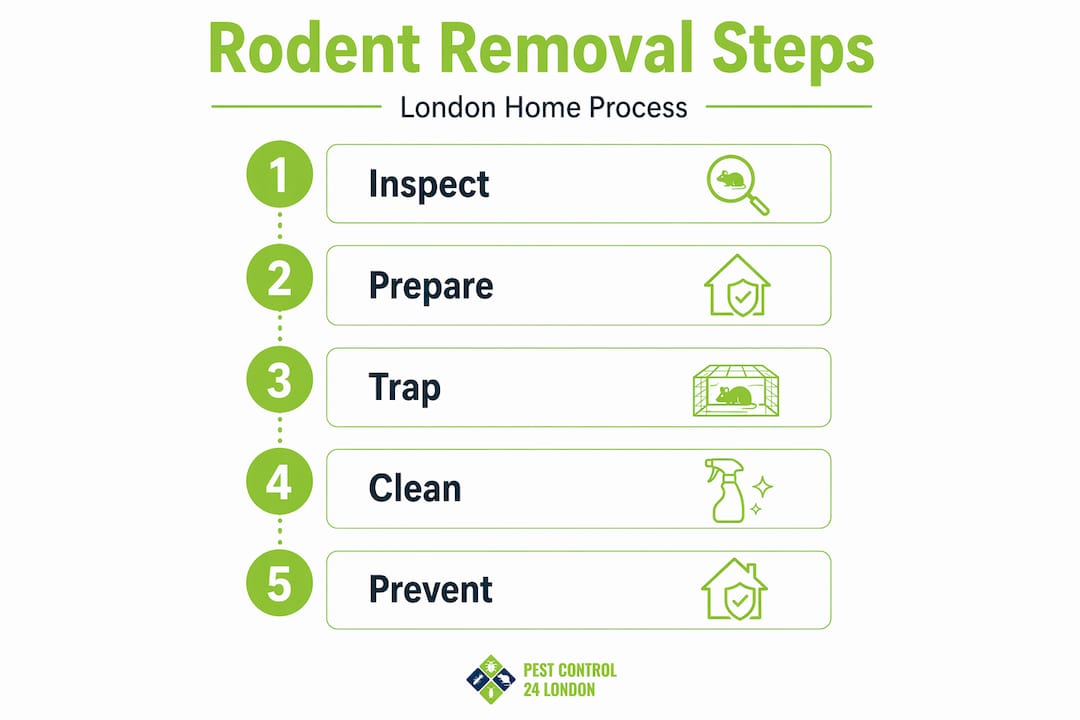
- Step-by-step rodent removal: The effective London method
- Safety and cleaning: Protecting your health during and after removal
- Prevention strategies to keep your London property rodent-free
- The uncomfortable truth most homeowners miss about rodent removal
- Professional rodent removal help for London properties
- Frequently asked questions
Key Takeaways
| Point | Details |
|---|---|
| Prepare thoroughly | Gather proper tools and understand UK regulations before starting rodent removal. |
| Follow safe steps | Use methods like trapping, blocking entry points, and legal baits for the most reliable results. |
| Clean up with care | Use PPE and avoid spreading dust when cleaning droppings to protect health. |
| Prevent repeat problems | Seal up potential entryways and maintain strict hygiene to keep rodents away for good. |
| Call a professional if needed | Persistent infestations or poison use require trained experts for safe, legal control. |
What you need before starting rodent removal
Now that you know why immediate, careful action is key, begin by preparing everything you need before tackling rodent removal.
Before you place a single trap or reach for any product, you need the right equipment and a clear picture of what you are dealing with. Rushing in without preparation is one of the most common mistakes London residents make, and it often leads to wasted money and a prolonged infestation.
Essential equipment checklist:
- Disposable nitrile gloves (heavy-duty, at least two pairs)
- FFP2 or FFP3 dust mask or respirator
- Disposable coveralls or old clothing you can wash at 60°C
- Snap traps or live capture traps (appropriate for mice or rats)
- Rodent bait stations (tamper-resistant for households with children or pets)
- Torch for inspecting dark areas
- Disinfectant spray (bleach-based or specialist rodent disinfectant)
- Heavy-duty refuse sacks for safe disposal
- Sealant, wire wool, and expanding foam for proofing
Once you have your PPE and tools, survey your property methodically. Check under sinks, behind appliances, in loft spaces, and along wall cavities. Look for droppings (dark, rice-shaped pellets for mice; larger and blunter for rats), gnaw marks on woodwork or cables, smear marks (greasy rub marks left along regular pathways), and nesting material such as shredded paper or insulation.
Understanding why rodents invade London homes in the first place helps you identify vulnerable areas. London’s dense terraced housing, ageing infrastructure, and proximity to the underground network create unique entry opportunities that you will not find in more modern suburban properties.
It is important to understand the legal framework before choosing your method. UK biocides regulations govern the use of rodenticides, and stewardship controls are in place to minimise risks to wildlife and non-target animals. Safe, effective rodent control involves using multiple method options — hygiene improvements, physical barriers, traps, and biocidal products — rather than relying on a single tactic alone. Familiarise yourself with the basics of rodent proofing before you begin, so that removal and prevention work together.
| Method | Best used for | Key advantage | Main limitation |
|---|---|---|---|
| Snap traps | Mice and rats indoors | Immediate kill, no poison risk | Requires daily checking |
| Live capture traps | Smaller infestations | Humane, no carcass indoors | Requires swift release or disposal |
| Bait stations | Larger infestations | Targeted, tamper-resistant | Must follow UK stewardship rules |
| Physical proofing | Long-term prevention | Stops re-entry permanently | Labour-intensive initially |
Pro Tip: If you find fresh droppings in more than two separate rooms, or if you hear movement at night across multiple areas of the property, call a professional before attempting DIY removal. This is a sign of an established colony.
Step-by-step rodent removal: The effective London method
With your equipment and preparation sorted, follow these precise steps to solve your rodent problem and see how to choose the right approach for your situation.
Survey and record activity. Walk every room with a torch. Note exactly where you find droppings, gnaw marks, or smear marks. Photograph everything. This baseline record helps you track progress and shows you where to concentrate your efforts.
Remove food sources immediately. Store all food in sealed, hard-sided containers. Move pet food into rodent-proof bins overnight. Clear up crumbs and spillages, and ensure all rubbish is in sealed bins both inside and outside the property.
Block entry points. Gaps as small as 6mm can allow a mouse entry. Fill holes around pipes, cables, and vents with wire wool packed tightly, then secure with expanding foam or sealant. Pay particular attention to areas where utilities enter the building.
Choose your removal method. For most London homes, snap traps placed against walls and in dark corners (where rodents naturally travel) are the most effective and controlled option. Place them perpendicular to the wall, with the trigger end facing the skirting board. Bait with a pea-sized amount of chocolate, peanut butter, or nesting material for mice; for rats, use a small piece of meat or chocolate.
Monitor daily and adapt. Check traps every 24 hours. If a trap is triggered but empty, reposition it. If you notice fresh droppings near an area where no trap is placed, move one there. Consistent monitoring is essential because UK stewardship guidance recommends following up inspections to confirm population reduction.
Dispose of rodents safely. Wear gloves and place dead rodents in a sealed plastic bag, then a second bag. Dispose of them in your general waste bin. Never compost rodent carcasses.
Important: For rodenticide use in the UK, CRRU stewardship is central to responsible practice. Professional access and deployment are governed by training, competence, and best-practice guidelines designed to reduce wildlife exposure. If you are considering poison, using a trained professional is strongly advised.
For persistent activity after one week of trapping, or if you suspect rats in a commercial kitchen or a multi-occupancy building, managing a rodent outbreak requires a different approach. Local councils and industry bodies consistently recommend professional intervention for persistent infestations, particularly where rodenticides and environmental assessments are involved.
Pro Tip: Rats are naturally cautious of new objects in their environment — a behaviour known as neophobia. Leave unset traps in position for two to three days before setting them, so rats become accustomed to them.
Safety and cleaning: Protecting your health during and after removal
Once removal is underway or complete, focus on cleaning safely to protect everyone living at the property.
Rodent droppings and urine carry serious health risks, including Hantavirus, leptospirosis (Weil’s disease), and salmonella. These are not minor concerns — they are genuine hazards that require careful handling, particularly in kitchens or children’s bedrooms.
Safe cleaning procedure:
- Put on gloves, a mask, and coveralls before entering the contaminated area
- Do not vacuum droppings. Vacuuming spreads fine particles into the air where they can be inhaled
- Spray droppings, nests, and urine trails thoroughly with a disinfectant solution (1 part bleach to 10 parts water works well) and leave for five minutes
- Wipe up using disposable paper towels, then place everything directly into a sealed plastic bag
- Wash hands thoroughly after removing gloves, even if the gloves appear intact
Handling rodent droppings should treat all waste as a disease-risk hazard. Dampening before removal and avoiding dust dispersal are the two most important steps for protecting your health.
For serious infestations or if rodents have been active in a kitchen or food preparation area, consider using a professional pest disinfection service to ensure all surfaces meet food safety standards.
Prevention strategies to keep your London property rodent-free
Prevention is just as important as removal. Use these strategies to ensure your hard work pays off and rodents do not return.
- Seal all gaps larger than 6mm in external walls, around pipe work, and under doors using wire wool and sealant
- Store food — including dry goods, cereals, and pet food — in rigid, sealed containers
- Keep bins tightly lidded and positioned away from the building where possible
- Clear garden debris, woodpiles, and overgrown vegetation regularly, as these provide nesting cover
- Carry out a monthly self-inspection: check for new droppings, gnaw marks on cables, and rub marks along walls
- Fit bristle strips to the bottom of external doors and mesh over air bricks and vents
Understanding rodent behaviour and neophobia is genuinely useful here. Rats are intelligent and wary; acclimatising monitoring stations before activating them improves your results significantly. Using multiple control methods together — proofing, hygiene, trapping, and where necessary biocidal products — is consistently more effective than any single approach.
For detailed guidance on making your property structurally resistant to future entry, review these detailed rodent-proofing tips which cover everything from letterbox seals to underground drainage checks.
The uncomfortable truth most homeowners miss about rodent removal
After more than a decade treating rodent infestations across London, from Victorian terraces in Hackney to purpose-built flats in Canary Wharf, there is one pattern we see repeatedly: homeowners declare victory too soon.
A few quiet nights after setting traps and the assumption is that the problem is gone. In reality, the breeding pair may still be present, nesting deeper in the wall cavity or simply avoiding the trap placement. Rodents are not just a nuisance; they are persistent survivors shaped by millions of years of evolution. Hoping the problem has resolved itself is not a strategy.
The second most common failure is incomplete proofing. A homeowner seals the obvious gap under the kitchen unit but misses the void behind the dishwasher or the space around the soil pipe in the bathroom. A mouse needs only a gap the width of a pencil. These partial measures provide false reassurance and allow re-infestation within weeks.
London’s buildings add a further layer of complexity that most pest control guides overlook. Shared party walls in terraced housing, communal bin stores in blocks of flats, and the ageing drainage systems beneath the city mean that even a perfectly treated individual property can be re-invaded from a neighbouring source. In these scenarios, professional guidance on rodent outbreaks — including building-wide inspections and coordinated treatment — is not a luxury; it is the only approach that actually works.
Proactive prevention, carried out consistently across the entire property, is what separates a one-time rodent problem from a recurring infestation. Early intervention truly is crucial — and consistency in follow-up is what makes the difference.
Professional rodent removal help for London properties
If you need absolute peace of mind or find re-infestation likely, professional help is just a click away.
Dealing with a persistent infestation, a complex building layout, or regulated rodenticide use is not something any homeowner should have to navigate alone.

We have been helping London homes and businesses solve rodent problems since 2015, and our BPCA-qualified team understands the unique challenges that London properties present. Whether you are a homeowner in a terraced house, a landlord managing a portfolio of flats, or a business owner in the hospitality sector, our 24/7 pest control service is available when you need it most. We offer tailored solutions for both domestic properties and commercial premises, combining legal, effective removal with long-term prevention strategies. Contact us today for a survey and quotation.
Frequently asked questions
What is the fastest way to get rid of rodents at home?
A combination of trapping, removing food sources, and sealing entry points produces the fastest results. For persistent problems, professional pest control ensures legally compliant removal using multiple methods simultaneously.
Is it safe to use rat poison in residential areas in London?
Rodenticides carry strict safety requirements under UK law. Only trained professionals operating under CRRU stewardship should deploy poison baits, especially in homes with children, pets, or garden wildlife.
How do I clean up after a rodent infestation?
Wear full PPE, dampen droppings and nesting material with disinfectant before removal, and never vacuum. Safe disposal habits prevent the spread of airborne disease particles.
Should I call a professional or try to remove rodents myself?
Small, early-stage problems can sometimes be managed with traps and proofing. However, persistent or widespread infestations require professional control and regulatory compliance, as councils and industry bodies consistently advise.