

The clearest signs that foxes have visited your garden are dark, twisted droppings left on prominent spots, narrow single-file paw prints in soft soil, and patches of disturbed earth where a fox has been digging. You may also find scattered food debris, buried scraps, or partial prey remains near boundaries and under decking. These signs of fox presence in garden settings are easy to miss at first glance, but once you know what to look for, they are unmistakable.
Quick safety steps before you investigate:
- Do not touch droppings with bare hands — wear disposable gloves and wash thoroughly afterwards.
- Keep pets away from areas where scat or carcass remains are present.
- Photograph any tracks, holes, or droppings with a coin or ruler for scale before disturbing them.
- Do not attempt to block any holes or dens until you have confirmed they are unoccupied.
The RSPCA, RHS, and Gov are the most reliable UK sources for fox behaviour, welfare, and legal property protection advice.
Pro Tip: Take photos immediately when you find a sign. Evidence degrades quickly in rain, and a clear photograph with a scale reference is the single most useful thing you can hand to a professional technician.
Key takeaways
The most reliable signs of fox presence in a garden are dark twisted droppings on prominent spots, narrow single-file tracks measuring 4–5 cm, disturbed soil or active dens under sheds, and scattered food debris or prey remains near boundaries.
| Point | Details |
|---|---|
| Identify the key signs | Look for scat, narrow single-file tracks (4–5 cm), digging, food debris, and scent marks. |
| Handle droppings safely | Wear gloves, double-bag scat, disinfect the area, and wash hands to reduce toxocariasis risk. |
| Remove attractors first | Secure bins, switch from bonemeal fertiliser, and seal compost before trying deterrents. |
| Test dens before acting | Cover the entrance lightly and check for disturbance over five days before any proofing work. |
| Pestcontrol24london | BPCA-qualified London technicians for site surveys, humane proofing, and 24/7 emergency callouts. |
Table of Contents
- Common signs of fox presence: your garden walk-round checklist
- How to recognise fox tracks and read their gait
- Fox droppings: what they look like and how to dispose of them safely
- Digging, holes and dens: is a fox foraging or living in your garden?
- Food debris, buried food and prey remains: what feeding signs tell you
- Noises, sightings and timing: when do foxes visit gardens?
- What draws foxes into gardens and the simplest fixes
- Are foxes dangerous? Risks to people, pets and property
- What to do next: your step-by-step action plan
- Field notes from our technicians: what 10+ years of London work has taught us
- Pestcontrol24london: professional fox control in London
- What the experts say: a field perspective on fox activity
- Sources
Common signs of fox presence: your garden walk-round checklist
A systematic walk around your garden, ideally in the morning after a dry night, will reveal most of the key indicators. Urban foxes are active and leave multiple types of evidence, so look for clusters of signs rather than relying on one alone.
- Droppings (scat): Dark, twisted, often with a pointed end; left on raised spots such as molehills, path edges, or the tops of low walls.
- Paw prints: Narrow, oval impressions in soft soil, mud, or sand; typically found along fence lines, under gates, and near compost heaps.
- Digging and scrapes: Small, shallow holes in lawns or borders, or larger excavations near sheds, decking, and boundary fences.
- Food debris: Scattered rubbish from upturned bins, chewed packaging, or food scraps left in the open.
- Buried food caches: Small depressions in soil, often near plant roots or lawn edges, where a fox has hidden food to retrieve later.
- Prey remains: Feathers, fur, or partial carcasses near the garden perimeter or under low-growing shrubs.
- Chewed or gnawed items: Garden hose fittings, rubber toys, or soft furnishings left outside may show tooth marks.
- Scent marks: A strong, musky odour near boundaries, under decking, or around compost bins — particularly noticeable in the breeding season (January to March).
- Visible sightings: Foxes themselves, most commonly seen at dawn or dusk, though urban foxes may appear in daylight. The Woodland Trust notes that urban foxes are often more visible than their rural counterparts.
How to recognise fox tracks and read their gait
Fox paw prints are distinctive once you know their key features. According to PTES field guidance, fox tracks in UK gardens are typically 4–5 cm long, narrow, and oval in shape. They show four toe pads arranged around a compact ‘X’-shaped negative space between the toes and the heel pad. That tight negative space is the most reliable single feature for separating a fox print from a dog print of similar size, where the toes tend to splay more loosely.
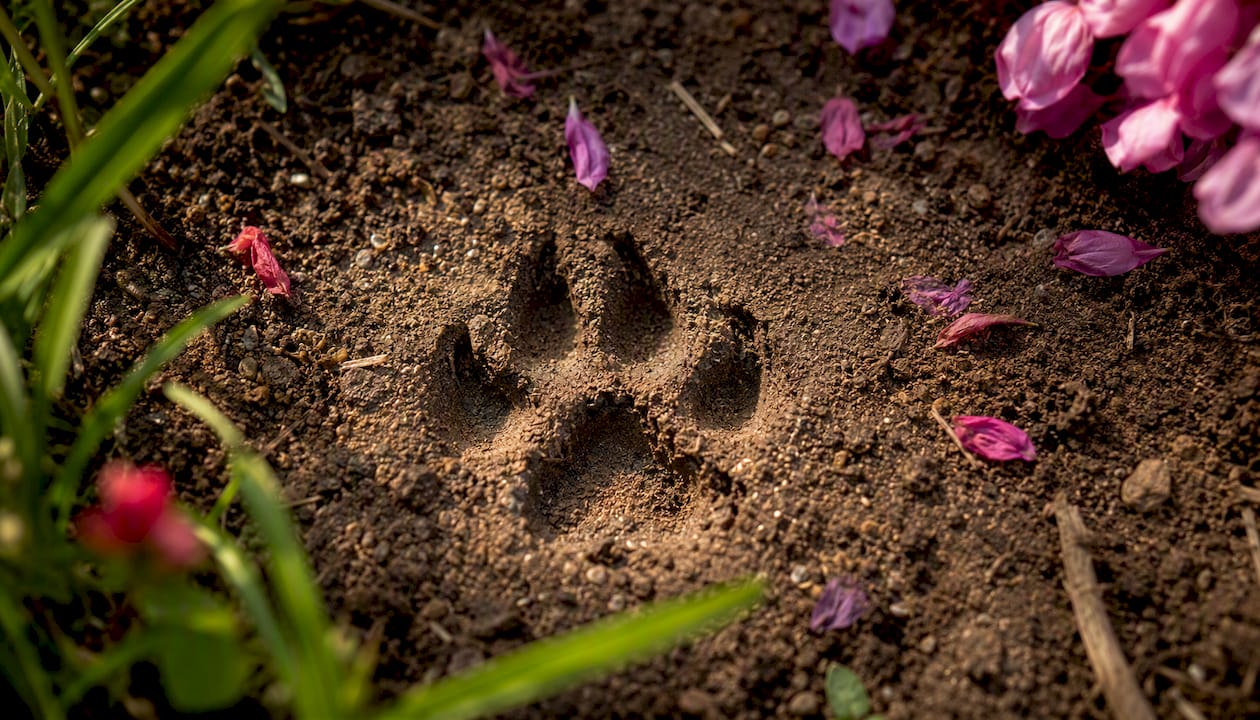
The gait is equally telling. Foxes use a direct-register walk, meaning the hind foot lands in or very close to the impression left by the forefoot. The result is a neat, almost straight line of prints, as if the animal walked along a tightrope. Dog trails, by contrast, tend to meander and show a wider, less regular spacing between prints. The Wildlife Nomad’s field guide explains this distinction clearly and is worth bookmarking for on-site reference.
| Measurement | Typical fox value | Notes |
|---|---|---|
| Track length | 4–5 cm | Narrow, oval shape |
| Track width | Narrower than length | Toes do not splay |
| Negative space | Compact ‘X’ between toes and heel | Key distinguishing feature |
| Stride pattern | Straight, single-file line | Direct-register gait |
| Claw marks | Usually visible | Claws are non-retractable |
Pro Tip: Photograph tracks from directly above with your phone camera, then place a coin or ruler in the frame for scale. A second photo taken at a low angle, with raking light, shows the depth and claw detail far more clearly than a straight-down shot.
Fox droppings: what they look like and how to dispose of them safely
Fox scat is one of the most reliable signs of urban fox activity. The typical dropping is a twisted, sausage-shaped cylinder with a pointed or tapered end, dark brown to black in colour, and often containing visible fragments of fur, bone, insect remains, or berry seeds depending on the season. PTES field guidance notes that droppings can reach up to around a dozen centimetres in length, though most are shorter, and the contents vary considerably with diet.
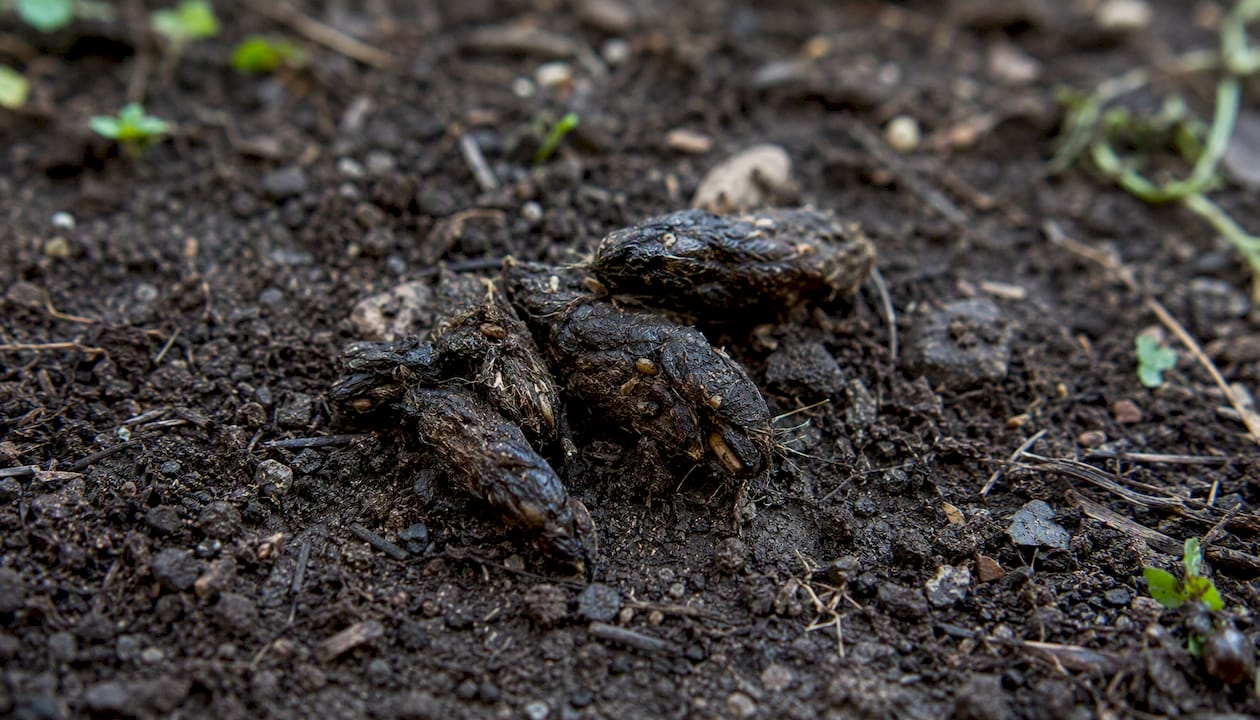
Foxes tend to deposit scat on prominent, elevated spots: the tops of molehills, path junctions, garden steps, dustbin lids, and low walls. This is territorial marking behaviour, not random. Fresh droppings have a strong, musky odour; older ones dry out, lighten in colour, and crumble.
Safe disposal: step-by-step
- Put on disposable gloves and, if available, a dust mask before approaching the area.
- Use a plastic bag turned inside out to pick up the dropping, then seal the bag.
- Double-bag and place in your general waste bin — not the compost.
- Disinfect the area with a diluted household disinfectant and allow to dry.
- Wash your hands thoroughly with soap and water for at least 20 seconds, even after wearing gloves.
- If children or pets have been in contact with the area, wash their hands or paws and seek medical or veterinary advice if there is any concern.
Roundworm eggs (Toxocara species) found in animal faeces can pose a health risk to humans, particularly children, and can survive in soil for extended periods. NHS guidance on toxocariasis recommends careful hygiene after handling soil or droppings from wild animals.
Garden Wildlife Health also monitors wildlife-borne pathogens in UK gardens and supports cautious handling of any carcasses or droppings found outdoors.
Digging, holes and dens: is a fox foraging or living in your garden?
Not every hole in your garden means a fox has moved in. Small, shallow scrapes — typically 5–10 cm across and a few centimetres deep — are foraging marks left by a fox hunting earthworms, beetles, or cached food. They appear randomly across lawns and borders and are usually solitary.
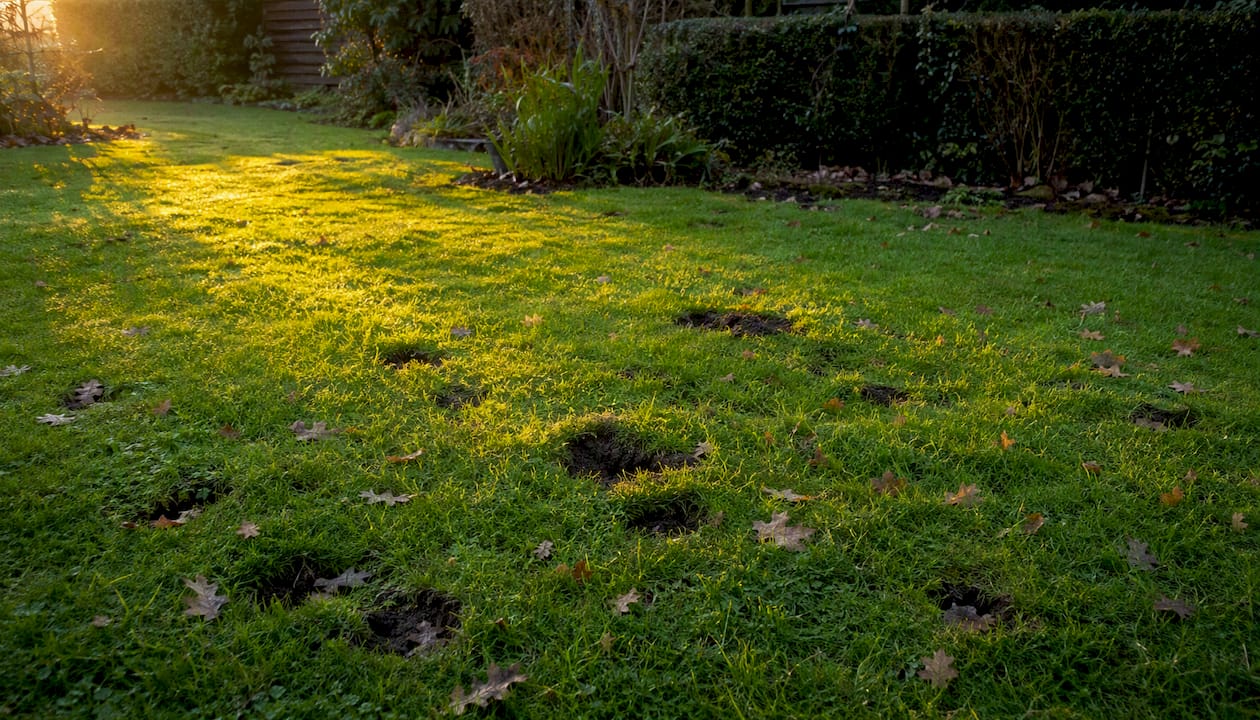
A fox earth (den) looks quite different. The entrance is larger, often 20–30 cm across, with a mound of excavated soil to one side. It is usually sited under a shed, decking, a dense hedge, or in a sheltered bank. You may notice a worn track leading to the entrance, a strong musky odour, and scattered food remains or fur nearby.
How to test for occupancy safely:
- Lightly cover the entrance with loose sticks or a thin layer of soil.
- Check the covering every 24 hours for three to five days.
- If the covering is disturbed, the earth is active.
- If undisturbed after five days, it is likely unoccupied.
The RSPCA advises strongly against blocking or sealing a den until you have confirmed it is empty. Blocking an active earth, particularly in spring when cubs may be present, causes serious welfare harm and may have legal implications under wildlife protection legislation.
The best time to act on an unoccupied earth is late summer or early autumn, after cubs have dispersed. If you find an active den with cubs, or if a fox appears injured or behaving abnormally, call the RSPCA (0300 1234 999) rather than attempting to intervene yourself.
Food debris, buried food and prey remains: what feeding signs tell you
Scattered rubbish near your bins, small depressions in lawn edges, and patches of feathers or fur are all feeding signs. Each tells you something specific about fox behaviour and, more usefully, about what is attracting the animal to your garden.
- Raided bins: Upturned or gnawed bin bags are a strong indicator. Foxes are persistent and will return nightly if a food source remains accessible.
- Buried food caches: Foxes cache surplus food by digging small holes and covering them. You may find these near plant roots, along fence lines, or in soft lawn areas. Repeated caches in the same zone suggest a regular visitor.
- Prey remains: Partial carcasses of birds, rabbits, or small rodents, along with scattered feathers or fur, are left near earths or along regular routes.
- Egg shells: Foxes raid ground-nesting birds and will carry eggs some distance before eating them.
Caching is normal fox behaviour, not a sign of an infestation. A fox buries food to return to it later, much as a squirrel does with nuts. The practical implication is that if you remove the cached food, the fox will often return to look for it, which can increase digging activity temporarily.
Pro Tip: The RHS recommends switching from bonemeal or dried-blood fertilisers to non-meat-based alternatives as one of the most effective ways to stop repeated digging. Foxes are strongly attracted to the smell of meat-based fertilisers and will dig up recently treated beds repeatedly until the scent fades.
Noises, sightings and timing: when do foxes visit gardens?
Foxes are primarily crepuscular, meaning they are most active around dawn and dusk. In urban areas, however, they adapt readily to human activity patterns and may be seen at almost any hour. A fox moving through your garden at midday is not necessarily sick or dangerous; it may simply be a younger animal or one that has learned your neighbourhood’s rhythms.
The sounds foxes make are distinctive and often alarming to those who have not heard them before.
Breeding season vocalisations peak between December and February, which is also when foxes are most active and visible in urban gardens.
A simple sighting log helps you build a picture of visit frequency and decide whether you are dealing with a passing animal or a regular resident:
| Field | What to record |
|---|---|
| Date | Day and month |
| Time | Approximate time of sighting or sound |
| Location in garden | Near shed, along fence, in lawn area, etc. |
| Sign observed | Droppings, tracks, digging, sighting, noise |
| Notes | Weather, any unusual behaviour |
Three or more entries in the same location within a week suggests a regular pattern worth acting on.
What draws foxes into gardens and the simplest fixes
Foxes enter gardens for three reasons: food, shelter, and water. Remove those attractors and most fox activity resolves without further intervention.
Common attractors:
- Unsecured wheelie bins or bin bags left outside overnight.
- Pet food left in the garden, including bowls of water that also attract foxes.
- Compost heaps containing cooked food scraps or meat.
- Blood and bonemeal fertilisers, which smell strongly of meat to a fox.
- Sheltered spaces under sheds, decking, or dense conifers that offer denning sites.
- Bird feeders that drop seed and attract the small mammals foxes prey on.
Do/don’t checklist:
- Do use fox-proof bin clips or bungee cords on wheelie bin lids.
- Do bring pet food bowls indoors at dusk.
- Do switch to plant-based fertilisers if you use bonemeal or dried blood.
- Do use a sealed, rodent-proof compost bin rather than an open heap.
- Do consider boundary fencing options designed to keep animals out, particularly for vegetable plots or poultry runs.
- Don’t put cooked food, meat, or fish in an open compost heap.
- Don’t leave fallen fruit on the ground for extended periods.
- Don’t deliberately feed foxes, even if they seem friendly — it encourages dependency and bolder behaviour.
Pro Tip: Securing your compost and switching fertiliser type costs nothing and often resolves persistent digging within a few weeks, without any deterrent sprays or devices.
Are foxes dangerous? Risks to people, pets and property
Foxes in the UK do not carry rabies. The realistic risks are low but worth understanding clearly.
Risks to people: Foxes rarely approach humans aggressively. The main health concern is indirect: contact with droppings or contaminated soil can expose people to Toxocara roundworm eggs, as noted in NHS toxocariasis guidance. Children playing in affected areas are most at risk. Bites are rare but do occur, usually when a fox is cornered, sick, or has been hand-fed and lost its natural wariness.
Risks to pets: Small pets left unsupervised outdoors, particularly rabbits and guinea pigs in flimsy hutches, are vulnerable. Cats generally hold their own against foxes, but kittens and elderly cats can be at risk. Dogs are rarely threatened by a fox, though a bite is possible if the animals come into direct conflict.
The RSPCA advises that a fox behaving unusually — approaching people without provocation, moving erratically, or appearing disorientated — should be reported to them rather than approached. This behaviour can indicate mange or another illness.
Safety steps:
- Supervise small pets outdoors, especially at dawn and dusk.
- Ensure rabbit and guinea pig hutches have secure, fox-proof latches and wire mesh.
- Do not approach or attempt to handle a fox that appears sick or injured.
- If a person or pet is bitten, seek medical or veterinary advice promptly and report the incident to the RSPCA.
- Wash hands after any contact with soil in areas where fox activity has been confirmed.
Garden Wildlife Health provides surveillance data on wildlife diseases in UK gardens and is a useful reference if you find a dead or visibly unwell fox.
What to do next: your step-by-step action plan
Once you have identified signs of fox activity, a clear sequence of actions will resolve most situations without professional intervention.
Ordered steps:
- Document the evidence. Photograph all signs (tracks, droppings, holes) with a scale reference and note the date, time, and location.
- Remove attractants. Secure bins, bring in pet food, switch fertiliser, and seal your compost heap.
- Check for an active den. Use the stick-and-soil occupancy test described above before taking any action near holes.
- Try humane deterrents. Motion-activated lights or sprinklers, citrus peel near entry points, and commercial fox repellent sprays can discourage casual visits.
- Monitor for repeat signs. Keep your sighting log for two to three weeks after making changes.
- Consider physical proofing. For persistent entry, landscaping with appropriate fencing can provide a long-term solution for vegetable plots and poultry areas.
Call a professional when:
- You find an active den with cubs, particularly between March and June.
- A fox is showing persistent daytime boldness, approaching people, or behaving erratically.
- Poultry or small pets have been repeatedly attacked despite hutch improvements.
- A fox appears visibly ill (mange, disorientation, laboured movement).
- Droppings or den activity are present in a high-use area such as a children’s play space.
GOV.UK guidance confirms that non-lethal protective measures are the recommended first response for householders. A BPCA-qualified technician will carry out an entry-point survey, assess whether a den is active, and advise on proofing options before recommending any removal. You can read more about what to expect from a professional pest control visit to understand how the process works.
Field notes from our technicians: what 10+ years of London work has taught us
The most common mistake we see is homeowners continuing to use bonemeal or dried-blood fertiliser on their borders while wondering why foxes keep digging up the same beds. The smell of those fertilisers is extraordinarily attractive to foxes, and no deterrent spray will compete with it. Switch the fertiliser, and the digging usually stops within two to three weeks.
The second most common issue is an open or poorly sealed compost heap. Cooked food scraps in an open heap are, from a fox’s perspective, a free meal left out every night. A sealed, rodent-proof compost bin removes the attraction entirely and also reduces the risk of rats, which is a separate but related problem worth addressing at the same time.
When our BPCA-qualified technicians attend a property, the first thing they do is a walk-round entry-point survey: checking under sheds and decking for den signs, looking for worn tracks along boundaries, and identifying the specific attractors present. In the majority of cases, the advice is homeowner-led: remove the attractors, proof the access points, and monitor. A booked removal or proofing installation is only necessary when a den is confirmed active, when proofing requires specialist equipment, or when the situation involves a health or safety risk that the homeowner cannot safely manage.
One detail that surprises many clients: a single set of fox tracks or a few droppings does not mean a fox lives in your garden. As the RSPCA notes, many signs are left by passing animals. The sighting log and occupancy test are the tools that tell you whether you have a resident or a visitor, and that distinction changes everything about how you respond.
Pestcontrol24london: professional fox control in London
When the signs point to an active den, repeated attacks on pets, or a health risk from droppings in a high-use area, the fastest and safest route is a professional assessment.

Pestcontrol24london has been handling urban fox situations across London since 2015. Our BPCA-qualified technicians carry out a full site survey, confirm den occupancy using welfare-safe methods, and advise on humane proofing under sheds and decking. Where sanitisation is needed after droppings contamination, we handle that too. Every job follows RSPCA welfare guidance and current legal requirements for wildlife handling. We offer 24/7 emergency callouts for urgent situations and free quotes for all fox control and proofing work. Request a free quote or book an emergency callout today and have a BPCA-qualified technician assess your property.
What the experts say: a field perspective on fox activity
The conventional wisdom on foxes in gardens tends to swing between two unhelpful extremes: either they are harmless wildlife that should be welcomed, or they are a persistent nuisance requiring immediate removal. Neither framing serves homeowners well.
The more useful lens is behavioural: a fox is an opportunist. It is in your garden because something there is worth the visit. In the vast majority of cases, that something is a food source the homeowner does not realise they are providing. Bonemeal in the borders. An unsecured bin. A compost heap with kitchen scraps. Remove the attractor, and the fox moves on. No deterrent, no removal, no drama.
Where this changes is when a den becomes established, particularly one with cubs. At that point, the fox is not visiting; it has committed. The welfare and legal considerations become more complex, and the homeowner’s options narrow. That is when a professional assessment genuinely earns its cost, not because removal is necessarily the answer, but because the occupancy test, the entry-point survey, and the proofing plan need to be done correctly the first time.
The other thing worth saying plainly: most people who call us about foxes do not need a removal service. They need someone to walk the garden with them, identify the attractors, and explain what to change. That is a conversation worth having before the situation escalates.
Sources
Before attempting to block a den or take any invasive action, consult these authoritative UK resources:
- Foxes in the garden: how to help or deter them – RSPCA
- Foxes in the Garden: Tips for Coexistence | RHS
- Spotting wild mammals (PTES)
- Gov
- Toxocariasis – NHS