

Pest control advisors (PCAs) are licensed professionals who deliver expert consultation on pest identification, risk assessment, and treatment planning. Their role differs fundamentally from that of a pest control technician. Where technicians carry out inspections and apply treatments, advisors provide the strategic guidance that determines whether any treatment is needed at all. Pestcontrol24london, BPCA fully qualified and operating across London since 2015, works within this advisory framework to deliver pest management that is both effective and proportionate. Understanding what advisors do helps you make better decisions about protecting your property.
What is the role of pest control advisors?
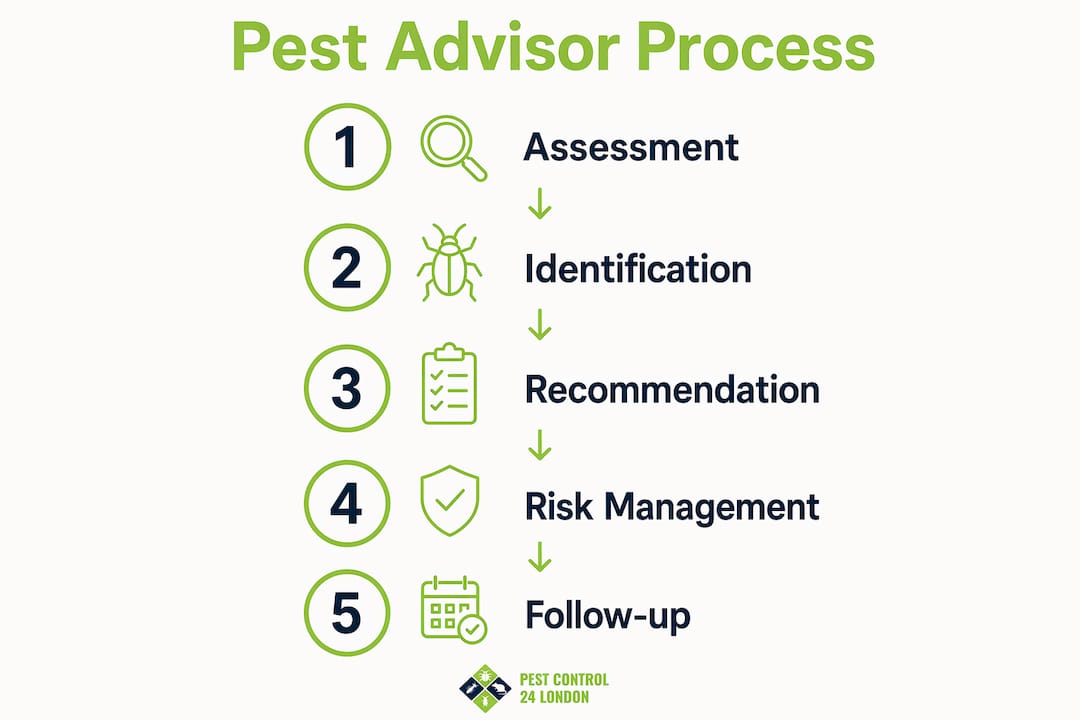
The role of pest control advisors centres on consultation, not application. Advisors assess pest pressure, diagnose the underlying causes of infestations, and produce written recommendations that guide treatment decisions. In agricultural settings, PCAs conduct scouting three to four times per week, covering 100% of harvested acreage for crops such as leafy vegetables. That frequency reflects how seriously the profession takes accurate, real-time data.

In urban and commercial pest management, the same principle applies. An advisor does not arrive, spray, and leave. They investigate why an infestation is occurring, whether that is a structural gap, a drainage issue, or a change in building use. Effective pest consultancy is a decision-making system that addresses the cause of an infestation, not just its symptoms.
The core duties of pest control experts include:
- Field scouting and monitoring: Systematic inspection of the property or site to record pest activity, population levels, and entry points.
- Written treatment recommendations: Formal, legally distinct documentation that specifies what action to take, when, and why.
- Risk assessment: Evaluating the cost, environmental impact, and necessity of any proposed treatment before it is authorised.
- Prevention planning: Advising on proofing, habitat modification, sanitation, and structural changes that reduce long-term pest pressure.
- Client education: Building the client’s own ability to spot early warning signs and respond appropriately.
Pro Tip: Before your first advisory visit, document any pest sightings with dates, locations, and photographs. This history gives the advisor a baseline and speeds up accurate diagnosis considerably.
How do pest control advisors manage pesticide use and environmental risk?
A common concern is that advisors paid on commission will recommend more pesticide use than necessary. A February 2026 UC Davis study directly addresses this. Growers advised by PCAs use equal or less pesticide than those without advisory support. That finding matters because it shows advisors act as risk managers, not sales agents.
“Different pesticide use patterns reflect growers’ and PCAs’ risk tolerance, not sales pressure. Advisors focus on sustainable pest management rather than pesticide volume due to reputational and long-term client success incentives.”
This risk management mindset is what separates quality advisory services from reactive treatment. An advisor weighs the cost of intervention against the cost of inaction, the likelihood of resistance developing, and the potential for environmental harm. Over-treatment creates pesticide resistance in pest populations, which makes future infestations harder and more expensive to control.
Correct pest identification is the most critical stage in this process. Misidentifying a pest species leads to treatments that fail, money wasted, and unnecessary chemical exposure. A qualified advisor identifies the species, understands its biology and behaviour, and selects the most targeted intervention available.
Why does specialised training and licensing matter?
Pest control advisors hold formal qualifications that technicians are not required to have. In regulated markets, PCAs must hold a university degree in a relevant life science and pass state licensing examinations. Continuing education is mandatory to maintain that licence. The formal written recommendations PCAs produce are legally distinct documents, not informal notes.
In the United Kingdom, the British Pest Control Association (BPCA) sets the professional standard. BPCA qualification requires structured training, assessed competency, and ongoing professional development. Pestcontrol24london holds full BPCA qualification, which means every advisory recommendation meets a recognised national standard.
The training process covers:
- Pest biology and identification: Understanding the life cycles, habitats, and behaviours of target species.
- Treatment science: Knowledge of pesticide chemistry, application methods, and resistance management.
- Legal compliance: Awareness of the Control of Pesticides Regulations, Health and Safety at Work Act, and relevant environmental legislation.
- Integrated Pest Management (IPM): A structured approach that prioritises prevention, monitoring, and targeted treatment over routine chemical application.
- Emerging threats: Ongoing training covers new invasive species, resistance patterns, and updated treatment technologies.
This depth of knowledge is what allows an advisor to make a confident, defensible recommendation. You can read more about the value of professional training in pest control and how it directly affects treatment outcomes.
How can you work effectively with a pest control advisor?
Getting the most from pest control advisory services requires preparation and active participation. Advisors work best when clients share full context about the property, its history, and any previous treatments. A restaurant that has had recurring rodent activity, for example, should provide records of where activity was found, what was done, and whether it recurred.
Practical steps to get the most from an advisory relationship:
- Share your property history: Previous infestations, treatments, structural changes, and any known entry points all inform the advisor’s assessment.
- Act on written recommendations promptly: Delays between recommendation and action allow pest populations to grow. Written advice has a time context.
- Involve your staff or household members: Advisors who educate client staff on early identification and habitat modification reduce the need for emergency interventions over time.
- Ask about qualifications: Verify BPCA membership or equivalent licensing before engaging any advisor.
- Request follow-up visits: A single inspection rarely tells the full story. Monitoring over time produces more accurate data and better outcomes.
Pro Tip: Ask your advisor to walk through the property with you and explain what they are looking for. This builds your own knowledge and makes future monitoring far more effective.
Businesses in particular benefit from avoiding common pest control mistakes that arise from reactive rather than advisory-led management. Property safety checks, including portable appliance testing, often run alongside pest surveys in commercial premises, as both address underlying maintenance risks that attract pests.
Key takeaways
Pest control advisors deliver the most value when clients treat them as risk managers rather than reactive treatment providers.
| Point | Details |
|---|---|
| Advisors versus technicians | Advisors provide formal written recommendations; technicians carry out inspections and apply treatments. |
| Pesticide use evidence | A 2026 UC Davis study shows PCAs do not increase pesticide use. They reduce or maintain it. |
| Training and licensing | BPCA qualification and equivalent licences require formal study, assessed competency, and ongoing development. |
| Correct identification | Misidentifying a pest species wastes money and increases unnecessary chemical exposure. |
| Client collaboration | Sharing property history and involving staff improves advisory outcomes and reduces long-term pest pressure. |
What I have learned from a decade of pest advisory work
The biggest shift I have seen over ten years in this industry is the move away from the idea that pest control means spraying something. Clients used to call expecting a technician to arrive with a product. Now, the best outcomes come from a conversation first. What changed? Mostly, trust.
When a client understands that the advisor’s job is to protect them from unnecessary cost and chemical exposure, not to sell treatments, the relationship changes completely. I have seen businesses cut their annual pest control spend significantly by following advisory-led prevention plans rather than booking reactive treatments every time something appears.
The misconception I still encounter most often is that advisors and technicians are interchangeable. They are not. An advisor who spots a drainage issue behind a commercial kitchen as the real cause of a rodent infestation saves that client months of repeated treatments. That diagnostic thinking is what formal training produces. It cannot be replicated by experience alone without the underlying knowledge base.
My honest view is that the industry still undervalues the advisory function. Clients who invest in proper consultation, rather than just treatment, consistently achieve better long-term results. Early intervention, grounded in accurate identification and risk assessment, is always less expensive than managing an established infestation.
— Dan
Pestcontrol24london: professional pest advisory services in London
Pestcontrol24london has provided professional pest control across London since 2015, working with hotels, restaurants, commercial premises, and residential properties. The team holds full BPCA qualification and approaches every case with the same advisory rigour described throughout this article.

Whether you need a full pest survey, a written management plan, or a rapid response to an active infestation, Pestcontrol24london offers 24/7 availability and free quotes. Businesses can access dedicated commercial pest management services tailored to the specific compliance and operational demands of London’s commercial sector. Contact Pestcontrol24london to arrange an assessment and get a clear, evidence-based plan for your property.
FAQ
What is the difference between a pest control advisor and a technician?
A pest control advisor provides formal written recommendations based on rigorous scouting and risk assessment. A technician carries out inspections and applies treatments, typically managing 10–15 properties daily.
Do pest control advisors recommend more pesticides to earn commission?
A 2026 UC Davis study found that growers advised by PCAs use equal or less pesticide than those without advisory support. Commission-driven over-treatment is not supported by the evidence.
What qualifications should a pest control advisor hold?
In the UK, BPCA qualification is the recognised professional standard. It requires formal training, assessed competency, and ongoing continuing education to maintain.
How often should a pest control advisor visit a property?
Visit frequency depends on the property type and pest pressure. In high-risk commercial settings, regular monitoring visits are standard. Residential properties typically require periodic inspections aligned with a written management plan.
Why is correct pest identification so important?
Misidentifying a pest species leads to treatments that fail, wasted expenditure, and unnecessary chemical exposure. Accurate identification is the foundation of every effective pest management plan.