

Effective pest prevention in schools starts with education, not pesticides. When staff, pupils, and governors understand how pests enter buildings, what attracts them, and how to report sightings promptly, the conditions that allow infestations to take hold are removed before a professional treatment is ever needed. Three actions you can take today:
- Brief all staff on what to report and who to contact when they spot signs of pest activity.
- Remove food attractants by enforcing covered bins, sealed storage, and no food outside designated areas.
- Start a sighting log so every observation is recorded, dated, and acted on.
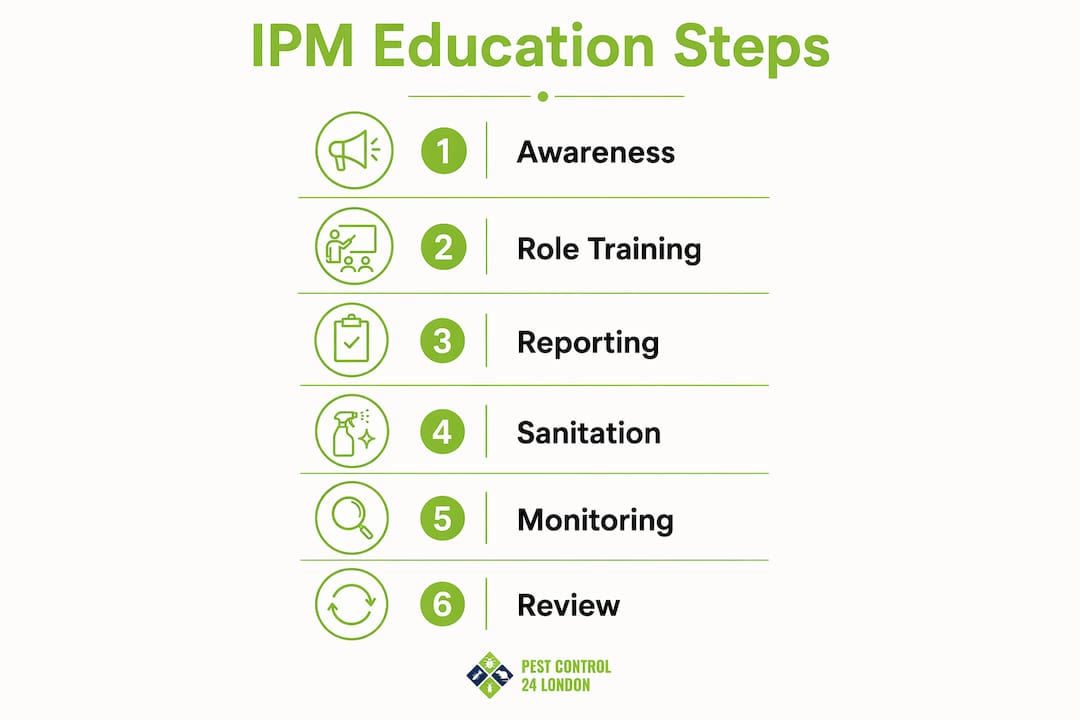
The sections below map each of these principles onto the six steps of Integrated Pest Management (IPM), giving you a practical framework to build or strengthen your school’s pest prevention programme.
Table of Contents
- 1. Why education sits at the heart of integrated pest management
- 2. What are the measurable benefits of an education-led prevention programme?
- 3. What should you teach each role group? A practical training guide
- 4. What policies and procedures should underpin your training programme?
- 5. Everyday prevention: sanitation, exclusion, and waste management in school settings
- 6. What are UK schools legally required to do about pest control?
- 7. A 30–90 day action plan to launch your IPM education programme
- 8. How do you measure whether your pest prevention programme is working?
- 9. What does the research say about training gaps in school pest management?
- Key takeaways
- Why the conventional wisdom on school pest control gets it backwards
- Pestcontrol24london: professional pest management for London schools and colleges
- Useful sources and further reading
1. Why education sits at the heart of integrated pest management
Integrated Pest Management is a structured, evidence-based approach to controlling pests that prioritises prevention over reactive treatment. Rather than reaching for a spray at the first sign of a mouse, IPM works through a repeating cycle of six steps: inspection, monitoring, record-keeping, sanitation, exclusion, and targeted controls. The EPA’s school IPM guidance frames education as a thread running through every one of those steps, not a bolt-on extra.
Here is how education changes what people actually do at each stage:
- Inspection — Trained staff know what signs to look for (droppings, gnaw marks, grease trails) and where to check, so inspections are thorough rather than cursory.
- Monitoring — Awareness of pest behaviour means staff notice changes between formal inspections and flag them early.
- Record-keeping — When people understand why logs matter, they complete them consistently rather than treating paperwork as an afterthought.
- Sanitation — Catering and cleaning staff who understand pest biology make different choices: covered bins, prompt spill clean-up, sealed food storage.
- Exclusion — Maintenance teams who can identify entry points (gaps around pipes, broken door seals, uncovered drains) report and fix them before pests exploit them.
- Targeted controls — Educated staff do not reach for retail pesticide sprays, which can interfere with professional treatments and make future control harder. They call the designated coordinator instead.
Statistic: Research published in the Journal of School Health found that only 56.1% of schools required custodial or maintenance staff to receive training on pest management practices that limit pesticide use — meaning nearly half of schools leave their first line of defence untrained.
The shift from reactive pest control to sustained pest management does not happen through a single treatment visit. It happens when the people who occupy a building every day understand their role in keeping pests out.
2. What are the measurable benefits of an education-led prevention programme?

The business case for investing in pest prevention education is straightforward, and the benefits fall across three areas.
Health and safety gains:
- Reduced exposure to pests such as cockroaches and rodents, which are known triggers for asthma and allergic reactions in children.
- Fewer pesticide applications on site, lowering chemical exposure for pupils and staff.
- Earlier detection means smaller infestations, which require less intensive treatment.
- Cleaner food preparation areas reduce the risk of contamination and food-borne illness.
Operational and financial gains:
- Fewer emergency callouts, which are significantly more expensive than scheduled prevention visits.
- Reduced downtime: a serious infestation can close a kitchen or classroom for days.
- Lower long-term treatment costs, because prevention is consistently cheaper than cure.
- Documented training and logs support compliance during local authority or Ofsted inspections.
Educational environment gains:
The link between a clean, pest-free environment and pupil wellbeing is well established. Pest activity in classrooms causes disruption, anxiety, and in serious cases, absence. Research on school IPM implementation shows that schools with stronger IPM practices conduct more regular inspections and communicate more consistently with families, both of which reduce the likelihood of an infestation reaching a disruptive scale.
Statistic: The same study found that only 35.6% of schools notified staff, students, and families prior to each pesticide application — a gap that education-led programmes close by making communication a standard procedure rather than an afterthought.
The advantages of a pest-free environment extend well beyond comfort: they directly affect health outcomes, attendance, and the school’s duty of care.
3. What should you teach each role group? A practical training guide
Training works best when it is role-specific. A catering assistant needs different knowledge from a class teacher or a school governor. The following module outlines give you a starting point for each group.
1. Custodial and maintenance staff (60-minute session)
Learning objective: Identify the top five pest entry points on site and know the reporting procedure.
Core topics: recognising signs of rodents, cockroaches, and stored-product insects; checking door seals, pipe penetrations, and drain covers; completing a sighting log correctly; understanding why personal retail pesticide sprays must not be used on site.
Delivery: Toolbox talk with a site walk-through. Repeat termly.
2. Catering and kitchen staff (45-minute session)
Learning objective: Apply food hygiene and storage practices that remove pest attractants.
Core topics: airtight food storage; bin management and cleaning schedules; spill response; reporting any sightings in food preparation areas immediately. The role of housekeeping in pest management is particularly relevant here, as kitchen hygiene is the single greatest driver of pest activity in school buildings.
Delivery: Induction module for new starters, refresher annually.
3. Teaching and administrative staff (20-minute session)

Learning objective: Know what to report, how to report it, and what not to do.
Core topics: recognising common signs (droppings, gnaw marks, unusual odours); the single contact point for reporting; why staff should not bring in or use retail pesticide products; keeping classroom food (packed lunches, snacks) in sealed containers.
Delivery: Staff briefing at the start of each academic year, with a one-page reminder posted in staff rooms.
4. School governors (30-minute briefing)
Learning objective: Understand the school’s legal obligations and governance responsibilities for pest prevention.
Core topics: overview of IPM policy and the school’s duty of care; review of inspection and treatment logs; budget allocation for prevention versus reactive treatment; oversight of the IPM coordinator role.
Delivery: Annual governor briefing, with a written summary for the minutes.
5. Pupils (lesson tie-in, 20–40 minutes, adapted by age)
Learning objective: Understand how their daily behaviour affects pest risk.
Core topics: why food waste and litter attract pests; proper bin use; not storing food in lockers or desks; reporting unusual sightings to a teacher. Curriculum links to science (pest biology), PSHE (health and environment), and geography (urban ecosystems) make this easy to embed without adding a separate lesson.
Delivery: Class lesson or assembly, with follow-up activities for younger pupils.
Pro Tip: Make reporting frictionless by placing a simple photo-enabled sighting log near the kitchen, bin store, and main plant room. A single email address or phone number for the IPM coordinator, displayed prominently, removes the barrier of “I wasn’t sure who to tell.”
4. What policies and procedures should underpin your training programme?
Training without governance is short-lived. The policies below give your education programme a structure that survives staff turnover and stands up to scrutiny.
Core policy components:
- A written IPM policy statement, signed by the headteacher or principal, committing the school to prevention-first pest management.
- A designated IPM coordinator (usually the facilities manager or site manager) with named responsibility for inspections, contractor liaison, and log maintenance.
- A committee or health and safety lead who reviews pest activity data termly and approves treatment decisions.
- A clear statement that personal retail pesticide products are prohibited on site, with the rationale explained.
Reporting procedure:
- Any staff member or pupil who observes signs of pest activity reports to the IPM coordinator using the designated log or contact point.
- The IPM coordinator assesses the sighting within 24 hours and decides whether to investigate further, deploy monitoring equipment, or contact the pest control contractor.
- Before any pesticide application, staff, pupils, and families are notified in writing, including the product used, the area treated, and any re-entry interval.
- The outcome of each treatment is recorded and reviewed at the next scheduled audit.
Record-keeping:
Logs should be retained for a minimum of three years to demonstrate a pattern of compliance and continuous improvement. Each record should include:
- Date and location of sighting or inspection.
- Pest species identified or suspected.
- Action taken and by whom.
- Date of follow-up inspection.
- Contractor name and treatment details (where applicable).
Sample sighting log fields:
| Field | Purpose |
|---|---|
| Date and time | Establishes timeline for response |
| Location (room/area) | Targets follow-up inspection |
| Pest type or description | Guides identification and treatment |
| Reported by | Accountability and follow-up contact |
| Action taken | Records response and closes the loop |
| IPM coordinator sign-off | Confirms review and next steps |
5. Everyday prevention: sanitation, exclusion, and waste management in school settings
The daily habits of staff and pupils are the most powerful pest prevention tool a school has. No amount of professional treatment will hold if the conditions that attract pests are recreated every day.
Sanitation schedules and tasks:
- Kitchen and food preparation areas: clean surfaces, equipment, and floors at the end of every service; check behind appliances and under units weekly for crumbs, grease, and moisture.
- Classrooms: no food or drink (other than water) outside designated break times; desks and lockers checked for food waste at the end of each week.
- Bin areas: empty internal bins daily; external bins stored away from building entrances with lids secured; bin areas hosed down weekly.
- Staff rooms: food stored in sealed containers or a dedicated fridge; no food left on surfaces overnight.
Exclusion checks staff can make:
- Door sweeps and seals on external doors: report any gaps wider than 6mm to the IPM coordinator.
- Service penetrations (pipes, cables entering through walls): check for gaps and report unsealed entries.
- Drain covers: confirm covers are in place and undamaged after maintenance work.
- Window and vent screens: report any damage that would allow insect entry.
Waste management and pupil behaviour:
Litter and food waste around school grounds are a primary attractant for rodents and birds. A pupil behaviour programme that links litter picking and proper bin use to pest prevention gives students a tangible reason to act. Contractor handover notes should specify bin collection frequency, and the IPM coordinator should confirm that external waste is removed before school holidays, when buildings are unoccupied and pest activity can go undetected.
Maintenance schedule template (adapt to term dates):
| Task | Frequency | Owner |
|---|---|---|
| Internal bin emptying | Daily | Cleaning staff |
| Kitchen deep clean | Weekly | Catering/cleaning staff |
| External bin area clean | Weekly | Site manager |
| Door seal and gap check | Monthly | Maintenance staff |
| Drain cover inspection | Monthly | Maintenance staff |
| Full site pest inspection | Monthly | IPM coordinator / contractor |
| Holiday period check | Each holiday | IPM coordinator |
Cleaning standards in food-handling environments are closely linked to pest risk. Professional childcare cleaning standards offer a useful benchmark for the level of hygiene that removes pest attractants in settings where children are present.
6. What are UK schools legally required to do about pest control?
UK schools operate under a clear legal framework, and pest prevention education is part of meeting those obligations, not separate from them.
Key legal duties:
- The Health and Safety at Work etc. Act 1974 places a duty on employers (including school governing bodies) to maintain a safe environment for staff and pupils. A pest infestation that poses a health risk is a breach of that duty.
- The Prevention of Damage by Pests Act 1949 establishes duties regarding pest damage control on premises, requiring occupiers to notify the local authority and take action when rats or mice are present.
- Food hygiene regulations (derived from EU Regulation 852/2004, retained in UK law) require food businesses, including school kitchens, to maintain pest-free food preparation areas and to document pest control measures.
Practical responsibilities:
- School kitchens must have documented pest control arrangements in place as part of their food safety management system (typically a HACCP plan).
- Building maintenance obligations include keeping the structure in a condition that does not facilitate pest entry, such as repairing broken drains, sealing gaps, and maintaining roof integrity.
- When an infestation is identified, the school must notify the local authority environmental health team if it involves rats or mice, and cooperate with any investigation.
How documentation demonstrates compliance:
During an Ofsted inspection, a food hygiene inspection, or a complaint investigation, the ability to produce dated inspection logs, treatment records, and staff training records demonstrates that the school has a functioning pest management system. A school that cannot produce these records is in a weak position, regardless of whether an active infestation is present. Documented education and training are the clearest evidence that prevention is taken seriously.
7. A 30–90 day action plan to launch your IPM education programme
This plan gives you a structured rollout that fits around term dates and avoids disrupting teaching.
Days 0–30: Foundations
- Appoint an IPM coordinator. Name a specific person (usually the site manager or facilities manager) with clear responsibility for the programme. Define their role in writing.
- Run a baseline inspection. Walk the entire site with a checklist: entry points, food storage areas, bin locations, drains, and any existing signs of pest activity. Record findings.
- Set up a sighting log. Place logs (paper or digital) at key locations: kitchen, bin store, plant room, and staff room. Communicate the reporting contact to all staff.
- Deliver an all-staff briefing. A 20-minute session covering what to report, how to report it, and the no-home-pesticide rule. This can be done at the start of a term.
- Review existing contractor arrangements. Confirm that your pest control contractor operates to IPM principles and can provide written reports after each visit.
Days 30–90: Building the programme
- Deliver role-specific training modules for custodial, catering, and teaching staff (see Section 3 above). Stagger sessions to avoid operational disruption.
- Implement exclusion works. Use the baseline inspection findings to prioritise and schedule repairs: door seals, pipe penetrations, drain covers.
- Formalise contractor arrangements. Agree on a scheduled inspection frequency (monthly is the standard), written reporting, and a clear escalation path for serious findings.
- Start monthly audits. The IPM coordinator reviews the sighting log, inspection reports, and any treatment records at the end of each month and produces a one-page summary for the health and safety lead.
- Schedule governor briefing. Present the programme overview, log data, and any outstanding works to governors at the next available meeting.
Success markers:
- 100% of site and catering staff have attended a training session.
- Sighting logs are in place and being used (at least one entry per month confirms the system is active).
- Monthly inspections are completed and recorded.
- Exclusion works from the baseline inspection are at least 80% complete.
A note on term dates: Schedule training sessions and inspections for the first week of each term, when buildings are freshly occupied and any holiday-period activity is most likely to be visible. Use school holidays for exclusion works and deep cleans, when contractors can access all areas without disruption.
For a broader view of pest management plans that can be adapted to educational settings, the linked resource provides practical templates.
8. How do you measure whether your pest prevention programme is working?
Measurement turns a pest prevention programme from a good intention into a managed system. The following KPIs give you a clear picture of progress each term.
| KPI | What to measure | Target |
|---|---|---|
| Incident rate per term | Number of confirmed pest sightings or infestations | Declining trend over three terms |
| Time from sighting to action | Hours between log entry and IPM coordinator response | Under 24 hours |
| Staff training completion | Percentage of relevant staff who have attended a session | 100% by end of term 2 |
| Exclusion tasks completed | Percentage of identified works completed | 80%+ within 90 days |
| Inspection completion rate | Monthly inspections completed vs. scheduled | 100% |
| Pesticide applications | Number of pesticide treatments per term | Declining trend |
Monthly trend tracking:
Keep a simple spreadsheet with one row per month. Record the number of sightings, the number of inspections completed, and the number of treatments carried out. After three months, a pattern becomes visible: if sightings are falling and inspections are consistent, the programme is working. If sightings are rising despite inspections, the exclusion or sanitation measures need review.
Termly audit questions:
- Have all staff who joined this term received an induction briefing?
- Are sighting logs being completed consistently, or are there gaps?
- Have all exclusion works from the last inspection been completed?
- Has the contractor provided written reports for every visit?
- Are there any recurring sighting locations that suggest an unresolved entry point?
Convert the answers into a short action list for the following term. This cycle of measure, review, and act is what keeps the programme improving rather than stagnating. For ongoing guidance on pest protection monitoring, the principles of continuous review apply equally to educational settings.
9. What does the research say about training gaps in school pest management?
The evidence for investing in pest prevention education is clear, and the gap it needs to fill is equally well documented.
Research published in the Journal of School Health examined IPM implementation across a large sample of US schools and found significant gaps in both training and practice. Only 56.1% of schools required custodial or maintenance staff to receive training on pest management practices that limit pesticide use. Only 55.3% of schools conducted campus-wide inspections at least monthly. These are not marginal shortfalls; they represent the majority of schools operating without the basic educational infrastructure that IPM requires.
The EPA’s school IPM framework addresses this directly by recommending that education be delivered to all groups: administrators, teachers, catering staff, maintenance teams, and pupils. The Philadelphia School and Community IPM Partnership, developed through Penn State Extension, demonstrates that community training and cross-agency collaboration can scale IPM education beyond a single school, a model that multi-academy trusts and local authority programmes in the UK can adapt.
Structured training programmes, such as the “Stop School Pests” initiative developed by EPA and university partners, offer certificate routes for IPM coordinators that provide both competence and documented evidence of professional development. In the UK, BPCA qualifications provide the equivalent standard for pest management professionals working in educational settings, and schools should confirm that any contractor they engage holds current BPCA accreditation.
The consistent finding across the research is that education does not merely support IPM; it is the mechanism by which IPM actually functions in a school environment.
Key takeaways
Education is the single most cost-effective pest prevention measure available to UK school facility managers, because it removes the conditions that attract pests before a professional treatment is ever needed.
| Point | Details |
|---|---|
| Appoint an IPM coordinator | Name one person responsible for inspections, logs, and contractor liaison from day one. |
| Train every role group | Custodial, catering, teaching staff, governors, and pupils each need a short, role-specific session. |
| Start sighting logs immediately | A simple log near the kitchen and bin store is the fastest way to detect and respond to early activity. |
| Document everything | Inspection records, training attendance, and treatment logs demonstrate compliance and drive continuous improvement. |
| Pestcontrol24london for professional support | BPCA-qualified site surveys, proofing installations, and emergency response for London educational sites. |
Why the conventional wisdom on school pest control gets it backwards
Most facility managers inherit a pest control arrangement that works like this: a contractor visits quarterly, treats whatever is found, and leaves a report. The school ticks a compliance box, and everyone moves on until the next visit. The problem is that this model treats pest control as a service the school buys rather than a condition the school maintains.
The research bears this out. When fewer than half of schools conduct monthly inspections and nearly half leave maintenance staff untrained, the quarterly contractor visit is doing all the work. That is an expensive and fragile arrangement. One missed visit, one staff change, one school holiday with an unsecured bin store, and the situation deteriorates quickly.
What the evidence actually supports is a model where the contractor’s role is to audit and advise, not to be the sole line of defence. Staff who know what a rodent runway looks like, pupils who understand why food in lockers is a problem, and a site manager who reviews a sighting log every month: these are the things that keep a school pest-free between professional visits. The contractor becomes a specialist resource rather than the entire programme.
The effort required to build this is genuinely modest. A 20-minute staff briefing, a one-page sighting log, and a named coordinator are enough to start. The schools that struggle with recurring infestations are almost never the ones that spent too little on treatments. They are the ones that never built the internal awareness that makes treatments stick.
Pestcontrol24london: professional pest management for London schools and colleges
Schools and colleges in London face a specific challenge: high footfall, food preparation on site, ageing buildings, and the reputational risk of any visible pest activity. Pestcontrol24london has worked with commercial and institutional clients across London since 2015, and our BPCA-qualified team understands the particular demands of educational environments.

Our services for educational sites include site surveys and baseline inspections, proofing installations (door seals, pipe penetrations, drain covers, bird netting), emergency pest control for urgent infestations, and sanitisation after treatment. We provide written reports after every visit, which means your sighting logs and treatment records are always complete and audit-ready. Our approach aligns directly with the 30–90 day IPM roadmap described in this guide: we can carry out your baseline inspection, advise on exclusion works, and set up a scheduled monitoring programme that fits your term calendar.
If you are ready to move from reactive treatment to a structured prevention programme, request a free site survey or call us for a no-obligation quote. Our commercial pest control team is available 24/7 for London educational sites.
Useful sources and further reading
The following resources will help you build, validate, and develop your school IPM education programme.
UK legal and regulatory guidance:
- Health and Safety Executive (HSE): guidance on employer duties under the Health and Safety at Work etc. Act 1974, available at hse.gov.uk.
- Local authority environmental health teams: your first contact for rat and mouse infestations that require statutory notification under the Prevention of Damage by Pests Act 1949.
- Food Standards Agency (FSA): food hygiene guidance for school catering, including pest control requirements within HACCP plans.
IPM frameworks and training:
- EPA school IPM guidance: the foundational document for IPM in educational settings, covering roles, responsibilities, and the six-step framework.
- Penn State Extension: community IPM partnership model: a practical example of how cross-agency collaboration scales IPM education for schools and communities.
- Stop School Pests training programme: a structured training and certificate route for IPM coordinators that can be used as evidence of professional development.
- Journal of School Health research on IPM implementation: the peer-reviewed study cited throughout this guide, covering training gaps and implementation metrics.
BPCA accreditation:
- The British Pest Control Association (BPCA) sets the professional standard for pest management in the UK. Confirm that any contractor you engage holds current BPCA membership and that their technicians hold relevant qualifications. BPCA-accredited contractors carry professional indemnity insurance and operate to a code of conduct, both of which matter when working in a school environment.
Practical templates:
- Adapt the sighting log fields and maintenance schedule in this guide to your site. Keep all completed logs for a minimum of three years.
- For broader pest management plan templates, see examples of pest management plans adapted for property managers and facility teams.