

Most property owners reach for traps or poison the moment they spot signs of rodents. It is an understandable reaction, but it addresses the symptom rather than the cause. Rodent proofing takes a different approach entirely. It is a proactive strategy focused on denying rodents access to your property in the first place. This guide covers what rodent proofing really means, why it is especially relevant for London properties, the most effective methods, common mistakes to avoid, and how to sustain results over the long term.
Table of Contents
- What rodent proofing actually means
- Why rodent proofing matters for London properties
- Essential rodent proofing methods: step-by-step
- Common mistakes and advanced pitfalls
- Keeping your property rodent-proofed over time
- A fresh perspective on rodent proofing: beyond quick fixes
- How professional support makes rodent proofing easier
- Frequently asked questions
Key Takeaways
| Point | Details |
|---|---|
| Prevention comes first | Rodent proofing is the most effective way to prevent infestations before they take hold. |
| Seal every gap | Even small openings can give rodents access, so detailed inspection and quality materials are vital. |
| Ongoing maintenance needed | Regular upkeep and seasonal checks keep properties rodent-proof over time. |
| Professional help pays off | Experts provide thorough proofing, especially for complex, vulnerable, or commercial sites. |
What rodent proofing actually means
Rodent proofing is the practice of preventing rodents from entering, sheltering in, or finding food within a property. It is not the same as extermination, which removes rodents already present. Think of proofing as closing the door before anyone unwanted walks through it.
The distinction matters practically. Extermination without proofing means rodents are removed but the entry points remain open. New populations move in quickly. Humane organisations emphasise proofing over poisons and glue traps because it addresses the root cause rather than just the current infestation.
| Method | Approach | Long-term effectiveness |
|---|---|---|
| Rodent proofing | Exclusion and prevention | High |
| Baiting | Kills present rodents | Moderate |
| Trapping | Removes individuals | Low to moderate |
For London businesses especially, proofing carries legal and reputational weight. Food businesses are legally required to demonstrate pest prevention measures under food safety legislation, and proofing is the most credible evidence of that commitment. Our detailed mouse proofing guide covers species-specific exclusion tactics in greater depth.
- Prevents recurring infestations rather than just treating current ones
- Reduces reliance on chemical treatments
- Supports regulatory compliance for commercial premises
- Protects structural integrity against gnawing damage
Why rodent proofing matters for London properties
Understanding the concept is important, but why is proofing so critical in the London context? London’s density creates ideal conditions for rodent movement. Shared walls, ageing infrastructure, and interconnected drainage systems mean rodents can travel freely between properties with little effort.
Mice can squeeze through a gap as small as 6mm, roughly the diameter of a pencil. Rats need only 20mm. Older London properties, particularly Victorian terraces and converted flats, are filled with such gaps around pipework, skirting boards, and roof junctions.
A key finding worth noting: bait stations are entered by only 24 to 63 percent of rodents present, meaning a large proportion are never caught. Proofing delivers better long-term control precisely because it does not depend on every individual rodent making a mistake.
Winter months intensify the pressure. Rodents seek warmth and food indoors as temperatures drop, which is why London homes face higher risk during autumn and winter. Proofing before the cold season sets in is far more effective than responding to an active infestation.
- Gaps around pipes and cable entry points
- Poorly fitted door seals and air bricks
- Flat roofs and shared loft spaces in terraced properties
- Overgrown vegetation providing shelter and access routes
Essential rodent proofing methods: step-by-step
With the importance clear, here is how to put rodent proofing into practice with proven steps.
- Inspect the full perimeter. Walk the exterior of the property and check for any gap larger than 6mm. Pay particular attention to where pipes, cables, and vents enter the building.
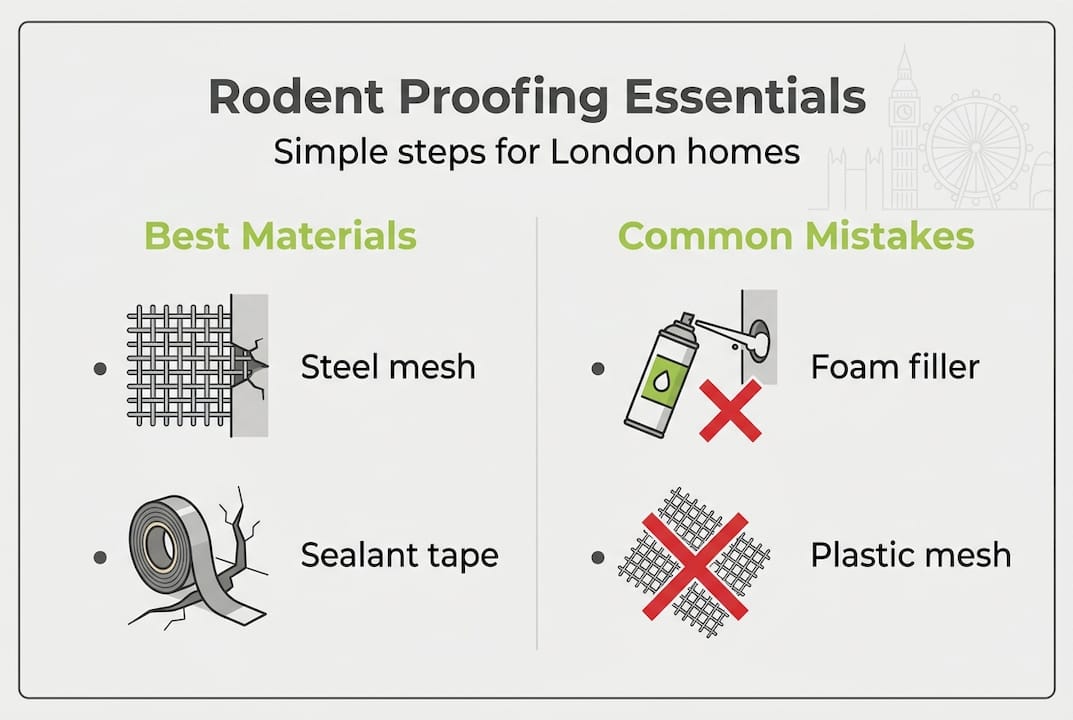
- Seal entry points with appropriate materials. Use steel wool combined with caulk, or better still, fit metal plates or concrete around penetration points. For ventilation openings, install steel mesh grilles.
- Fit door brushes and threshold seals. A significant gap under a back door is one of the most common entry points in London properties.
- Secure bins and external food sources. Bins without lids and bird feeders placed close to buildings are reliable attractants. Storing food airtight and clearing external clutter significantly reduces risk.
- Manage vegetation. Cut back shrubs and ivy from walls and roof lines, as these create sheltered pathways directly to your building.
Pro Tip: Never use expanding foam alone to fill rodent entry points. Rodents gnaw through it within hours. Steel mesh backed by concrete or a specialist proofing netting system is the only reliable long-term fix for gaps in older masonry.
For commercial kitchens and listed buildings, specialist drainage solutions such as rat gate installations prevent rodents using sewer lines to access the property. These are particularly relevant for London restaurants and hospitality venues. Our broader essential pest control tips cover additional preventive measures worth combining with physical proofing.
Common mistakes and advanced pitfalls
Even with the right approach, many efforts are undermined by a few critical errors.
The most frequent mistake is using the wrong materials. Foam filler, thin plastic mesh, and domestic caulk all fail quickly. Professional pest controllers warn that inferior proofing materials create a dangerous false sense of security. A property manager who seals gaps with foam and considers the job done may find an infestation weeks later, frustrated and confused.
| Material | Effectiveness | Why it fails |
|---|---|---|
| Expanding foam | Poor | Easily gnawed through |
| Plastic mesh | Poor | Flexible and chewable |
| Steel wool alone | Moderate | Corrodes over time |
| Steel mesh with concrete | High | Durable and rodent-resistant |
| Specialist proofing strips | High | Purpose-built for exclusion |
A second common pitfall involves baiting as a standalone solution. When rodents consume poison bait and die within walls or roof voids, the resulting odour can be severe and prolonged. There is also a secondary poisoning risk to pets and wildlife that feed on affected rodents.
Pro Tip: If your property houses vulnerable groups, such as care homes, schools, or commercial kitchens, always engage a BPCA-accredited specialist. The best pest control practices combine physical proofing with professional monitoring rather than relying on bait alone.
IPM, or Integrated Pest Management, is the professional standard. It combines proofing, monitoring, habitat modification, and targeted treatment only where necessary. It is more thorough, more ethical, and more cost-effective over time.
Keeping your property rodent-proofed over time
Long-term success depends on ongoing maintenance, and here is what works after initial proofing.
Proofing is not a one-time task. Building movement, weather, and routine wear gradually open new gaps. A property that was properly proofed two years ago may have developed new vulnerabilities since. Removing outdoor food sources, keeping storage areas tidy, and maintaining vegetation clearance are habits that must become part of regular property management.
- Quarterly inspections: Walk the perimeter every three months and check previously sealed points for deterioration.
- Bin discipline: Ensure all external bins have fitted lids and are positioned away from building entry points.
- Vegetation trimming: Keep shrubs, ivy, and overhanging branches cut back, particularly before autumn.
- Bird feeder management: Move feeders away from the building and clean fallen seed regularly.
- After building work: Any renovation or repair that disturbs walls, floors, or pipework should trigger a fresh proofing review.
Partnering with a professional pest control service for periodic monitoring is particularly worthwhile for high-risk sites such as food businesses. An autumn proofing checklist is a useful seasonal starting point. Building this into your annual property maintenance schedule costs far less than dealing with a full infestation.
A fresh perspective on rodent proofing: beyond quick fixes
Having worked across London for over a decade, we have seen the same pattern repeatedly. A property owner spends money on traps or bait, gets temporary relief, and then faces the same problem six months later. The real cost is not the treatment. It is the repeated treatments, the structural damage, and in commercial settings, the reputational risk of a pest sighting by a customer or inspector.
Rodent proofing tends to be undervalued because its success is invisible. When it works, nothing happens, and that absence of drama can make the investment feel unnecessary. But the risks of rodent incursions to health, property, and relationships with neighbours are real and serious. Treating proofing as a core part of property stewardship rather than an optional extra is the mindset shift that separates properties with chronic pest issues from those that rarely see them.
How professional support makes rodent proofing easier
For those wanting total peace of mind, professional support is just a step away.

Our BPCA-qualified team has been protecting London homes and businesses since 2015, from hotels and restaurants to residential flats. A professional inspection identifies vulnerabilities that are easy to miss and ensures the right materials and methods are used from the start. Our commercial pest control service includes thorough proofing audits, and we offer cleaning and disinfection services to support business continuity after any treatment. For urgent situations, contact our team for a rapid response across London.
Frequently asked questions
What is the difference between rodent proofing and rodent control?
Rodent proofing focuses on preventing entry through exclusion and habitat modification, while rodent control includes reactive elimination through trapping or baiting. Proofing is the preventive layer; control is the reactive one.
Does rodent proofing really work for all types of rodents?
Yes. When done correctly, proofing stops mice, rats, and squirrels by eliminating the access points and shelter they depend on. Research confirms that exclusion works across multiple rodent species.
How often should proofing be checked in London homes or businesses?
Quarterly inspections are ideal. After weather changes, building work, or seasonal transitions, a fresh proofing review ensures no new vulnerabilities have appeared since the last check.
What materials are best for sealing rodent entry points?
Steel mesh combined with concrete and specialist proofing strips are the most reliable options. Professional pest controllers consistently warn against foam and plastic mesh, which rodents can gnaw through quickly.
Recommended
- Why Rodents Invade London Homes in Winter and How to Stop Them – Pest Control 24 London
- Mouse Proofing Guide: Step-by-Step for London Homes
- Rat Removal London | Professional Rat Control & Drainage Surveys – Pest Control 24 London
- Blog – Pest Control 24 London
- Control Mice Invasions with Ratgate Installations North London