

Do not remove or seal an active pigeon nest. Leave it until the chicks have fledged, or call a licensed professional to assess it, because interfering with an active nest carries both legal and health risks. Focus first on your own safety and hygiene, not the birds’ removal.
TL;DR:
- Active pigeon nests cannot be removed legally until chicks have fledged or a professional has confirmed they are abandoned.
- Signs of active nests include frequent adult visits, fresh droppings, and sounds from chicks; abandonment signs include no visits and old droppings.
- Physical proofing methods like netting, spikes, and solar panel skirting are effective but must be installed without trapping smaller birds or voiding warranties.
- Heavy fouling around gutters and roof spaces poses health and property risks, requiring proper cleaning, disinfecting, and professional sanitisation.
- Regular maintenance, removing food sources, sealing entry points, and professional surveys prevent pigeons from re-establishing nests long-term.
Table of Contents
- Pigeons nesting on roof: immediate safe actions you can take today
- Legal rules and timing: why you cannot remove active nests
- How to tell if a nest is active or abandoned
- Humane exclusion and proofing options that work
- Cleaning and health risks after nests or heavy fouling
- Prevention and maintenance: deny pigeons the attraction
- When to call a professional and what a pest-control visit involves
- A practitioner’s view: what actually gets called out most
- How Pestcontrol24london handles roof pigeon problems
- Sources
Pigeons nesting on roof: immediate safe actions you can take today
You cannot legally clear an active nest, but you can still act. The right early steps protect you and the birds while you plan a permanent fix.
- Look, don’t touch. Check the roofline, gutters, and any gaps around eaves from ground level or a safe window. Never climb onto the roof or reach into a void to inspect a nest.
- Leave the gaps open for now. Sealing an entry point while chicks are inside traps them, which creates a welfare problem and a foul smell as the situation worsens.
- Cut off the food supply. Stop any feeding nearby, secure bin lids, and clear standing water in guttering or plant pots. Pigeons return to reliable food sources, so removing them reduces the appeal of your roof.
- Keep pets and children away from the nesting area, both for their safety and to avoid stressing the birds.
- Photograph the site from a distance for your records. This helps a professional assess the situation quickly if you do call one in.
Legal rules and timing: why you cannot remove active nests
The Wildlife and Countryside Act 1981 makes it an offence to intentionally take, damage, or destroy the nest of any wild bird while it is being built or in use. Pigeons fall squarely under this protection, and the law does not care whether the nest is inconvenient or unsightly.
Key point: There is no fixed “pigeon season” in UK law, because pigeons breed throughout the year rather than in one defined window.
That single fact catches out most homeowners. You might assume spring is the only risky period, then find a nest active in November.
- Never break apart, move, or discard nesting material while eggs or chicks are present.
- If you’re planning roofing, solar, or gutter work, check for active nests before scheduling it.
- Contact Natural England, NatureScot, or Natural Resources Wales if you believe a licence is needed for a specific case.
- When in doubt, bring in a licensed pest professional rather than guessing.
How to tell if a nest is active or abandoned
Get this wrong and you either leave a problem to worsen or break the law trying to fix it. A few reliable signs separate the two.
- Adult pigeons coming and going repeatedly, often carrying twigs or settling low over the nest, point to active breeding.
- Fresh, pale droppings around the site suggest recent activity, whereas old, dry, flaking guano usually means the nest has been vacated.
- Quiet chirping or scratching sounds from within a roof void are a strong sign of chicks, even when you can’t see them.
- No adult visits over several days, combined with dry, undisturbed material, points towards abandonment.
If you’re not certain, treat the nest as active. RSPB guidance is clear that pigeons can reoccupy a site quickly, so a nest that looks empty today can have eggs in it within days. A professional survey settles the question properly rather than leaving you to guess from the ground.
Humane exclusion and proofing options that work
Once a nest has been vacated naturally, or you’re proofing before pigeons ever settle, physical exclusion is what actually stops them coming back. Everything else is a stopgap.
Netting suits large open voids, such as the gap under a pitched roof edge or across a wide balcony recess. Professional-grade netting installed with roughly a 50mm aperture keeps pigeons out without trapping smaller birds, but incorrect tensioning or the wrong mesh size can create an entanglement hazard, which is why professional installation matters here more than almost any other proofing job.
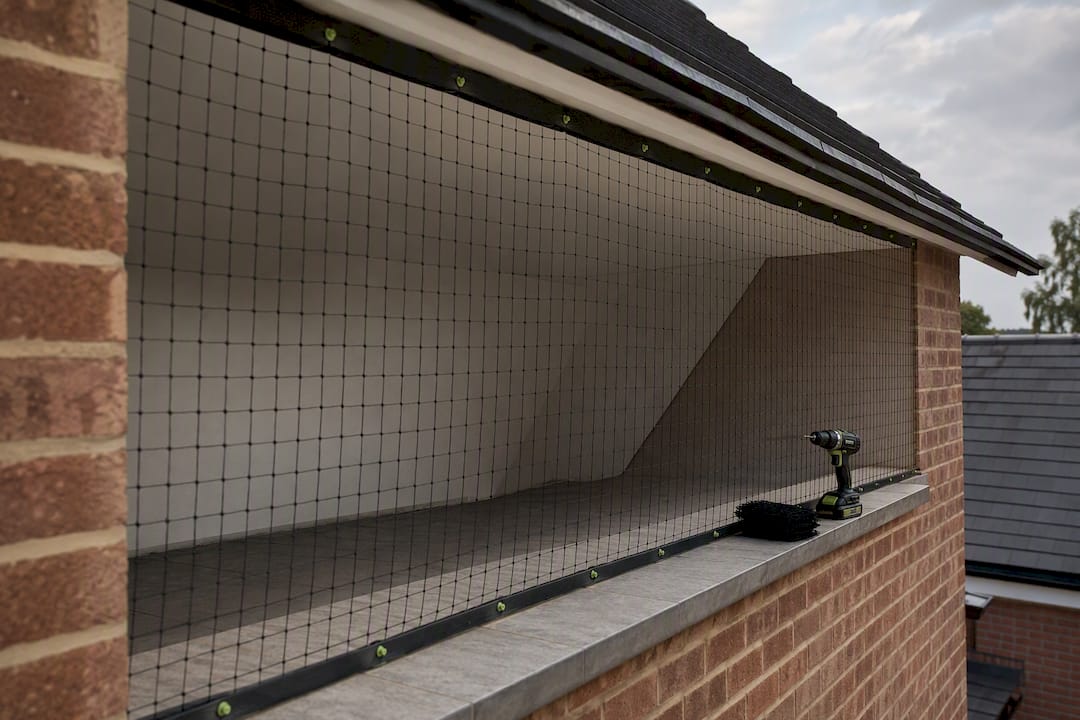
Anti-perching spikes and bird wire work well on ledges, chimney stacks, and narrow parapets where pigeons like to sit before they ever build. They stop the habit forming in the first place.
Solar panel skirting deserves its own mention, because the gap beneath a panel array is warm, dry, and sheltered, which makes it one of the most popular pigeon nesting spots on modern roofs. Standard spikes don’t fit this space, so specialist mesh skirting fitted around the panel edges is the only workable fix, and it needs to be done without voiding your panel warranty.
- Netting: best for large voids and open eaves.
- Spikes and wire: best for ledges, ridges, and ledgelike perching sites.
- Solar skirting: essential wherever panels create a sheltered cavity.
Pro Tip: Decoy owls, reflective tape, and ultrasonic sound devices might scare pigeons off for a week or two, but the birds habituate fast. Use them as a temporary measure alongside physical exclusion, never as your only defence.
Cleaning and health risks after nests or heavy fouling
Pigeon droppings are acidic and eat into roofing felt, render, and paintwork over time, and heavy fouling around gutters is a common cause of blocked downpipes and subsequent water ingress into the loft.
- Never dry-sweep or pressure-wash guano. Dried droppings release dust that can be inhaled, so dampen the area first.
- Wear gloves and a properly fitted mask if you’re clearing a small, accessible amount yourself.
- Bag and seal all waste and old nesting material before disposal rather than leaving it exposed.
- Avoid direct contact with sick or dead birds. Government guidance on staying safe around wild birds recommends minimising contact and seeking advice rather than handling them.
For anything beyond a light, accessible mess, professional disinfection is the safer route. Roof voids and loft spaces trap airborne particles, and a proper sanitisation treatment clears pathogens that a domestic clean simply can’t reach.
Prevention and maintenance: deny pigeons the attraction
Long-term success comes down to removing the reasons pigeons chose your roof in the first place, then keeping it that way.
- Stop feeding pigeons anywhere near the property, including indirectly through spilled bird feed or unsecured bins.
- Clear standing water from flat roof areas, gutters, and any pooling spot after rain.
- Check ledges, valleys, and solar panel edges every few months for early nesting material, twigs, or fresh droppings.
- Repair loose tiles or gaps around eaves promptly, since a small entry point today becomes a nesting cavity within weeks.
- Treat proofing as routine maintenance rather than a one-off job. A property that had pigeons once is more likely to attract them again unless the original access points stay sealed.
Source reduction paired with physical exclusion consistently outperforms either measure used alone, according to RSPCA advice on garden and balcony pigeons.
When to call a professional and what a pest-control visit involves
Some situations are beyond safe DIY handling, and knowing where that line sits saves you time, money, and a possible legal misstep.
- The nest sits inside a roof void, chimney, or another space you can’t inspect safely from ground level.
- Fouling has built up heavily around gutters, solar panels, or loft insulation.
- You need proofing installed on a solar array, a steep roof pitch, or anywhere requiring access equipment.
- You’re unsure whether a nest is active and need a definitive answer before starting building or roofing work.
A typical professional visit starts with a pest risk assessment of the site, followed by proofing installation suited to the specific landing points found, and sanitisation where fouling is present.
Pro Tip: Ask any pest-control provider whether their technicians hold BPCA qualifications. It’s the clearest sign they understand both the wildlife law and the correct proofing standards.
A practitioner’s view: what actually gets called out most
Most roof pigeon jobs follow the same pattern: a homeowner spots droppings on a windowsill weeks before they ever hear a chick. By the time the noise starts, the nest is already established, and the caller wants it gone immediately. It never is, and shouldn’t be.
The fix that actually holds is always two steps, not one. Clear and sanitise once the birds have moved on naturally, then install proofing the same week, before anything new can move in. Skip step two and you’ll be back here within a season.
Dos: check regularly, remove food sources, call for a proper survey when unsure. Don’ts: seal an occupied gap, disturb a nest yourself, or trust a decoy owl to do a proofing job’s work.
— Dan
How Pestcontrol24london handles roof pigeon problems
Professional pest control services are the practical alternative to piecing together decoys, tape, and guesswork yourself. Where DIY fixes stall at the “it worked for a fortnight” stage, our pigeon removal service pairs a proper site survey with correctly specified proofing, whether that’s netting on a large void, spikes along a ledge, or bespoke skirting around solar panels.

Our team has spent over a decade working on London roofs, from residential terraces to hotel rooftops, and proofing is installed to a standard that avoids both entrapment risk and repeat call-outs. Where heavy fouling has built up, proofing is followed by proper sanitisation rather than leaving that job half done.
If pigeons have already settled on your roof, or you want proofing installed before they do, you can get a free quote to arrange a survey around your schedule, including emergency callouts where urgent service is needed.
Sources
Recommended
- Common types of bird pests in the UK: identification guide
- Pigeon Removal London | Bird Proofing & Deterrent Systems – Pest Control 24 London
- Bird Proofing London | Professional Pigeon & Seagull Deterrents – Pest Control 24 London
- Bird Control London | Professional Bird Deterrents & Management – Pest Control 24 London