

Bird feeders do create genuine pest risks in UK gardens, and the single most effective action you can take right now is to reduce spillage under and around the feeder. That one change cuts the primary attractant for rats, mice, and other opportunistic feeders more reliably than any repellent or trap.
Three things you can do today:
- Sweep or rake up spilt seed, husks, and damp food from the ground beneath the feeder
- Reduce your daily fill to only what the birds consume within a few hours
- Move any open seed bags into a sealed, rodent-proof container stored indoors or in a secure outbuilding
Key takeaways
Consistent daily spillage removal is the single most effective measure for reducing pest risks near bird feeders in UK gardens.
| Point | Details |
|---|---|
| Spillage is the primary attractant | Sweep up spilt seed and husks every evening to remove the main draw for rats and mice. |
| Weekly cleaning prevents disease | Clean feeders at least once a week with a dilute bleach or vinegar solution to reduce salmonellosis and aspergillosis risk in line with RSPB recommendations. |
| Sealed storage is non-negotiable | Store seed in metal or heavy-duty plastic containers with tight-fitting lids, not in thin bags in a shed. |
| Placement height and clearance matter | Position feeders roughly 1.2 metres off the ground and 2.4 metres from any jump point to limit rodent and squirrel access. |
| Pestcontrol24london for escalation | When active burrows, daytime rat sightings, or indoor signs appear, it is advisable to seek a certified pest control inspection, proofing, and treatment service. |
Table of Contents
- Why do bird feeders attract pests in the first place?
- Which pests are commonly drawn to garden feeders in the UK?
- What health risks do feeders pose to birds and people?
- How can you tell if pests are already present?
- Practical prevention: cleaning, storage, and feeder placement
- DIY deterrents that actually work
- When should you call a professional pest controller?
- Practical tips from a BPCA-qualified pest controller
- Your daily and weekly checklist for keeping pests away
- What most homeowners get wrong at the feeder
- Pestcontrol24london can help when prevention is not enough
- Useful UK resources for further guidance
- Sources
Why do bird feeders attract pests in the first place?
The core mechanism is simple: a bird feeder offers a predictable, high-calorie food source at a fixed location, day after day. Rats and mice are neophobic by nature, meaning they are cautious around new things, but once they locate a reliable food supply they return repeatedly and begin nesting nearby. A feeder that is topped up at the same time each morning removes all uncertainty for them.
Spilt seed is the real problem. Sunflower hearts, nyjer, and mixed seed fall to the ground with every visit from a bird, and the husks left behind absorb moisture and ferment, creating a persistent scent trail that nocturnal foragers follow. Damp, decomposing seed is particularly attractive to brown rats, which are active from dusk and rarely seen by householders until an infestation is already established.
Nearby cover compounds the risk. Dense shrubs, log piles, compost heaps, and garden sheds within a few metres of a feeder give rodents shelter and nesting material. The feeder feeds them; the cover houses them. That combination is what turns a casual visit into a resident population.
RSPB guidance highlights that the area directly beneath the feeder, not the feeder itself, is the critical control point. Frequent raking and a hard, sweepable surface underneath reduce nocturnal foraging opportunities considerably.
Pro Tip: Position your feeder over patio slabs or a concrete path rather than bare soil or lawn. Spilt seed on a hard surface is far easier to sweep up each evening, and it gives rats and mice nowhere to burrow directly beneath the food source.
Which pests are commonly drawn to garden feeders in the UK?
The species you are most likely to encounter depend on your location, but the following are the most frequently reported across UK gardens:
- Brown rats (Rattus norvegicus): The most common and most concerning visitor. Attracted by spilt seed and the predictability of the food source. Signs include burrows near the base of fences or under sheds, dark droppings roughly 15–20mm long, and gnaw marks on plastic feeders or seed bags. More prevalent in urban and suburban gardens than rural ones, partly because urban rat populations are already dense.
- House mice (Mus musculus): Smaller and more agile than rats, mice can climb feeder poles and access seed directly. Droppings are smaller (3–6mm), and you may notice gnawed packaging or fine scratch marks on wooden posts. Common in both urban and rural settings.
- Grey squirrels (Sciurus carolinensis): Persistent and highly capable climbers. They will raid hanging feeders, chew through plastic tubes, and cache seed in flowerbeds. Not a public health risk in the same way as rodents, but they displace garden birds and cause physical damage to feeders. Widespread across England and Wales.
- Foxes (Vulpes vulpes): Attracted by the seed and by the small mammals that feeders draw in. Foxes rarely eat seed directly but will scavenge beneath feeders and may disturb nesting birds. More active at night; signs include distinctive musky odour, scattered droppings, and disturbed soil.
- Corvids (crows, jackdaws, jays) and pigeons: Large, bold birds that dominate open feeders and ground-feeding areas. Corvids in particular will cache food and return repeatedly. Feral pigeons carry diseases including ornithosis and can contaminate feeding areas with droppings. More of a nuisance and hygiene concern than a structural pest, but worth managing.
- Magpies: Opportunistic and intelligent. They will take eggs and chicks from nearby nests if a feeder draws them into your garden regularly. Not a pest in the legal sense, but their presence can suppress smaller garden bird populations.
For a detailed identification guide to rodent species and the signs they leave, the rodent pest guide for London homeowners is a useful reference.
What health risks do feeders pose to birds and people?
Disease transmission is the most serious health risk associated with bird feeders, both for the birds themselves and, to a lesser extent, for the people who handle feeders or work in the garden.
Feeders concentrate birds from a wide area into a small space, which accelerates the spread of pathogens. The three diseases most commonly linked to garden feeders in the UK are:
- Trichomonosis: A parasitic disease caused by Trichomonas gallinae, primarily affecting finches and pigeons. Infected birds appear lethargic, have difficulty swallowing, and may regurgitate food. RSPB guidance warns that a single infected bird visiting a high-traffic feeder can turn it into a disease hotspot rapidly.
- Salmonellosis: Caused by Salmonella bacteria, most commonly seen in sparrows and finches. Infected birds appear fluffed up and unresponsive. Contaminated droppings on feeders, perches, and the ground beneath represent a genuine hygiene risk to humans who handle feeders without washing their hands.
- Aspergillosis: A fungal respiratory disease caused by Aspergillus moulds that thrive in damp, decomposing seed. Birds inhale spores; the disease is not transmissible to humans in normal garden conditions, but mouldy seed should always be removed promptly.
CWHC technical guidance recommends small, covered feeders that drain freely, routine cleaning, and reducing crowding to lower disease transmission risk. Garden Wildlife Health advises temporarily stopping feeding altogether if you observe sick or dead birds at your feeder, and reporting the incident through their surveillance scheme.
Feeders that are not cleaned regularly become reservoirs of bacteria, fungi, and parasites. The risk is not theoretical: disease outbreaks linked to garden feeders have caused measurable declines in greenfinch and chaffinch populations across the UK.
For human hygiene, the practical rules are straightforward: always wash your hands thoroughly after handling feeders, seed, or anything in the area beneath the feeder. Do not allow children to handle feeders without supervision and handwashing afterwards. Virginia DWR also recommends spreading feeders across the garden to reduce crowding and the associated disease risk.
On the humane side, deterring pests should never involve methods that harm non-target wildlife. Rodenticide placed near a feeder can kill hedgehogs, birds of prey, and other protected species through secondary poisoning. Physical proofing and hygiene management are always the preferred first response.
How can you tell if pests are already present?
Active infestation signs are usually visible before you see the animal itself. The following are the clearest indicators:
- Droppings: Rat droppings are dark, tapered, and roughly 15–20mm long; mouse droppings are smaller and more pointed. Fresh droppings are dark and moist; older ones are grey and crumble easily.
- Gnaw marks: Plastic feeders, wooden posts, and seed bags with clean-edged gnaw marks indicate rodent activity. Rats leave wider, rougher marks than mice.
- Burrows: Shallow, smooth-edged holes roughly 6–9cm in diameter near fences, walls, or under sheds are a strong indicator of brown rat activity.
- Runways and grease marks: Rats follow the same routes repeatedly, leaving dark grease marks along walls and fences and flattened grass trails across lawns.
- Nocturnal sounds: Scratching or scurrying sounds from sheds, decking, or beneath outbuildings at night.
- Increased scavenger visits: A sudden rise in fox, corvid, or magpie activity around the feeder area can indicate that rodents are present and attracting secondary predators.
- Disturbed or scattered seed: Seed scattered well away from the feeder, or feeders physically displaced, suggests a larger animal such as a squirrel or fox is involved.
When to manage it yourself: One or two mouse droppings, a single squirrel visit, or occasional corvid activity can usually be addressed with the hygiene and placement measures in the next section.
When to call a professional: Active rat burrows, repeated rat sightings at any time of day, gnaw damage to structural elements (decking, shed timbers), or persistent activity despite two weeks of good hygiene practice all warrant professional assessment. If rodents have moved from the garden into the house, that is an immediate escalation trigger. The rat control checklist for homeowners covers the decision points in detail.
Practical prevention: cleaning, storage, and feeder placement
The most effective prevention package combines daily small fills, weekly cleaning, sealed seed storage, and correct feeder placement. No single measure works in isolation; the combination is what makes the difference.
Cleaning routine
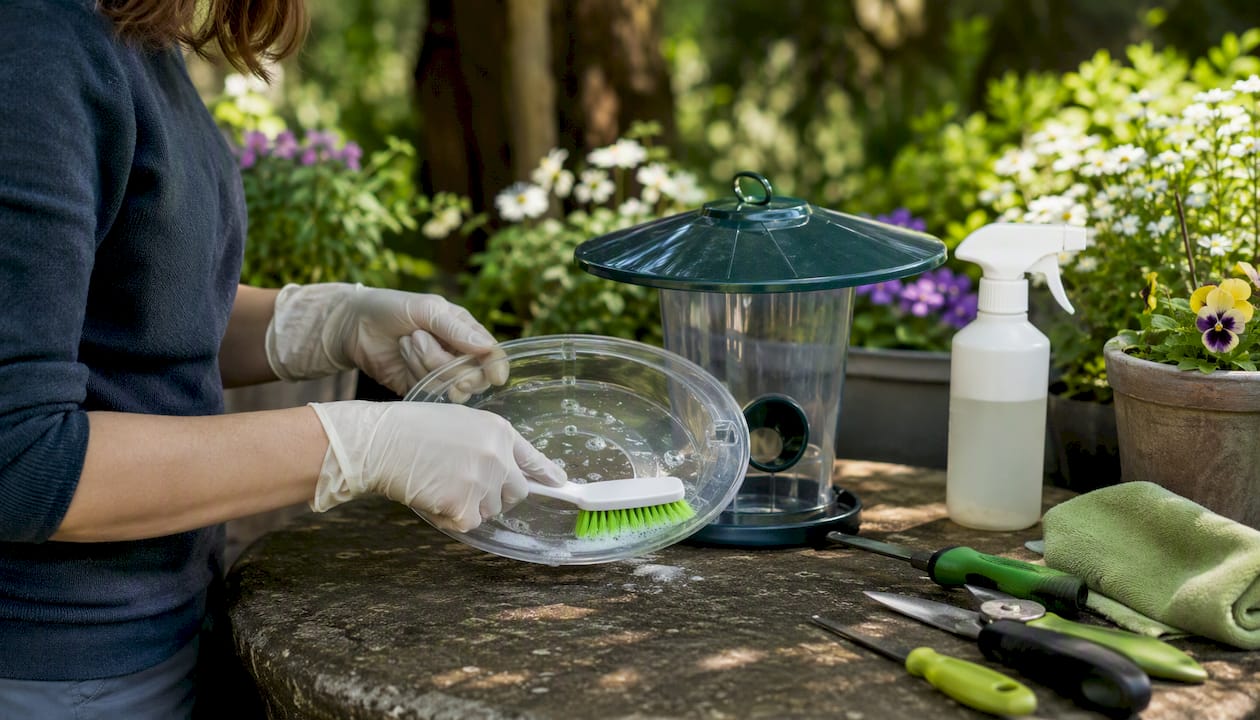
RSPB recommends cleaning feeders at least once a week and moving them to a fresh spot occasionally to prevent the build-up of droppings and contaminated debris in one area. Extension (UNH) advises cleaning every other week as a minimum, with nectar and hummingbird-style feeders cleaned weekly. For UK gardens, weekly is the practical standard for most feeder types.
Use a dilute bleach solution (one part bleach to nine parts water) or a white vinegar solution to scrub feeders, perches, and trays. Rinse thoroughly and allow to dry completely before refilling. Wet feeders encourage mould growth and accelerate the conditions that cause aspergillosis.
Seed storage
North Lanarkshire Council guidance emphasises clearing and storing seed properly as the primary measure for avoiding rodents. Store seed in metal or heavy-duty plastic containers with secure, tight-fitting lids. Thin plastic bags left in a shed or garage are not adequate; rats and mice can gnaw through them within minutes. Buy seed in quantities you can use within two to three weeks to avoid long-term storage. For advice on making outbuildings more secure against rodent entry, the shed security guidance covers practical options for locks, gaps, and flooring.
Feeder placement
King County guidance recommends placing feeders approximately 1.2 metres (4 feet) off the ground and keeping them roughly 2.4 metres (8 feet) from any jump point such as a fence, branch, or wall. This height and clearance combination makes it significantly harder for rats to climb the pole and for squirrels to leap across.
Feeder types and pest risk
| Feeder type | Pest risk level | Cleaning ease | Notes |
|---|---|---|---|
| Tube feeder (enclosed) | Low to moderate | Moderate | Limits spillage; clean ports weekly |
| Open tray / platform | High | Easy | Accumulates droppings; needs daily clearing |
| Seed catcher tray (under tube) | Moderate | Easy | Reduces ground spillage significantly |
| Suet cage | Low | Easy | Less attractive to rodents; clean weekly |
| Nyjer sock | Low | Moderate | Fine seed; check for mould after rain |
Tube feeders with integrated seed-catcher trays offer the best balance of bird access and pest risk reduction for most UK gardens.
DIY deterrents that actually work
Physical proofing and spillage reduction are the most reliably effective DIY deterrent category. Repellent sprays, ultrasonic devices, and scent-based deterrents have inconsistent results in outdoor environments and should not be relied upon as primary measures.
Practical options that do work:
- Pole baffles: A cone or dome baffle fitted below a hanging feeder or around a pole prevents rats and squirrels from climbing up. Position the baffle at least 45cm below the feeder.
- Raised feeders on smooth metal poles: Rats struggle to climb smooth metal. Avoid wooden posts, which provide grip and can be gnawed.
- Seed-catcher trays: Fitted beneath tube feeders, these catch the majority of spilt seed before it reaches the ground. Empty them daily.
- Night removal: Virginia DWR recommends bringing feeders in at night in areas where larger mammals are active. This removes the food source during the hours when rats and foxes are most active.
- Spreading feeders: Placing two or three feeders at different points in the garden, rather than one central station, reduces the congregation of birds and the associated build-up of droppings and spillage in one spot.
- Squirrel-specific feeders: Weight-sensitive feeders that close under the heavier load of a squirrel allow smaller birds to feed while excluding grey squirrels. They do not prevent ground spillage but reduce the volume taken.
What to avoid:
- Rodenticide near feeders: Poison bait placed near a bird feeder risks killing birds of prey, hedgehogs, and other non-target species through secondary poisoning. Killing or injuring certain protected species is a criminal offence under UK law. If rodenticide is necessary, it must be placed in a tamper-resistant bait station by a qualified professional.
- Glue traps: Banned for use against rats and mice in England since 2024 except under licence. Do not use them.
- Ultrasonic repellers: No consistent evidence supports their effectiveness in open outdoor environments.
For squirrels specifically, placing a small amount of food (whole peanuts or corn) away from the main feeder area can reduce their interest in the bird feeders, though it does not eliminate it.
When should you call a professional pest controller?
The earliest sensible moment to call a professional is when you find evidence of active rat burrows, see a rat during daylight hours, or notice persistent activity despite two weeks of consistent hygiene improvement. Daytime rat sightings almost always indicate a population large enough that individuals are being pushed out to forage at unusual times.
What a professional inspection covers
A qualified pest controller will typically:
- Inspect the garden and property perimeter for active burrows, entry points, and harbourage sites
- Assess the extent of the infestation and identify the species involved
- Place tamper-resistant bait stations or traps in appropriate locations, away from non-target wildlife
- Advise on proofing measures (blocking entry points into the property, sealing gaps in decking and outbuildings)
- Arrange follow-up visits to monitor bait take and assess progress
- Carry out sanitisation of contaminated areas if required
Factors that affect timeline and cost
Severity, access, and the need for structural proofing are the main cost drivers. A straightforward garden rat treatment with two or three follow-up visits typically takes two to four weeks to resolve. Properties where rodents have entered the building, or where extensive proofing work is needed, will take longer and cost more. Sanitisation after an infestation, particularly in enclosed spaces like sheds or under decking, adds to the overall cost but is often necessary to remove scent trails that attract new rodents.
Questions to ask a contractor before booking
- Are you BPCA-qualified or a member of a recognised professional body?
- Do you use tamper-resistant bait stations, and how are they positioned to protect non-target wildlife?
- How many visits are included, and what is the follow-up protocol?
- Do you offer proofing work as part of the treatment, or is that a separate quote?
- What sanitisation services do you provide after treatment?
Understanding why rodents invade London homes in winter is also worth reading if you are concerned that garden activity may be escalating indoors.
Practical tips from a BPCA-qualified pest controller
Pro Tip: The single most important thing you can do before any other measure is remove all food from the ground each evening. Rats are creatures of habit; break the nightly food reward and you disrupt the routine that keeps them returning.
A qualified pest controller approaching a garden feeder problem will typically work through the following priorities:
- Evidence of activity first: Look for fresh droppings, burrow entrances, and grease marks before deciding on treatment. The location of evidence tells you where the population is centred.
- Identify entry points into the building: Garden infestations become indoor infestations when there are gaps at ground level. Check air bricks, gaps around pipes, and the base of doors.
- Assess nearby attractants: Compost heaps, unsecured bins, and pet food left outdoors all contribute. Feeders rarely act alone.
- Proofing quick wins: A metal kick plate on a shed door, a concrete apron around the base of a fence post, or a baffle on a feeder pole can each be installed in under an hour and deliver lasting results.
- Advise on feeder management: Professional treatment will fail if the feeder continues to provide a competing food source. During active treatment, the feeder should be removed entirely or managed with extreme care.
DIY measures work well for prevention and for early-stage activity. Once a population is established, however, professional proofing and treatment consistently outperform DIY approaches because they address the harbourage and entry points, not just the food source.
Your daily and weekly checklist for keeping pests away
The goal of this checklist is to remove the conditions that attract pests before they have a chance to establish. Consistency matters more than any individual action.
Daily:
- Fill feeders with only what birds will consume within a few hours
- Sweep or rake spilt seed, husks, and droppings from the ground beneath the feeder
- Empty seed-catcher trays and rinse if damp
- Bring feeders in at night if rats or foxes have been seen recently
Weekly:
- Clean all feeders with a dilute bleach or vinegar solution; rinse and dry before refilling
- Check seed storage containers for signs of gnawing or moisture ingress
- Inspect the area around the feeder for new burrows, droppings, or gnaw marks
- Move the feeder to a slightly different position to prevent build-up in one spot
Seasonal:
- In wet autumn and winter months, check for mould in feeders and stored seed more frequently; damp conditions accelerate aspergillosis risk
- During spring breeding season, reduce fill amounts as natural food becomes more available and pest pressure can increase with warmer temperatures
- In winter, rodents are more likely to move indoors; review the mice prevention checklist for homeowners if you notice any indoor signs
Extension (UNH) recommends filling feeders only with what birds will eat in a day as a baseline rule across all seasons.
What most homeowners get wrong at the feeder
The pattern seen most often on professional visits is not neglect. Most people who call about a rat problem near their bird feeder are conscientious garden bird enthusiasts who clean their feeders regularly and buy quality seed. The mistake is almost always one of the following: filling the feeder too generously, storing seed in a thin plastic bag in the shed, or placing the feeder directly over a planted border where spilt seed disappears into the soil and cannot be swept up.
Overfilling is particularly common in winter, when people want to support birds through cold weather. The instinct is understandable, but a feeder that still has seed in it at dusk is a feeder that will have rats beneath it by midnight. Matching fill quantity to daily consumption, as RSPB and North Lanarkshire Council both recommend, is the single most underused control measure available to homeowners.
Feeding at ground level, whether via a ground tray or simply scattering seed on the lawn, dramatically increases pest risk and should be avoided unless the area can be cleared completely within an hour or two. BirdLife notes that poorly sited or maintained feeders can cause disturbance and increased disease risk for the very birds you are trying to support.
The reassuring reality is that most feeder-related pest problems respond well to the hygiene and placement measures described in this guide. You do not have to stop feeding garden birds. You just need to feed them more carefully.
Pestcontrol24london can help when prevention is not enough
When hygiene measures have not resolved the problem, or when you have found active burrows or evidence of rodents entering the property, professional assessment is the right next step. Pestcontrol24london has been providing BPCA-qualified pest control across London since 2015, with more than a decade of experience handling rodent infestations in domestic gardens and residential properties.

Services relevant to feeder-related pest problems include full garden and property inspections, tamper-resistant rodent treatment, structural proofing of entry points, professional bird control and bird-proofing installations, and post-infestation sanitisation to remove scent trails and contamination. Emergency callouts are available 24/7. To arrange an inspection or request a free quote, contact Pestcontrol24london directly.
Useful UK resources for further guidance
- RSPB: Keep your garden birds healthy — Practical guidance on feeder hygiene, disease prevention, and safe feeding practices for UK garden birds.
- Garden Wildlife Health — Disease surveillance and reporting for garden wildlife; advises on when to stop feeding and how to report sick birds.
- BirdLife International — Conservation-oriented best-practice feeding guidance and context on the wider impact of garden feeding stations.
- North Lanarkshire Council: Bird feeding and avoiding rodents — A clear example of UK local council guidance on seed storage and sensible feeding routines to reduce rodent attraction.
- CWHC: Bird feeder disease strategies — Technical guidance on pathogen transmission at feeders and evidence-based recommendations for feeder design and cleaning.
- BPCA (British Pest Control Association) — The professional body for pest control in the UK; use their member search to find qualified local contractors.
- Your local council’s environmental health team — Most UK councils publish guidance on rodent control and can advise on reporting significant infestations in residential areas.
Sources
- Keep your garden birds healthy | RSPB
- Strategies to prevent and control bird feeder associated diseases and threats | CWHC
- Bird feeders and rats: What you need to know | King County
- Cleaning your bird feeders | Extension
- Safe bird feeding | Virginia DWR
- Garden Wildlife Health
- BirdLife
- Bird feeding and avoiding rodents | North Lanarkshire Council