

A pest control guarantee is a written promise to re-treat, refund, or keep monitoring a problem until it is resolved. Its actual worth depends entirely on the paperwork behind it: the exact scope of work, the technician’s competence certificates, and whether the treatment was lawful and correctly targeted. Before you pay anyone, get the terms in writing, confirm BPCA membership, and read the exclusions twice.
TL;DR:
- Guarantees primarily cover re-treatment visits, refunds, and follow-up inspections within a defined period, usually depending on the pest type.
- They often exclude issues like new infestations caused by neighbors, damage from tampering, and problems linked to customer maintenance.
- UK law restricts what pest control providers can promise, emphasizing lawful product use and current competence certificates.
- Verifiable documentation, such as surveys, scope of work, and insurance, is essential for a guarantee to be trustworthy.
- Commercial guarantees must align with food safety regulations and include detailed reporting, scheduled visits, and clear responsibilities for the business.
Table of Contents
- What does a pest control guarantee typically cover?
- How should you read the fine print on a guarantee?
- Why UK regulation limits what a guarantee can promise
- Questions to ask before you trust a guarantee
- What guarantees mean for businesses and food premises
- Proof behind the promise: Pestcontrol24london’s approach
- What does treatment cost, and when does the guarantee start?
- When guarantees are enforced, and when they fall apart
- How do residential and commercial guarantees differ?
- Why most “guarantee” marketing misses the point
- Getting a guarantee you can actually rely on
- Where to check the rules yourself
- Sources
What does a pest control guarantee typically cover?
Most legitimate guarantees follow a similar pattern. They promise to return and re-treat if the pest activity persists within a set window, sometimes with a money-back clause if the problem cannot be resolved, and often with a scheduled monitoring visit to confirm the treatment worked. Proofing work, where a technician blocks entry points, usually carries its own separate assurance covering the materials and installation.
None of this is unconditional. A guarantee typically covers:
- Re-treatment visits within a stated period depending on the pest
- Refunds or partial refunds if the agreed treatment plan fails to resolve the original problem
- Proofing work commitments, such as guaranteed sealing of entry points identified during the survey
- Scheduled follow-up or monitoring visits to confirm activity has stopped
What it will not cover is just as important. Providers routinely exclude new infestations caused by a neighbouring property, damage from tampering with bait stations or traps, and failures linked to the customer’s own maintenance, such as leaving food waste exposed or ignoring proofing advice. Crucially, the guarantee almost always depends on an initial survey and an agreed pest risk assessment that defines the scope of works. Skip that step, or treat something outside the agreed scope, and the guarantee never activates in the first place.
How should you read the fine print on a guarantee?
Guarantee formats vary more than most customers expect, and the label attached to one matters less than the clause underneath it.
- Re-treatment policies promise a free return visit if activity resumes within the stated window. This is the most common and most reliable format because it commits to action, not an outcome.
- Fixed-term warranties cover a defined period, often 3 to 12 months, after which any further work is chargeable. Read the end date carefully; it usually starts from the last treatment, not the first.
- Money-back offers refund some or all fees if the problem is not resolved, but almost always require proof that you followed the agreed proofing or hygiene advice.
- “Lifetime” or “while you live here” claims sound generous but tend to be the most heavily conditioned. They usually require an ongoing paid contract, annual inspections, or specific proofing works to remain valid.
Watch for phrases like “subject to”, “resident responsibilities”, and “proof of activity”. These are the clauses that decide whether a claim gets honoured. Some providers also charge a call-out fee for visits after the guarantee period lapses, or bill separately for proofing materials even when the labour is “guaranteed”. Ask about both before signing.
Pro Tip: Ask the provider to point to the exact clause that would apply if the pests returned tomorrow. If they cannot answer immediately, the guarantee probably isn’t as solid as the sales pitch suggests.
Why UK regulation limits what a guarantee can promise
No pest control guarantee exists in a vacuum. UK law and industry standards set hard limits on what a technician can lawfully do, which in turn sets the ceiling on what any guarantee can honestly claim.
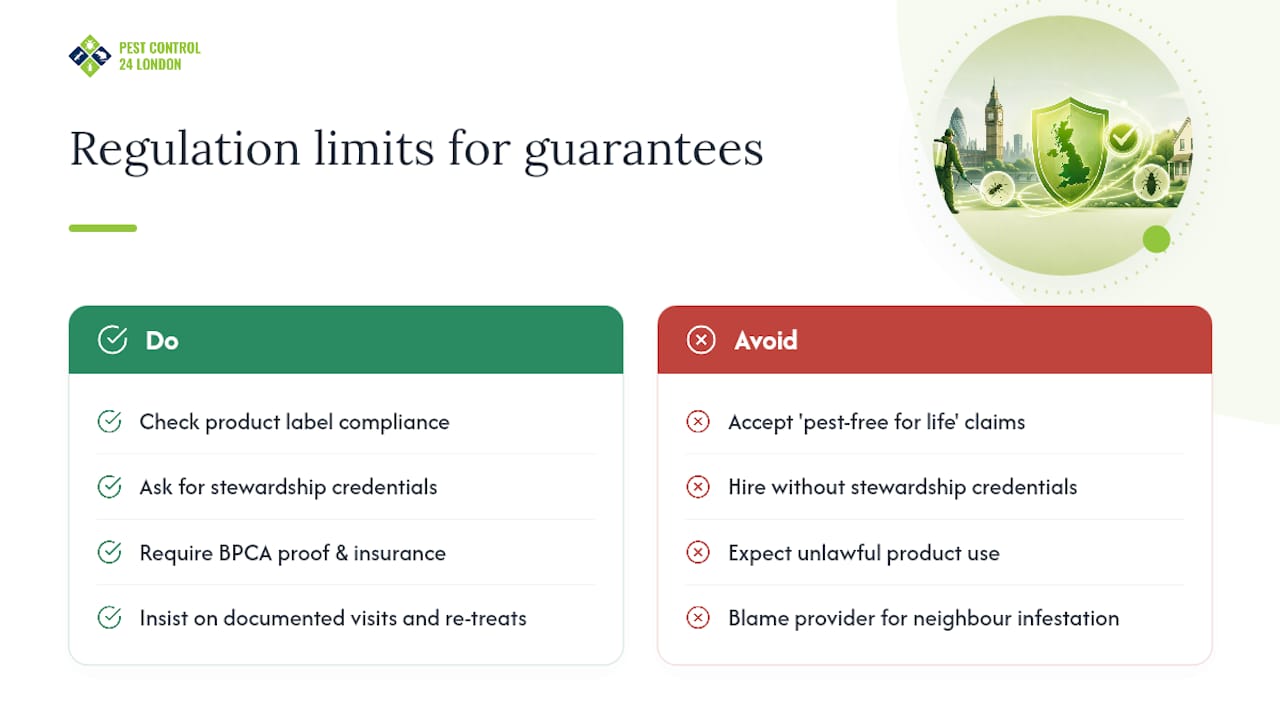
Commercial pesticide use is governed by the Control of Pesticides Regulations 1986, which means technicians must follow label conditions exactly. There is no discretion to use a stronger dose or an unapproved method just to make a guarantee stick. This is often summarised in the trade as “the label is the law.”
From 1 January 2026, the rodenticide stewardship regime requires anyone buying professional rodenticides to show a recent approved training certificate at the point of sale. A technician without current stewardship credentials simply cannot access the same tools as one who holds them, which directly affects what they can realistically promise for a rodent problem.
BPCA membership is the clearest trust signal available to a UK customer. Members are audited against the British Standard EN16636 and typically carry at least £2 million in public and products liability insurance, covering both the quality of the work and the financial protection if something goes wrong.
This regulatory backdrop is exactly why “pest-free for life” guarantees deserve scepticism. No provider can lawfully guarantee an outcome that depends on factors outside their control, like a neighbour’s untreated infestation or a customer’s own housekeeping. Credible guarantees promise a process, documented visits, defined re-treatments, and lawful product use, not an absolute state.
Questions to ask before you trust a guarantee
Most disputes over pest control guarantees come down to something that was never written down. Asking the right questions before you book protects you far more than any clause you might spot afterwards.
Put these to any provider before agreeing to work:
- Can I have the guarantee terms in writing, including the exact duration?
- What specifically voids the guarantee, and is that listed anywhere?
- Is proofing work included, and does it carry its own separate warranty?
- What insurance do you hold, and can you confirm the policy limit?
- Are re-treatment visits genuinely free, or is there a call-out charge?
- Can you show current competence certificates for the technician attending?
Some answers should raise immediate concern. A guarantee offered only verbally, with no paperwork to follow up, is not a guarantee at all; it is a sales tactic. Vague durations (“ongoing cover”, with no end date or renewal terms) tend to hide charges that surface later. Be equally wary of a provider who cannot describe their own survey process or who has no record-keeping system to prove what was treated and when.
Verification takes minutes. The BPCA runs a public member directory, so you can check membership status directly rather than taking a technician’s word for it. Ask for proof of the EN16636 audit, a copy of the liability insurance certificate, and evidence of stewardship-approved training if rodenticides are involved.
Pro Tip: Request the survey report before you agree to anything. If a company cannot produce one, there is no defined scope of works, and without a defined scope, there is no guarantee to enforce.
What guarantees mean for businesses and food premises
Commercial customers, particularly food businesses, face a different standard entirely. Guarantees supplement a business’s own responsibilities; they never replace them. Industry guidance is explicit that pest control for food premises must be risk-based and integrated with HACCP, meaning the proprietor retains legal responsibility for prevention regardless of what a contractor promises.
A commercial contract typically needs to specify more than a residential one:
- Scheduled visit frequency, tied to risk level rather than a fixed calendar
- Detailed reporting after every visit, filed for food safety audits
- Clear access arrangements for out-of-hours or emergency callouts
- Record-keeping that satisfies environmental health inspections
Businesses should also push contracts to cover non-food areas and waste storage explicitly, since these are where most infestations actually start. A commercial pest control agreement that only covers the kitchen floor misses the point.
Proof behind the promise: Pestcontrol24london’s approach
Pestcontrol24london has handled London pest problems since 2015, working across hotels, hostels, restaurants, shops, takeaways, and thousands of residential properties over more than a decade. That range matters because guarantee terms differ between a single flat and a working commercial kitchen.
The business is fully BPCA qualified, meaning every guarantee offered sits on the same foundation covered earlier: audited standards, current competence certificates, and proper insurance. That combination is what separates a written commitment from a sales promise, and it is the same standard we encourage every reader to check for when comparing providers.
What does treatment cost, and when does the guarantee start?
Costs and guarantee timelines vary by pest and property type, but the pattern is consistent across the industry. An initial survey typically comes first, often free or charged as a small fixed fee that is credited against the treatment cost if you proceed. This visit is what defines the scope of works, and the guarantee period usually only begins once that treatment is complete, not from the date you first called.
Most re-treatment windows run for a period depending on the pest’s life cycle. Rodent problems tend to sit at the shorter end because breeding activity resumes quickly if a treatment fails; a wasp nest guarantee might only need a couple of weeks, since the colony either dies or it does not. Bed bug treatments often need multiple visits built into the original price precisely because a single treatment rarely finishes the job, given the insect’s resistance and hiding behaviour.
Timelines for activating a guarantee claim also matter. If activity resumes, most providers ask you to report it within the guarantee window itself, not after it lapses, and often want photographic evidence or a description of where the activity was seen. Waiting until the guarantee has technically expired to report a recurring problem is the single most common reason customers lose a claim they otherwise would have won. Reading the residual treatment methodology used matters here too, since some chemicals keep working for weeks after application, which affects how soon “no activity” can genuinely be confirmed.
When guarantees are enforced, and when they fall apart
Guarantee disputes tend to follow a recognisable shape. A guarantee holds up when the paperwork tells a complete story: a survey was done, a scope of works was agreed, the treatment matched that scope, and the customer reported recurring activity within the stated window with some form of evidence. In cases like this, reputable providers return and re-treat without argument, because the contract terms were clear from the start and both sides met their obligations.
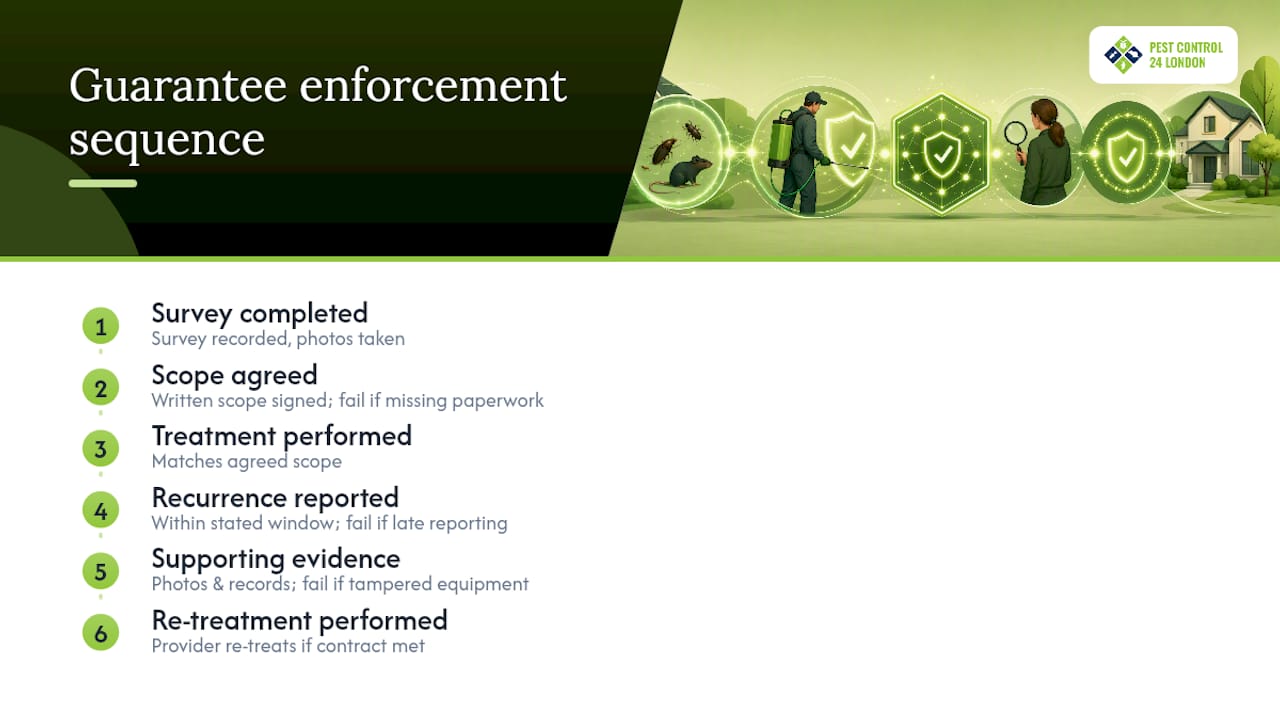
Guarantees fall apart for more predictable reasons than most customers expect. A common failure pattern involves a customer who received a verbal promise of “ongoing cover” with no written duration, then found the provider unwilling to return months later, arguing the informal promise never specified a timeframe. Another recurring pattern involves proofing work: a customer assumes sealed entry points are covered indefinitely, only to discover the guarantee applied solely to the pest treatment, not the physical proofing materials, which needed a separate agreement.
Tampering is another frequent sticking point. Bait stations moved or disturbed by a curious pet or a well-meaning cleaner can void a claim outright, because the provider can no longer verify what happened during the guarantee period. This is precisely why record-keeping and photographic evidence, taken at each visit, protect both parties. It converts a dispute over memory and assumption into a dispute over documented fact, which is far easier to resolve fairly.
How do residential and commercial guarantees differ?
Residential and commercial guarantees share the same underlying principles, survey, scope, re-treatment, but the practical detail diverges sharply once contracts are drawn up.
| Feature | Residential guarantee | Commercial guarantee |
|---|---|---|
| Typical duration | 30 to 90 days per treatment | Ongoing contract, often annual with scheduled reviews |
| Reporting requirement | Informal, phone or email | Formal, tied to food safety or audit records |
| Scope | Single property, often one pest type | Multiple zones, including non-food and waste areas |
| Documentation | Basic invoice and treatment note | Detailed visit reports for compliance inspections |
| Who retains responsibility | Homeowner for maintenance and access | Business proprietor for HACCP and due diligence |
A homeowner’s guarantee tends to be a single, self-contained promise attached to one job. A business guarantee is usually one clause within a much larger service contract, where the pest control element has to align with wider food safety obligations and cannot be judged in isolation. Landlords managing multiple properties sit somewhere between the two, and often benefit from the same structured reporting that commercial contracts use, particularly when coordinating access and repairs through a system like the one described on Prop Report.
Why most “guarantee” marketing misses the point
The industry’s biggest problem isn’t dishonest providers. It’s the language itself. Terms like “guaranteed pest-free” get used so loosely that customers stop distinguishing between a genuine process commitment and a slogan with nothing behind it.
The BSI’s own guidance frames this correctly: a responsible guarantee is a commitment to documented method, risk-based treatment, and transparent re-treatment policy, not a promise about a biological outcome no one can fully control. That distinction gets lost in most marketing copy, and it is where I think the conventional advice on this topic falls short. Guides tell readers to “ask if there’s a guarantee” as though the presence of one settles the matter. It doesn’t. A guarantee with no written scope is worth less than no guarantee at all, because it creates false confidence.
What should change first is the reader’s own checklist. Before asking about duration or price, ask whether a survey happened and whether the scope of works was written down. Everything else, re-treatment windows, exclusions, insurance limits, only means anything once that foundation exists. Prioritise the paperwork over the promise, and the rest of the decision becomes far easier.
— Dan
Getting a guarantee you can actually rely on
Pestcontrol24london builds every guarantee the way this article has described one should work: a proper survey first, a written scope of works, clearly stated re-treatment terms, and technicians operating to BPCA and EN16636 standards throughout. Nothing verbal, nothing vague.

When you book, expect a written quote before any work begins, a defined scope covering exactly what will be treated and what falls outside it, and an agreed inspection schedule so follow-up visits are never a surprise. For residential jobs, that usually means one clear point of contact for the whole guarantee period; for commercial pest management, it means reporting that slots straight into your existing food safety or facilities records. If you’re dealing with an active infestation right now, the emergency contact line runs around the clock. Otherwise, request a free quote and survey, and get the guarantee terms in writing before you decide anything.
Where to check the rules yourself
For readers who want to verify any of this independently: BPCA’s guidance on UK pest management regulation explains the self-regulation framework; the Control of Pesticides Regulations 1986 sets out legal product-use conditions; and the rodenticide stewardship rules confirm the competence requirements now attached to professional rodent control.
Sources
- BS EN 16636 explained — NPTA
- Control of Pesticides Regulations 1986 — schedule 3
- Meet your pest control, landscaping and waste duties — Guvnor