

Pest problems rarely announce themselves. A rodent gnawing behind a wall, a cockroach colony establishing itself beneath commercial kitchen equipment, or a cluster of bed bugs settling into hotel mattresses — these issues can develop for weeks before any visible sign appears. By the time most business owners or property managers notice something is wrong, an infestation is already well established and far costlier to resolve. Formal pest control contracts exist precisely to prevent this scenario, and for London properties operating under strict health and safety obligations, they are not simply convenient — they are often essential.
Table of Contents
- What is a pest control contract and why does it matter?
- Legal and regulatory requirements in London
- Comparing preventive contracts and reactive treatments
- Choosing the right pest management provider
- The uncomfortable truth about pest control: what contracts solve and why most businesses overlook them
- Protect your property with London’s trusted pest control solutions
- Frequently asked questions
Key Takeaways
| Point | Details |
|---|---|
| Prevention saves money | Evidence shows scheduled contracts cut long-term costs compared to emergency-only treatments. |
| Compliance is essential | Meeting BPCA/EN16636 standards protects you from fines and keeps your property legally secure. |
| Choose certified providers | Insist on BPCA, EN16636, and RSPH Level 2 certified technicians for best results and assured compliance. |
| Contracts offer peace of mind | Formal agreements ensure routine inspections, rapid response, and clear responsibilities. |
| Regulations drive contract value | Audits, environmental risk assessments, and insurance demands make contracts crucial for London businesses. |
What is a pest control contract and why does it matter?
A pest control contract is a formal agreement between a property owner or manager and a qualified pest management provider. It sets out the scope of services, inspection schedules, response times, and responsibilities for both parties. Unlike a one-off treatment booked when pests are spotted, a contract places pest management on a structured, proactive footing.
The difference is significant. Contracts typically include:
- Regular scheduled inspections at agreed intervals
- Documented treatment records and compliance reports
- Preventive measures such as proofing and baiting station maintenance
- Priority emergency response should an infestation occur between visits
- Written risk assessments updated as your property changes
Evidence supports this approach firmly. Preventive IPM reduces long-term costs and pest pressure compared to reactive treatments, which fail more often than most property managers realise. Integrated Pest Management (IPM) is the professional standard: it combines biological, physical, and chemical controls in a coordinated programme rather than simply reaching for a pesticide when a problem becomes visible.
For businesses like restaurants, hotels, and food retail outlets, documented inspections are not optional extras. They are precisely what environmental health inspectors and food safety auditors look for. Good pest control tips will always stress early intervention, but a contract ensures that early intervention happens automatically, without relying on a manager to notice a problem first.
Pro Tip: When reviewing any pest control contract, ask specifically whether the inspection reports are formatted for use during food safety or environmental health audits. A good provider will offer documentation that is audit-ready from day one.
Legal and regulatory requirements in London
London’s business environment is one of the most heavily regulated in the UK, and pest management is no exception. Whether you manage a restaurant in Shoreditch, a hotel in Kensington, or a warehouse in Stratford, the legal expectation is clear: you must demonstrate proactive, documented pest management.
The gold standard for pest management services in the UK is BS EN 16636, which sets requirements covering root cause analysis, IPM methodology, staff competence, environmental risk assessments, and regular external audits. BPCA (the British Pest Control Association) requires all member companies to comply with this standard and to undergo audits on a set schedule.
| Standard or requirement | What it covers | Audit frequency |
|---|---|---|
| BS EN 16636 | IPM, staff qualifications, risk assessments | Every 18 months |
| BPCA membership | Technician training, CPD, ethics | Ongoing |
| Food Safety Act 1990 | Pest-free food environments | Inspected on demand |
| Environmental Protection Act | Waste and chemical handling | Inspected on demand |
“BS EN 16636 sets requirements for pest management services including root cause analysis, IPM, staff competence, environmental risk assessments, and regular audits. BPCA membership requires full compliance with this standard.” — BPCA
For London businesses, a properly structured contract supports your obligations under all of these frameworks. Your provider should supply written evidence of compliance at every visit. Our commercial compliance guide explains how different property types fit into these legal obligations, while our guidance on best practices for London homes addresses residential landlords who are equally bound by housing and public health legislation.
Failing an environmental health inspection due to pest evidence can result in significant fines, mandatory closure, and lasting reputational damage. A pest control contract is one of the clearest, most defensible ways to demonstrate to any inspector that your management is systematic and ongoing.
Comparing preventive contracts and reactive treatments
Are contracts really worth the commitment, or is it simpler to call a pest controller when you actually see a problem? Let’s look at the facts directly.
| Factor | Preventive contract | Reactive treatment |
|---|---|---|
| Cost structure | Predictable annual fee | Variable, often higher per visit |
| Response time | Priority, often same-day | Standard queue |
| Documentation | Comprehensive audit trail | Limited records |
| Compliance support | Built in | Rarely included |
| Long-term pest pressure | Significantly reduced | Often returns |
| Insurance and liability | Covered by provider’s policy | Your risk if untreated |
Research clearly shows that reactive treatments fail more often, whereas preventive IPM-based programmes reduce both the cost and the frequency of infestations over time. This is not simply a commercial argument for signing a contract. It reflects how pest biology actually works. Rodents breed rapidly. A single female mouse can produce up to 60 offspring in a year. Waiting until you see a mouse means the population has already grown considerably.
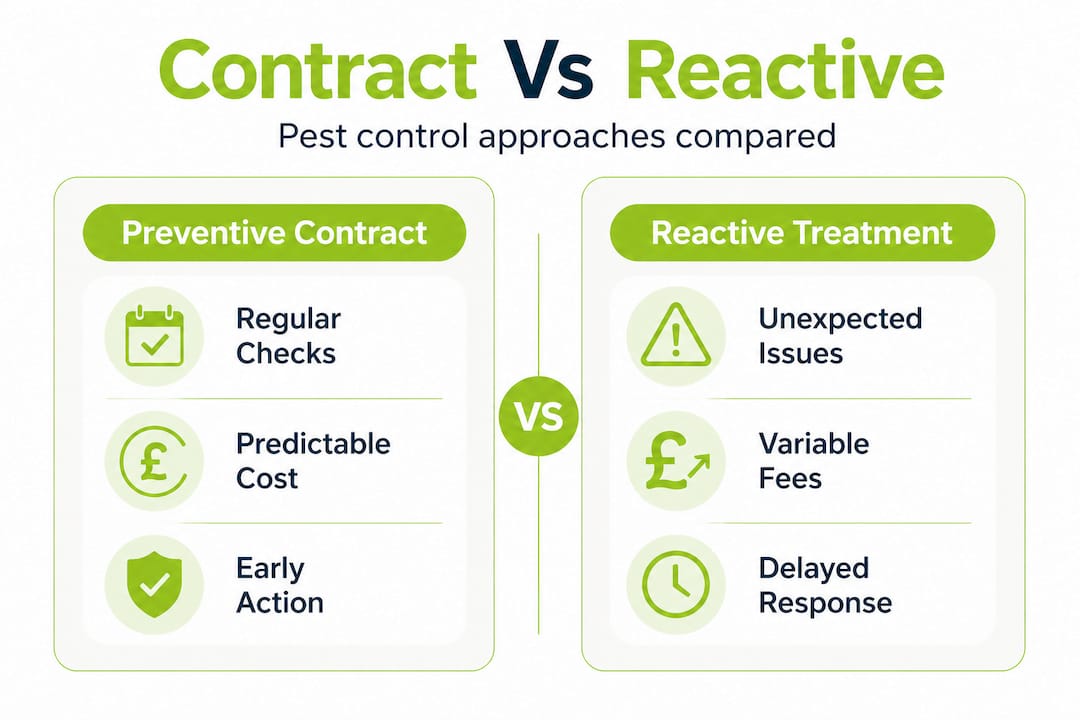
Preventive contracts allow technicians to identify and address the conditions that attract pests before those conditions become problems. They check entry points, monitor bait stations, and flag structural vulnerabilities. This kind of ongoing attention is impossible to replicate with occasional reactive visits.
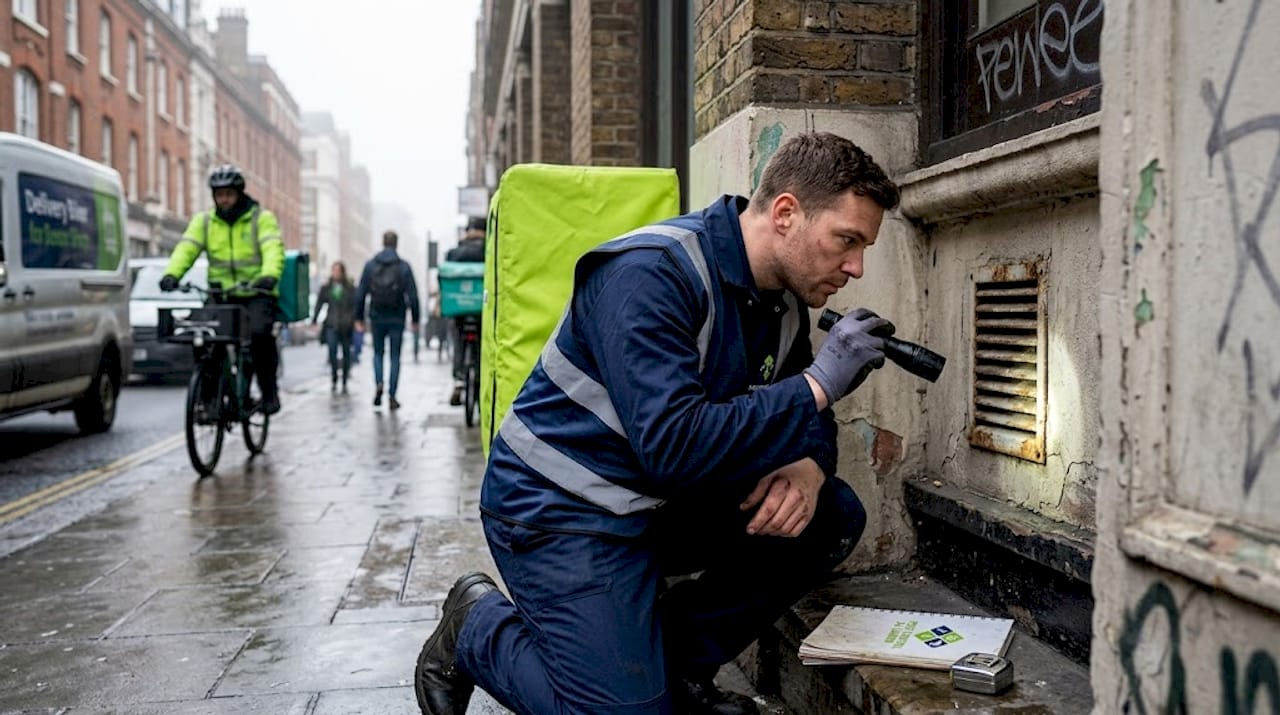
Some property managers assume they can identify lawn pests or interior pest activity early enough on their own. In practice, commercial premises are too complex and too busy for thorough self-inspection. A trained technician sees things that busy staff simply do not notice.
Pro Tip: Before signing a contract, ask your provider for a baseline survey of the property. A written survey gives you a clear picture of current risks and ensures the contract is priced and scoped appropriately for your premises. Understanding what to expect will also help you prepare for pest treatment more effectively.
Choosing the right pest management provider
Not every pest control company operating in London meets the standards required for commercial or regulated properties. Choosing the wrong provider can leave you exposed, both legally and practically.
Here is what to check before committing to any contract:
- BPCA membership — Confirms the company operates to the BS EN 16636 standard and undergoes regular external auditing.
- EN 16636 compliance — Ask for evidence of current accreditation, not just a claim.
- RSPH Level 2 technicians — Technicians should hold at minimum a Royal Society for Public Health Level 2 Award in Pest Management.
- Insurance of at least £5 million — Public liability insurance protects your property if something goes wrong during treatment.
- CPD commitment — Qualified providers ensure their staff undertake Continuing Professional Development so knowledge stays current.
- Waste management compliance — Chemical waste from treatments must be handled correctly under environmental law.
BPCA guidance on assessments is clear: choosing a certified provider for these qualifications helps you avoid fines and ensures your pest management is legally defensible. Providers who cannot demonstrate these credentials should be avoided regardless of how attractive their pricing appears.
We serve businesses across London from our base, with local expertise available through our Barking Pest Control team as well as broader services including specialist pest control cleaning services that go beyond treatment to restore premises after an infestation.
Pro Tip: Ask any prospective provider how they handle an infestation discovered outside normal scheduled visits. The answer reveals whether emergency cover is genuinely included or whether you will face additional charges every time a problem arises.
The uncomfortable truth about pest control: what contracts solve and why most businesses overlook them
Having worked across London’s commercial property sector since 2015, we have seen one pattern repeat itself far too often: a business cuts its pest control contract to save money, gets through several quiet months, and then faces an emergency infestation during its busiest trading period. The cost of that single emergency frequently exceeds an entire year’s contract fee.
Short-term thinking is understandable when budgets are tight. But pest risk does not pause because you have decided not to pay for prevention. Rodents, insects, and birds remain as active as ever, and London’s density, older building stock, and busy food trade create conditions where pest pressure is constant.
A commercial pest control contract does something beyond pest management: it signals to your insurers, your staff, your customers, and any regulatory body that hygiene and property protection are taken seriously. That signal carries real value. Some commercial insurers now ask whether documented pest management is in place when calculating liability cover for hospitality and food businesses.
The businesses that invest in formal contracts also tend to catch minor issues before they become major ones, protecting not just their premises but their reputation. In an age of online reviews and food hygiene ratings publicly displayed on every restaurant door, a single pest sighting reported by a customer can undo years of effort.
Protect your property with London’s trusted pest control solutions
Now that you understand what pest control contracts offer in practical, legal, and financial terms, the next step is straightforward.
We have been providing certified pest management across London since 2015, working with hotels, restaurants, food retailers, residential landlords, and everything in between. Our contracts are built around full BS EN 16636 compliance, with audit-ready documentation and genuine emergency response cover. Whether you need a structured commercial pest control contract for a regulated business premises or a reliable domestic pest control contract for a residential portfolio, we can tailor a programme to your property’s specific needs. Get in touch for a free quote and baseline survey.
Frequently asked questions
What does a pest control contract include?
Typically, contracts cover scheduled inspections, preventive treatments, compliance reports, and emergency response to infestations between planned visits.
How often are pest control audits required in London?
BS EN 16636 audits are required at least every 18 months for BPCA-accredited providers, though your business may face additional regulatory inspections at any time.
Can I cancel a pest control contract early?
Most contracts allow early termination with appropriate notice, but you should read your terms carefully to check for minimum durations or cancellation fees before signing.
Are preventive contracts really cheaper than reactive treatments?
Evidence shows that preventive IPM contracts reduce long-term costs and pest pressure considerably compared to repeated emergency callouts, which often carry premium pricing.
What qualifications should a pest control contractor have in London?
Look for BPCA accreditation and EN 16636 compliance, RSPH Level 2 qualified technicians, a minimum of £5 million public liability insurance, and documented waste management procedures.
Recommended
- Best pest control practices for London homes: 10+ years of expertise
- Commercial Pest Control London | Business Pest Management 24/7 – Pest Control 24 London
- Pest Control Cleaning Services London | Post-Treatment Sanitization – Pest Control 24 London
- Essential pest control tips for London homes and businesses