

A compliant pest audit for a hospitality venue runs through eight core steps: review the site profile and pest history, walk the exterior perimeter checking for proofing failures, sweep interior zones from high-risk to low-risk, inspect all monitoring devices, capture and label photographic evidence, log corrective actions with priority ratings, schedule immediate repairs for critical gaps, and hand over a completed documentation pack. Run these in order every time, and your audit trail will satisfy BRC, SALSA, and local authority inspectors.
Quick brief for staff: “Today we are checking every zone from the loading dock inward, recording all device readings, photographing any evidence, and logging every defect before we leave the building.”
The site manager or head chef signs the completed record. Store the digital folder or physical binder on site, accessible to your contracted pest controller and any visiting auditor.
A pest audit is only as strong as its paper trail. A thorough site walk with no written record is, in audit terms, a site walk that never happened.
Table of Contents
- What is a pest audit and why do hospitality venues need one?
- When should you schedule audits and who should carry them out?
- Step-by-step audit checklist: exterior, interior and room-by-room tasks
- Common audit findings in hospitality venues and how to fix them
- Typical audit timeline and realistic cost expectations in the UK
- Key takeaways
- What most hospitality managers get wrong about pest audits
- Pestcontrol24london’s audit and remedial service for London venues
- Useful sources and standards for UK hospitality managers
What is a pest audit and why do hospitality venues need one?
A pest audit is a structured inspection of a premises that assesses the risk of pest activity, verifies that monitoring and proofing measures are working, and produces documented evidence that management is meeting its duty of care. The outcome is a written record, not just a verbal report.
Hospitality venues sit at the sharp end of pest-related risk. A single rodent sighting in a kitchen or a cockroach found in a food store can trigger an Environmental Health Officer visit, a food hygiene rating drop, or a retailer delisting. The health risks linked to kitchen pests are well documented, and the reputational damage from a public pest incident can outlast any remediation work.
Three standards shape what auditors expect from UK hospitality sites:
- BRC Global Standard for Food Safety (Issue 9): Requires documented pest management procedures, contractor oversight, monitoring device records, trend analysis, and evidence of corrective actions. An internal audit checklist aligned to BRC v8 covers proofing, monitoring, treatments, device checks, chemical storage, and trend tracking.
The basic evidence package auditors expect includes a current site plan with monitoring points marked, a pest sighting log, dated service reports from each visit, and a corrective-action register showing what was found and what was done about it.
When should you schedule audits and who should carry them out?
Frequency is not a matter of preference; it is a compliance requirement shaped by site risk and the standards your venue is audited against.
Recommended schedule for hospitality venues:
- Monthly: Interior and exterior visual checks, monitoring device inspection, and sighting log update. Industry guidance recommends monthly interior and exterior inspections with a 12-month tracking grid for evidence and monitoring points.
- Quarterly: Full building-envelope walk with your pest controller, pipe and conduit sealing review, floor-to-wall junction inspection, and 7-day repair scheduling for any critical gaps found.
- Annual: Comprehensive review covering all zones, full device audit, contractor performance review, and update of the site pest management plan.
Who should be present:
- Contracted BPCA-qualified pest controller: Leads the technical inspection, operates monitoring devices, and produces the service report.
- Head chef or kitchen manager: Provides access to high-risk food zones and can flag recent sightings or housekeeping concerns.
- Maintenance lead: Responsible for structural proofing repairs and can assess feasibility of corrective actions on the spot.
- Quality or health-and-safety lead: Ensures findings are logged against the compliance register and escalated appropriately.
Choosing the right contractor — a short checklist:
- Holds current BPCA membership and relevant qualifications (BASIS PROMPT or equivalent).
- Has demonstrable experience with food-production or hospitality sites.
- Provides a written service specification before starting work.
- Delivers a signed, dated service report after every visit.
- Can supply Safety Data Sheets (SDS) for all products used on site.
Some administrative elements, such as reviewing the previous service report or updating the sighting log, can be completed remotely. The physical inspection, device checks, and proofing assessment must always be carried out in person.
Step-by-step audit checklist: exterior, interior and room-by-room tasks
A zoned inspection approach reduces the risk of missing activity at transition points and makes documentation far more defensible. Start at the building perimeter and work inward.
Zone 1: Exterior perimeter and loading areas
- Check all external doors, roller shutters, and dock levellers for gaps and worn seals.
- Inspect drainage grates, manhole covers, and external drain runs for signs of rodent activity.
- Examine vegetation, pallets, and stored materials within 3 metres of the building.
- Check external bait stations: tamper-resistance, bait consumption, and labelling.
- Look for gnaw marks, burrow entrances, and smear marks at ground level.
- Review waste enclosures: lids secure, no spillage, collection frequency adequate.
Zone 2: Service entries, plant rooms, and utility areas
- Inspect all pipe and conduit penetrations through external walls for gaps.
- Check HVAC intake and exhaust points for mesh or flap integrity.
- Examine electrical trunking runs for rodent gnawing or insect harbourage.
Zone 3: Kitchen and food preparation
- Inspect floor-to-wall junctions, particularly behind fixed equipment.
- Check under and behind refrigeration units for grease accumulation and pest evidence.
- Examine dry-goods storage for stored product insect (SPI) activity: webbing, frass, or larvae.
- Verify glue boards are in position, dated, and within their replacement schedule.
- Check drain covers and floor drains for drain fly larvae or rodent entry.
Zone 4: Storerooms and dry goods
- Inspect all racking at floor level and at the back of shelves.
- Check for rodent droppings, gnaw marks on packaging, or evidence of nesting material.
- Verify stock rotation (FIFO) is being followed to prevent harbourage in old stock.
- Confirm monitoring devices are accessible and not obscured by stock.
Zone 5: Dining areas and staff rooms
- Check skirting boards, service hatches, and ceiling voids for access points.
- Inspect upholstered seating for bed bug evidence if the venue includes overnight accommodation.
- Review staff locker rooms and break areas for food waste and harbourage conditions.
Zone 6: Refuse and external waste areas
- Confirm bins are lidded and positioned away from the building entrance.
- Check for fly breeding conditions: standing liquid, organic matter accumulation.
- Inspect the perimeter of the waste enclosure for rodent burrows.
Monitoring device and proofing data reference:
| Inspection item | Standard / threshold | Check cadence |
|---|---|---|
| Entry gap (mice) | Seal any gap larger than 6 mm | Quarterly minimum |
| Entry gap (rats) | Seal any gap larger than 13 mm | Quarterly minimum |
| Internal bait station | Check bait consumption and condition | Monthly |
| External bait station | Check tamper-resistance, consumption, label | Monthly |
| Glue board | Replace when 50% covered or at 4 weeks | Monthly |
| Drain inspection | Check for larvae, blockage, rodent entry | Monthly |
| Floor-to-wall junctions | Inspect for gaps and proofing integrity | Quarterly |
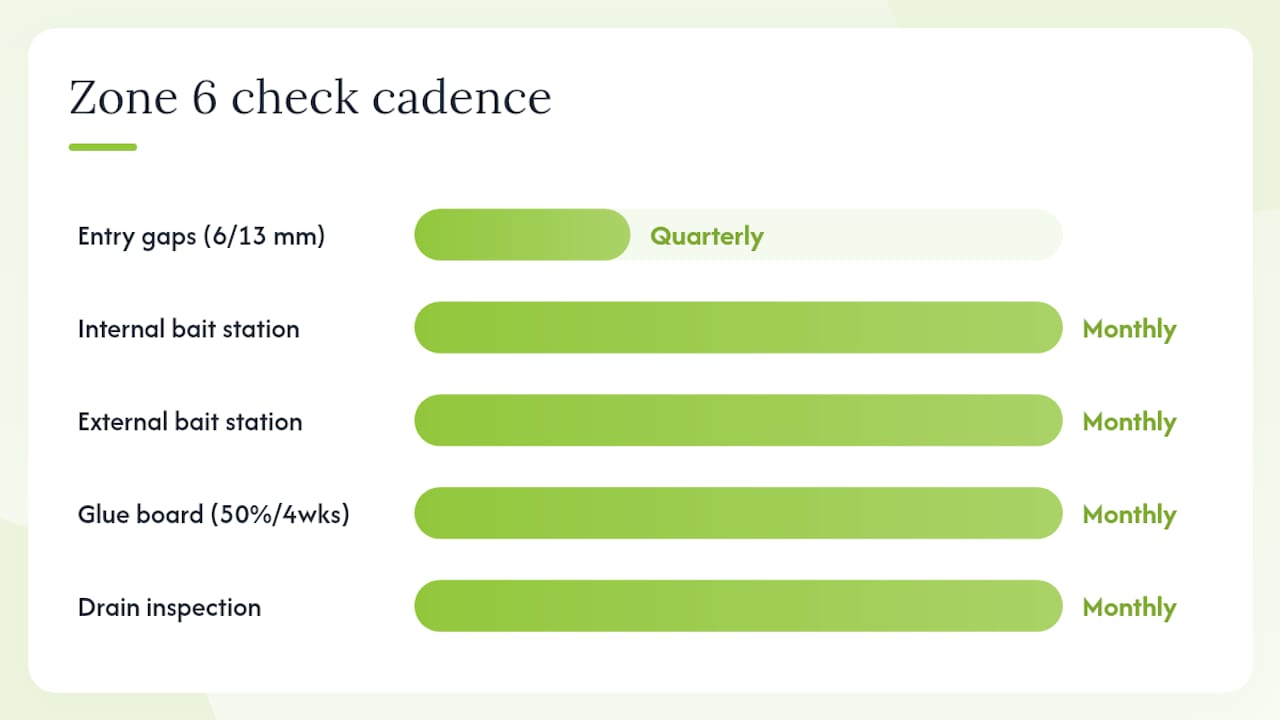
Gap-size thresholds matter for commercial compliance: gaps larger than approximately 6 mm allow mice to enter, and gaps larger than approximately 13 mm allow rats. Scheduling critical gap repairs within 7 days is the standard that BPCA-aligned programmes follow.
Pro Tip: Photograph every monitoring device at each visit using a consistent naming convention: zone code, device number, and date (e.g., KIT-GB-03-2026-03-15). This lets a follow-up technician verify the prior status of any device without ambiguity.
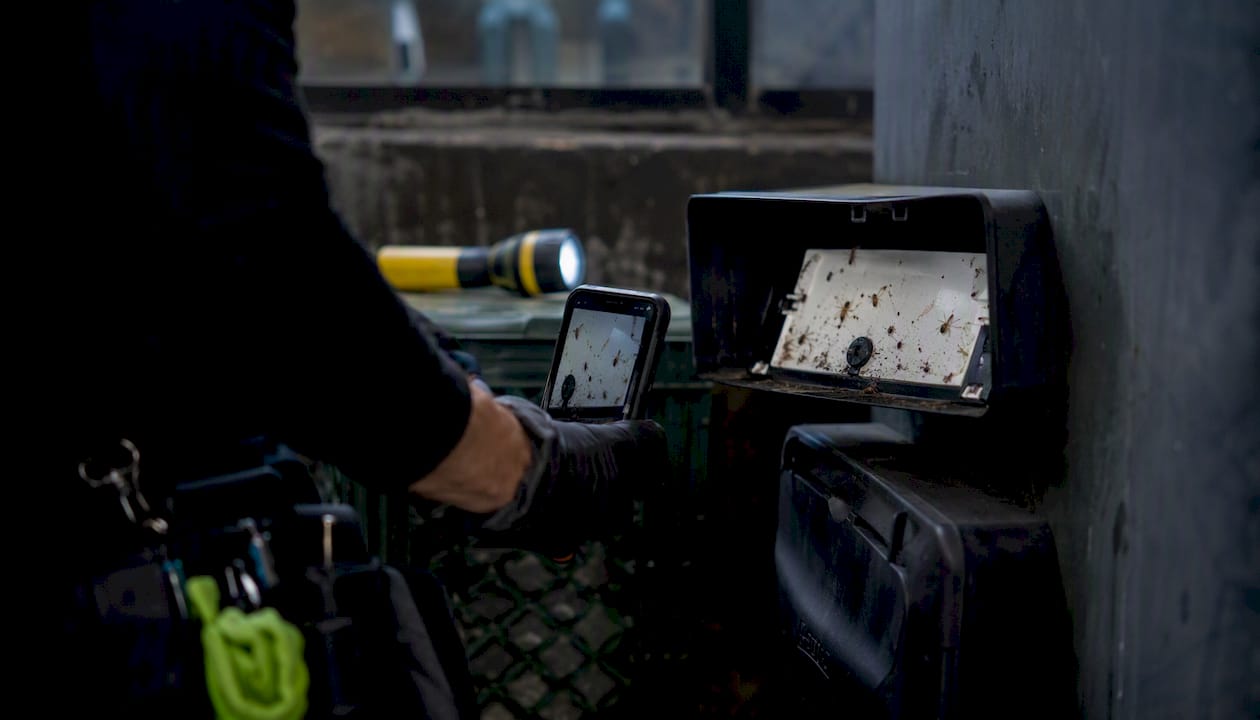
Pro Tip: Always record negative findings. Noting “no evidence at high-risk point” is as important as recording activity, because it allows auditors to assess trends and verify that the point was actually checked.
Common audit findings in hospitality venues and how to fix them
Most non-conformances found during hospitality pest audits fall into a short list of recurring categories. Knowing them in advance lets you address them before an external auditor does.
Priority: Immediate (resolve within 24 hours)
Priority: High (resolve within 7 days)
- Gaps at pipe penetrations: The most common structural finding. Seal with appropriate materials (wire wool backed by mortar or proprietary foam for smaller gaps). See rodent proofing guidance for material specifications.
Priority: Medium (resolve within 30 days)
Priority: Low (resolve within 90 days)
For common commercial pest control mistakes that compound these findings, a structured avoidance checklist is worth reviewing alongside this guide.
When to escalate to an external BPCA-qualified provider: Any active infestation evidence in a food zone, any structural gap that cannot be sealed within 7 days using in-house resource, or any finding that would constitute a critical non-conformance under BRC or SALSA.
Typical audit timeline and realistic cost expectations in the UK
Understanding how long an audit takes and what it costs helps managers budget accurately and avoid under-resourcing the programme.
Time estimates by audit type:
- Monthly interior check (single-site, up to 500 m²): 1–2 hours including device inspection, sighting log update, and brief written report.
- Quarterly exclusion audit (full building envelope, up to 500 m²): 2–4 hours including perimeter walk, proofing assessment, and corrective-action log.
- Annual comprehensive audit (multi-zone site, 500–2,000 m²): 4–8 hours including all zones, full device audit, trend review, and updated site plan.
Cost-band guidance (UK, 2026):
These are indicative ranges based on typical London and South East market conditions; actual quotes will vary by site complexity, number of monitoring points, and contractor.
- Monthly routine visit (single-site contract): £80–£200 per visit.
- Quarterly exclusion audit: £150–£400 per visit, depending on site size and proofing complexity.
- Remedial proofing works (typical single-site job): £200–£800, depending on the number of penetrations and materials required.
- Drain survey (CCTV inspection for pest entry): £150–£350 for a standard survey.
Key cost drivers:
- Number of monitoring points and device types (bait stations, glue boards, pheromone traps, electronic monitors).
- Site complexity: multi-floor venues, basement kitchens, and external storage areas all add time.
- Volume of corrective-action work required after the inspection.
- Whether specialist surveys (drain, roof, or void inspection) are needed.
Budgeting for minor recurring repairs, typically £50–£150 per quarter for sealant, brush strips, and replacement device components, prevents the accumulation of structural defects that eventually require a costly remediation programme. A pest management plan with examples can help managers structure this budget into an annual maintenance schedule.
Key takeaways
A compliant pest audit for a UK hospitality venue requires monthly monitoring checks, quarterly structural exclusion audits, complete documentation at every visit, and a BPCA-qualified contractor who can produce defensible records.
| Point | Details |
|---|---|
| Audit frequency | Monthly interior checks and quarterly exclusion audits are the minimum for hospitality compliance. |
| Gap-size thresholds | Seal any gap larger than 6 mm (1/4 inch) for mice, and larger than 13 mm (1/2 inch) for rats; schedule critical repairs within 7 days to maintain pest-proofing integrity. |
| Documentation standards | Every service report must record species, life stage, location, product, rate, and technician name. |
| Photographic labelling | Use a consistent naming convention (zone, device number, date) so any technician can verify prior status. |
| Pestcontrol24london | BPCA-qualified audits for London hospitality venues, with photographic reports and 7-day repair scheduling. |
What most hospitality managers get wrong about pest audits
The single most common mistake is treating the pest audit as a contractor’s job rather than a management responsibility. A BPCA-qualified technician can inspect every corner of a building and produce a thorough report, but if the venue manager has not briefed staff, updated the sighting log, or arranged access to locked areas, the audit is compromised before it starts.
The second mistake is filing the service report without acting on it. A corrective-action register that lists defects from six months ago, still marked as open, is one of the first things an Environmental Health Officer will notice. The audit process only has value when the findings drive repairs, and the repairs are verified and closed in the record.
There is also a tendency to focus exclusively on rodents and overlook stored product insects, drain flies, and structural harbourage conditions that accumulate gradually. A zoned, device-by-device inspection catches these before they become the headline finding on an audit report.
Hospitality pest management is not a reactive discipline. The venues that consistently pass audits without critical findings are the ones that run the same structured checklist every month, keep their records current, and treat every quarterly exclusion audit as an opportunity to find problems before an auditor does.
Pestcontrol24london’s audit and remedial service for London venues
London hospitality venues that need a structured, audit-ready pest management programme get exactly that from Pestcontrol24london. The service covers onsite exclusion audits, a photographic service report with every visit, a corrective-action register, 7-day critical repair scheduling, and a follow-up verification to confirm defects are closed.

Every technician holds current BPCA qualifications, and the service has been running since 2015 across hotels, restaurants, hostels, and catering operations throughout London. The documentation pack produced after each visit is formatted to satisfy BRC, SALSA, and local authority requirements, so venue managers have exactly what they need when an auditor arrives.
For a commercial pest control contract that covers routine monitoring, quarterly exclusion audits, and remedial proofing, contact Pestcontrol24london directly. You can also visit pestcontrol24london.co.uk to request a free quote or book an initial site survey. If you need a same-day response to an active finding, the 24/7 emergency line is available around the clock.
Useful sources and standards for UK hospitality managers
These resources are worth saving to your site pest-management folder. Each one serves a specific purpose in building or auditing your programme.
- Free Pest Control Inspection Checklist PDF | IPM & Health Code Compliant | MaintainIQ
- Pest Control Inspection Checklist: Complete Field Template — PestPro Blog
- Pest Control Internal Audit Checklist (AU-001-X) BRC V8 | Free Template
- Pest Control Checklist
- Free Pest Control Evaluation Checklist for Hospitality | PDF
For event and catering-specific planning that sits alongside your pest management programme, the catering checklist guide for event planners covers pre-event preparation steps that complement a venue’s ongoing compliance controls.