

A single mouse sighting in your restaurant kitchen or a wasp nest spotted near your warehouse loading bay might seem minor. Many business owners brush these off, assuming a quick fix is enough. But London’s commercial pest control regulations hold businesses to a far stricter standard, and what looks like a small issue can trigger enforcement action, fines, or even temporary closure. This guide breaks down exactly what the regulations require, where businesses most often fall short, and what practical steps you can take right now to stay compliant and protect your operation.
Table of Contents
- Understanding commercial pest control regulations in London
- Business responsibilities: What compliance really means
- Best practices for ongoing pest prevention
- How professional pest control services support compliance
- Why compliance demands more than pest checks: A hard-earned lesson
- Stay compliant with professional pest control for your London business
- Frequently asked questions
Key Takeaways
| Point | Details |
|---|---|
| Legal compliance is mandatory | London businesses must follow strict pest control laws to avoid fines and protect their operations. |
| Prevention requires routine action | Consistent cleaning, inspections, and prompt response are crucial to preventing pest-related violations. |
| Documentation safeguards your business | Keeping thorough pest control records can make the difference during audits or regulatory checks. |
| Professional help streamlines compliance | Hiring experts ensures proper monitoring, quick intervention, and audit-ready reporting. |
Understanding commercial pest control regulations in London
Pest control in commercial premises is not simply a matter of good housekeeping. It is a legal obligation. Pest control in commercial premises is governed by multiple UK and local regulations, including the Food Safety Act 1990 and the Health and Safety at Work Act. These laws exist to protect public health, safeguard employees, and ensure that businesses do not become sources of contamination or disease.
The Food Safety Act 1990 requires food businesses to maintain hygienic conditions and prevent contamination. The Health and Safety at Work Act places a duty on employers to provide a safe working environment, which includes managing pest risks. On top of these national laws, individual London boroughs may impose additional requirements through local environmental health departments.
Who enforces these rules? Local authority environmental health officers (EHOs) carry out inspections and have the power to issue improvement notices, prohibition orders, and fines. They can act on complaints from the public, conduct routine checks, or respond to reported incidents.
The consequences of non-compliance are serious:
- Fines that can run into thousands of pounds
- Immediate closure notices for premises deemed a public health risk
- Reputational damage from public records of enforcement actions
- Loss of food hygiene ratings, which directly affects customer trust
- Potential criminal prosecution in severe cases
The businesses most affected by these regulations include:
| Business Type | Key Regulatory Concern |
|---|---|
| Restaurants and takeaways | Food contamination, hygiene ratings |
| Warehouses and storage | Rodent and insect damage to goods |
| Retail shops | Customer safety, stock protection |
| Offices | Employee health and duty of care |
| Hotels and hostels | Guest safety, licensing compliance |
Every one of these business types can face enforcement action if pest management is not taken seriously. The regulations do not distinguish between a small café and a large hotel chain. Compliance is expected across the board.
Business responsibilities: What compliance really means
With regulations in mind, what exactly are businesses required to do on a daily and ongoing basis? The short answer is: more than most realize. Businesses must take all reasonable precautions to prevent pest problems, maintain hygiene, and document their pest management strategy. That last part, documentation, is where many businesses fall short.
Here is what compliance actually looks like in practice:
- Conduct regular risk assessments to identify potential entry points, harbourage areas, and conditions that attract pests.
- Implement preventive measures such as sealing gaps, managing waste correctly, and maintaining clean storage areas.
- Schedule and record professional inspections at appropriate intervals for your business type.
- Maintain a pest control logbook that records all sightings, treatments, and corrective actions taken.
- Act promptly when a pest issue is identified, and document the response.
The level of obligation varies depending on your business type. Here is a quick comparison:
| Business Type | Inspection Frequency | Documentation Required |
|---|---|---|
| Food businesses (restaurants, cafes) | Monthly or quarterly | Full logbook, treatment certificates |
| Retail and shops | Quarterly | Inspection records, action logs |
| Offices | Bi-annually | Basic records, risk assessments |
| Warehouses | Quarterly | Stock inspection logs, treatment records |
Food businesses carry the heaviest burden because contamination risks are highest. But offices and retail spaces are not exempt. Even a single unaddressed rodent sighting in an office can constitute a failure to meet the duty of care owed to employees.

Staying current with compliance updates is also important, as local borough requirements can change and new guidance is periodically issued.
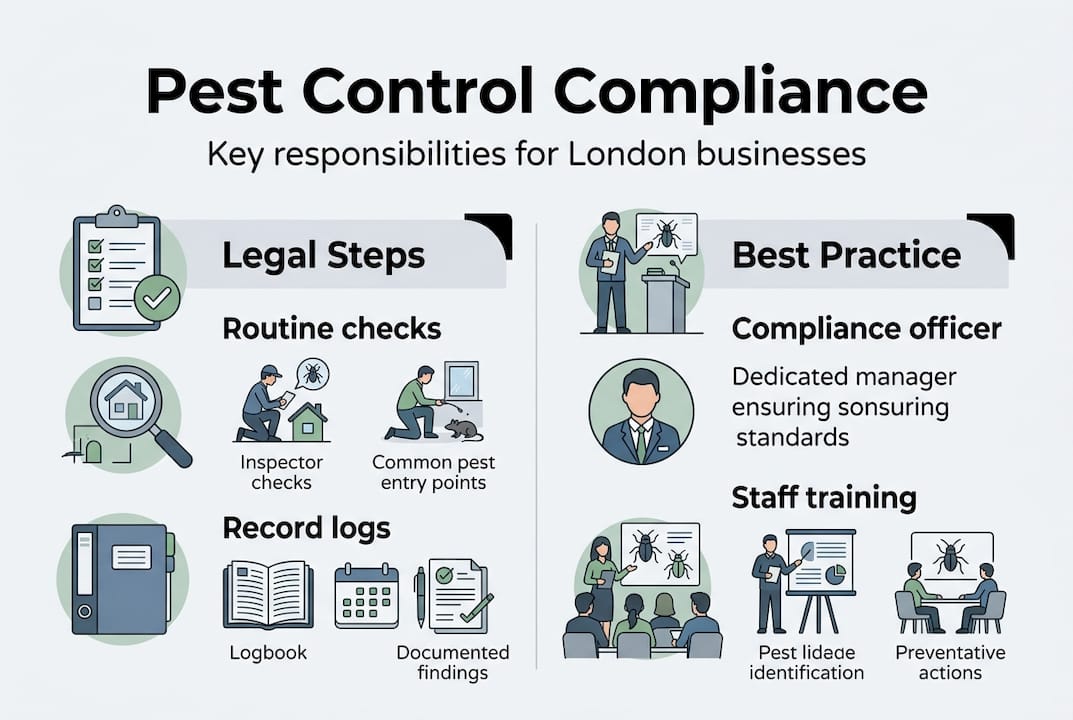
Pro Tip: Designate a specific staff member as your pest control compliance officer. This person should be responsible for maintaining the logbook, coordinating with your pest control provider, and flagging any sightings immediately. Shared responsibility often means no responsibility.
Best practices for ongoing pest prevention
Knowing your responsibilities is half the battle. Maintaining compliance requires ongoing vigilance and smart routines built into your daily operations. Prevention is far less costly than remediation, and it is far better for your reputation.
Here are the core daily and weekly tasks that keep commercial premises pest-free:
- Waste management: Ensure bins are sealed, emptied regularly, and stored away from entry points. Overflowing or improperly stored waste is one of the top attractants for rodents and insects.
- Cleaning protocols: Clean behind and beneath equipment, inside storage areas, and along wall edges where grease or debris accumulates.
- Entry point checks: Inspect doors, windows, utility penetrations, and drainage regularly. Even a gap the width of a pencil is enough for a mouse to enter.
- Stock rotation: Rotate stored goods to prevent undisturbed harbourage areas where pests can nest undetected.
- Reporting culture: Train all staff to report pest sightings immediately, not at the end of the week.
Regular professional inspections are the most effective way to catch pest issues before they become violations or public health hazards. Scheduling these in advance and keeping records of every visit is essential.
The top three mistakes that lead to repeat violations are:
- Skipping scheduled inspections because the premises looks clean
- Failing to document corrective actions after a sighting
- Relying solely on reactive treatments rather than preventive routines
For practical guidance on keeping your premises protected year-round, reviewing pest prevention news and following pest-proofing tips can give you a useful edge.
Pro Tip: Even spotless facilities can have hidden pest risks. Pests do not just seek food. They seek warmth, shelter, and water. A clean kitchen with a dripping pipe under the sink is still an attractive target. Never skip scheduled checks based on appearances alone.
How professional pest control services support compliance
While prevention is key, regulatory compliance often depends on documentation and expertise from outside professionals. Hiring a qualified pest control company is not just a convenience. For many London businesses, it is a regulatory necessity.
Professional pest controllers can provide certification and audit-ready records, which are often requested by local authorities during inspections. This means that when an EHO visits your premises, you can produce a complete paper trail showing every inspection, treatment, and corrective action taken. That documentation can be the difference between a warning and a fine.
A typical professional pest control service contract for a commercial client covers:
- Scheduled monitoring visits at agreed intervals
- Rapid response callouts for urgent infestations
- Written reports after every visit, including findings and recommendations
- Treatment certificates for any pesticide applications
- Proofing advice to address structural vulnerabilities
Before signing a service agreement, ask the following questions:
- Is the company BPCA (British Pest Control Association) certified?
- Do they provide written reports after every visit?
- What is their response time for emergency callouts?
- Can they supply documentation in a format accepted by local authority audits?
- Do they have experience with your specific business type?
“Choosing a certified pest control provider is not just about solving a current problem. It is about building a documented history of responsible pest management that protects your business during any regulatory review.”
For situations that cannot wait, having access to emergency pest control means you can respond quickly and document that response, which is itself a compliance requirement. A well-structured business pest service contract gives you scheduled coverage and emergency support in one arrangement.
Why compliance demands more than pest checks: A hard-earned lesson
After more than ten years working with London businesses, from large hotel chains to independent takeaways, we have seen a clear pattern. The businesses that get penalized are rarely the ones that ignore pest control entirely. They are the ones that do the work but fail to prove they did it.
Documentation gaps are the most common reason businesses fail inspections. A verbal instruction to seal a gap, a treatment applied without a written record, an inspection that happened but was never logged. These are the procedural failures that enforcement officers act on.
The businesses that consistently stay compliant treat pest management as ongoing risk mitigation. They do not wait for a sighting. They schedule, document, review, and repeat. Working with compliance service experts means you are not just reacting to visible pests. You are building evidence of continual prevention, which is exactly what regulators want to see. That shift in mindset is what separates businesses that pass inspections from those that do not.
Stay compliant with professional pest control for your London business
Navigating commercial pest control regulations in London does not have to be overwhelming. With the right professional support, you can meet every legal requirement, maintain a safe environment for staff and customers, and have the documentation ready for any inspection.
At Professional Pest Control Services, we have been helping London businesses stay compliant since 2015. We are BPCA fully qualified, and we work with restaurants, hotels, retail outlets, and offices across the city. Our service contracts are built around your business type and regulatory obligations. Whether you need scheduled monitoring or urgent support, our pest control experts are ready to help. Reach out today to discuss a London commercial pest control plan tailored to your premises.
Frequently asked questions
What are the penalties for failing to follow commercial pest control regulations in London?
Violations may result in hefty fines or immediate closure notices for London businesses, and enforcement records can become publicly accessible, causing lasting reputational harm.
Who is responsible for pest control compliance in a rented commercial space?
Business owners are generally accountable for pest management in their occupied premises, though lease terms can define shared duties between landlord and tenant, so reviewing your agreement is essential.
How often should my business schedule professional pest inspections?
Quarterly or even monthly inspections are best practice for London commercial premises, with food service businesses typically requiring more frequent checks due to higher contamination risks.
Can pest control documentation really make a difference during inspections?
Proper documentation is key to passing regulatory audits and avoiding penalties, as it gives environmental health officers clear evidence that your business has actively managed pest risks over time.
Recommended
- Commercial Pest Control London | Business Pest Management 24/7 – Pest Control 24 London
- Domestic Pest Control London | Professional Home Pest Removal – Pest Control 24 London
- Pest Control Cleaning Services London | Post-Treatment Sanitization – Pest Control 24 London
- Emergency Pest Control London | 24/7 Rapid Response Service – Pest Control 24 London