

Report the problem in writing to your landlord or letting agent today — that single step is the most effective first action you can take. If the infestation poses an immediate health risk, or if your landlord fails to respond within a reasonable period, contact your local authority’s environmental health team. Shelter guidance confirms that verbal reports alone are insufficient if the case is escalated; a dated, written record is the foundation of every successful complaint.
In the first hour, do this:
- Photograph every sign of pest activity (droppings, gnaw marks, entry points) with your phone’s timestamp on.
- Write a brief, dated email to your landlord or letting agent describing what you have seen, where, and when.
- Note any structural defects you can see — holes in skirting boards, gaps around pipes, missing roof tiles — and include them in the same message.
- If the situation is unsafe (for example, a large rodent infestation near food preparation areas or a child’s bedroom), call a BPCA-registered contractor for emergency attendance.
- Save copies of everything you send.
Pro Tip: When you write to your landlord, explicitly link the pest problem to any structural defect you have identified. A message that says “rats are entering through a hole in the skirting board at the rear of the kitchen” shifts repair responsibility — and potential cost liability — onto the landlord far more effectively than a general complaint about rodents.
The Housing Ombudsman sets clear complaint-handling timescales for social landlords: acknowledgement within 5 working days, a stage 1 written response within 10 working days, and a stage 2 written response within 20 working days. Knowing these deadlines gives you a firm basis for escalation if your landlord goes quiet.
Table of Contents
- Who is responsible for dealing with pests in your home?
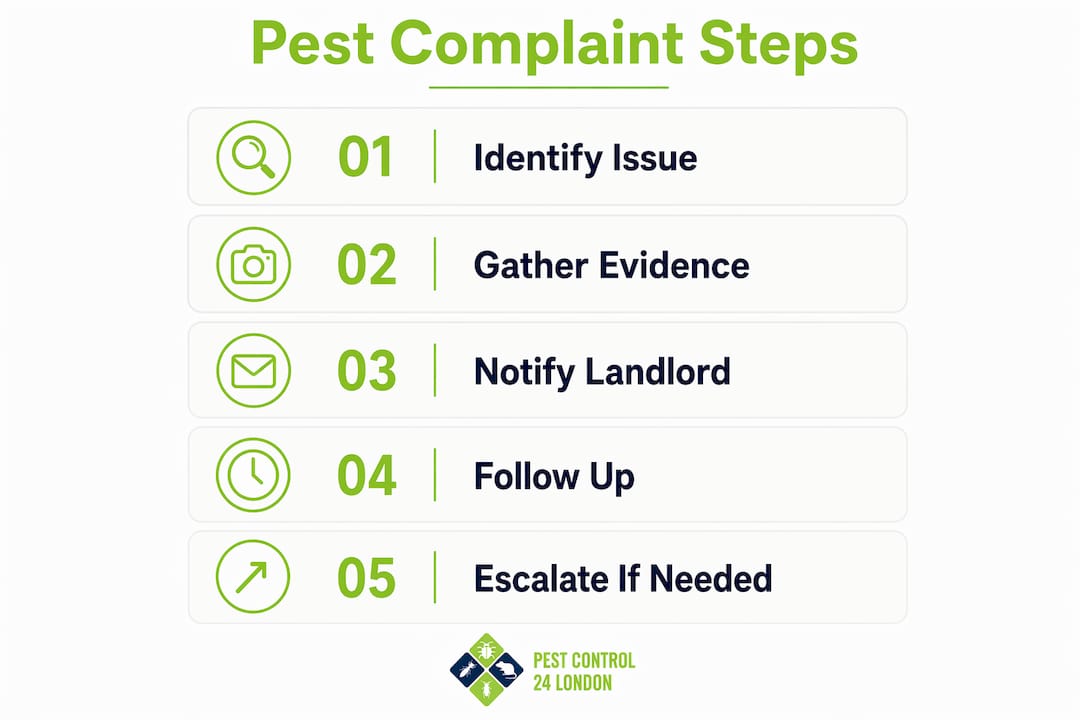
- How to report a pest complaint step by step
- What counts as a pest infestation, and why evidence matters
- What landlords and councils can do — powers and timescales
- Safe short-term steps you can take while waiting for action
- When to call a professional pest controller
- If your landlord still won’t act: escalation routes
- Key takeaways
- A pest-control professional’s perspective
- Pestcontrol24london: BPCA-qualified pest control across London
- Sources and further reading
Who is responsible for dealing with pests in your home?
Responsibility is determined by cause, not simply by who lives in the property. When pests enter because of a structural defect — a gap in the brickwork, a broken drain, missing roof tiles — the landlord is responsible for both the treatment and the repair. When an infestation arises from poor housekeeping or incorrect waste disposal, the tenant is typically liable.

Two common scenarios illustrate this clearly. Rats entering through a hole in the party wall are the landlord’s problem; a mouse infestation that developed because food was left out and rubbish was not disposed of correctly is more likely to fall on the tenant. Documenting the defect in writing — with photographs — is what shifts liability onto the landlord when the cause is structural.
| Party | When responsible | Who usually pays | Typical immediate action |
|---|---|---|---|
| Landlord | Structural defects, disrepair, building fabric failures | Landlord | Arrange inspection, treatment and repairs |
| Tenant | Poor housekeeping, incorrect waste disposal, tenant-caused damage | Tenant | Clean up, remove attractants, report defects |
| Neighbour | Conditions on neighbouring land attracting pests | Neighbour (or council) | Report to local authority environmental health |
Neighbour-related infestations — for example, a neighbouring property with accumulated rubbish attracting rats — sit with the neighbour or, where they refuse to act, with the local authority. In those cases, reporting to environmental health is the correct route.
- Always report suspected structural defects (holes, damp, broken drains) in writing as soon as you notice them.
- Keep a record of every communication, including dates and the landlord’s response (or silence).
- If a pest infestation spans shared areas of a block, the freeholder or managing agent is usually responsible for communal spaces.
How to report a pest complaint step by step
The single best first action is to send a dated email. It creates a timestamp, establishes a paper trail, and puts the landlord on formal notice. Phone calls are useful for urgent situations, but they leave no record.
What to include in your written report:
- The date you first noticed the problem and any dates since.
- The specific location (room, wall, floor level) and type of pest if known.
- Photographs attached to the email, labelled with dates.
- Any health impacts — allergic reactions, sleep disruption, contaminated food.
- Reference to any previous verbal or written reports you have already made.
- Details of structural defects you believe are contributing (holes, gaps, damp patches).
- A clear request for the landlord to inspect and treat within a reasonable timeframe.
Who to contact and when:
- Landlord or letting agent — always first. Give them reasonable time to respond (typically 14 days for non-urgent issues, sooner for health risks).
- Social landlord support team — if you rent from a housing association, use their formal repairs or complaints line and request a reference number.
- Local authority environmental health — if the landlord does not act, or if the infestation is severe. Find your local council via gov.uk.
Sample email you can adapt:
Pro Tip: Send the email to both the landlord and the letting agent simultaneously, and request a read receipt. If you must post a letter, use recorded delivery and keep the tracking reference.
What counts as a pest infestation, and why evidence matters
An infestation is more than a single sighting. It refers to an established presence of pests — rodents, cockroaches, bed bugs, fleas, or similar — in numbers sufficient to cause damage, health risk, or significant nuisance. A mouse seen once near an open back door is not automatically an infestation; repeated sightings, droppings across multiple rooms, gnaw damage, or larvae in food storage areas indicate an established population.
The distinction matters because councils and landlords treat isolated sightings differently from confirmed infestations. Strong evidence pushes a complaint from “possible” to “actionable.”
Evidence that makes a complaint credible:
- Dated photographs of droppings, gnaw marks, larvae, nesting material, or live/dead pests.
- Photographs of structural entry points (holes, gaps, broken vents).
- Traps or glue boards showing catches, with dates noted.
- Written records of smell, noise (scratching in walls), or visible damage to belongings.
- Medical notes if the infestation has caused illness, bites, or allergic reactions.
- Copies of all written communications with the landlord.
Written records and photographs are critical — Shelter and the Housing Ombudsman both stress that verbal reports alone will not support escalation or a court claim. If you later pursue a disrepair claim or a money claim through the courts, your evidence pack is what determines whether you can recover costs.
What landlords and councils can do — powers and timescales
When an infestation is caused by structural disrepair, landlords must arrange both treatment and the underlying repairs. Local authorities have independent enforcement powers and can act even when a landlord refuses.
Typical landlord actions:
- Commission a professional inspection and written treatment plan.
- Arrange pest treatment (baiting, trapping, proofing).
- Carry out structural repairs to remove entry points.
- In severe cases, arrange temporary rehousing while works are completed.
Council environmental health powers:
Local authority environmental health teams can inspect a property, require access, and — in serious cases — apply for warrants to enter and carry out treatment or repairs directly. They can issue improvement notices requiring a landlord to act within a set period, or prohibition orders preventing occupation of a property until conditions are remedied. Some councils offer their own pest control services, often at reduced rates for residents on means-tested benefits.
| Stage | Timescale | Body responsible |
|---|---|---|
| Complaint acknowledgement | Within 5 working days | Social landlord (Housing Ombudsman Code) |
| Stage 1 written response | Within 10 working days | Social landlord |
| Stage 2 written response | Within 20 working days | Social landlord |
| Council inspection | Varies by authority | Local authority environmental health |
| Improvement notice | Issued after inspection | Local authority |
The Housing Ombudsman notes that many pest cases it reviews mask wider disrepair. A durable solution usually requires the landlord to fix structural defects while the tenant maintains cleanliness — neither action alone resolves the problem long-term.
Safe short-term steps you can take while waiting for action
While you wait for your landlord or council to respond, there are practical measures you can take immediately to reduce risk and slow the spread of an infestation. These steps do not replace professional treatment, but they limit the damage.
Do this now:
- Store all food in sealed, hard-sided containers — cardboard packaging offers no barrier to rodents.
- Remove clutter from floors and under furniture, which provides nesting sites.
- Seal obvious small gaps around pipes and skirting boards with wire wool or filler as a temporary measure.
- Dispose of household waste in sealed bags, placed in lidded bins, and removed regularly.
- Report any leaks or damp patches to your landlord in writing — moisture attracts many pest species.
- Keep communal areas tidy if you live in a shared building.
Avoid using DIY pesticide sprays without professional guidance. Some products are harmful if misused, particularly in homes with children, pets, or people with respiratory conditions. If the infestation involves a health risk — for example, a large rodent presence near food or a child’s sleeping area — contact emergency services or a professional contractor rather than attempting self-treatment. Guidance from Mass.gov summarises the principle well: dry them out, starve them out, keep them out.
Pro Tip: Set up a simple photographic log. Take a photo of the same affected area every two to three days, with your phone’s date and time visible. This creates a timeline that shows whether the infestation is worsening — powerful evidence if you later need to escalate to the council or Housing Ombudsman.
For more pest prevention advice specific to London homes, Pestcontrol24london’s guidance covers practical maintenance steps tenants can apply immediately.
When to call a professional pest controller
Call a BPCA-registered or NPTA-registered professional when the infestation is established, when pests are active inside walls or ducting, when there is a clear health risk, or when DIY attempts have failed. Do not delay if you can hear gnawing inside walls or if you have found evidence of bed bugs — these situations require specialist treatment that DIY products cannot reliably deliver.
What a qualified contractor will do:
- Carry out a thorough inspection and risk assessment.
- Provide a written treatment plan before work begins.
- Explain the chemicals, baiting systems, or trapping methods they intend to use.
- Conduct follow-up visits to confirm the treatment has worked.
- Issue documentation of works completed — keep these receipts.
Before you hire, ask:
- Are you registered with the BPCA or NPTA? (Ask to see proof.)
- Are you fully insured for domestic pest control?
- What methods will you use, and are they safe for children and pets?
- What are the estimated timescales and costs?
- Do you provide a written treatment plan and a warranty on the work?
Keep every receipt, report, and photograph the contractor provides. If the infestation was caused by the landlord’s failure to maintain the property, this documentation supports a later disrepair claim or a request for reimbursement. Preparing your home before a technician visits also speeds up treatment; Pestcontrol24london’s guide on preparing for pest treatment covers the practical steps in detail.
If your landlord still won’t act: escalation routes
When a landlord ignores a written complaint, the escalation sequence is clear. Follow it in order, and keep evidence at every stage.
- Send a formal written complaint to the landlord, referencing your original report and the time elapsed without action. State that you intend to contact environmental health if the matter is not resolved within 14 days.
- Report to local authority environmental health. Provide your evidence pack: photographs, dated correspondence, and details of any structural defects. Councils can inspect and issue improvement notices or prohibition orders.
- Complain to the Housing Ombudsman (for social landlords and housing associations). The Ombudsman requires the landlord’s stage 2 complaint response before it will investigate, and accepts referrals within 12 months of that response. If a social landlord fails the Complaint Handling Code timescales, escalate immediately rather than waiting.
- Pursue a disrepair claim or money claim through the courts as a last resort. Tenants who pay for emergency treatment risk not recovering costs if the infestation is later judged to be their responsibility — documented evidence and proof that the landlord was given reasonable time to act are essential.
What to prepare before each escalation:
- A chronological evidence pack (photos, dates, written reports).
- Copies of all landlord correspondence and any responses received.
- The landlord’s stage 2 complaint response (required for the Ombudsman).
- Quotes from contractors if you have paid for or are considering paying for treatment yourself.
Sample paragraph for a formal complaint or Ombudsman referral:
Special case — council tenants: If your landlord is the local council, the council cannot enforce against itself. In this situation, escalating to the Housing Ombudsman is the practical remedy.
Key takeaways
Addressing pest complaints effectively in UK rental properties requires written evidence, clear knowledge of who is responsible, and a structured escalation path if the landlord fails to act.
| Point | Details |
|---|---|
| Report in writing immediately | Send a dated email with photos and structural defect details; verbal reports cannot support escalation. |
| Responsibility follows the cause | Structural defects make the landlord liable; tenant behaviour or poor housekeeping shifts liability to the tenant. |
| Know the official timescales | Social landlords must acknowledge complaints within 5 working days and respond at stage 1 within 10 working days. |
| Escalate in sequence | Landlord → local authority environmental health → Housing Ombudsman → court; prepare an evidence pack before each step. |
| Pestcontrol24london | A BPCA-qualified contractor operating across London since 2015; provides written treatment plans and follow-up visits. |
A pest-control professional’s perspective
The calls that concern me most are the ones where a tenant has been dealing with a problem for weeks before picking up the phone. By that point, what might have been a contained rodent entry point has often become a well-established run behind the kitchen units, with gnaw damage to cables and contamination across a wide area. Early intervention genuinely changes the outcome — not just in terms of cost, but in how quickly the property can be made safe again.
When a call comes in, the first thing a technician assesses is safety and spread risk: is this a single entry point, or is there evidence of an established population? Structural causes — gaps in the building fabric, broken drains, missing proofing around pipes — are identified during the inspection and documented in the written report. Realistic cure timelines depend on the pest species and the extent of the infestation, but most domestic rodent treatments require at least two to three follow-up visits to confirm the population has been eliminated and entry points have been sealed.
Pestcontrol24london has been carrying out BPCA-qualified domestic pest control across London since 2015. The combination of a written treatment plan, documented follow-up visits, and clear communication with both tenants and landlords is what makes the difference between a problem that keeps returning and one that is resolved for good.
Pestcontrol24london: BPCA-qualified pest control across London
When you have followed the reporting steps and need a qualified contractor to attend, Pestcontrol24london offers 24/7 emergency pest control with free quotes, written treatment plans, and documented follow-up visits — all delivered by a BPCA-qualified team with over a decade of experience across London residential and commercial properties.

Whether you need urgent rodent removal, bed bug treatment, or a post-treatment sanitisation service, the team attends promptly and provides the written documentation you need to support a landlord claim or council referral. Always ask any contractor you call to confirm their BPCA or NPTA registration before they attend.
For immediate assistance, visit Pest Control 24 London to request a free quote or book an emergency call-out. For domestic pest control across London, the service page covers all common household pest species and treatment options.
Sources and further reading
- Pests and infestations — Shelter England: The definitive UK guide to landlord and tenant responsibilities, council enforcement powers, and how to document a complaint for escalation.
- Pests support guide — Housing Ombudsman: Official complaint-handling timescales, the Complaint Handling Code, and guidance on when and how to refer a case to the Ombudsman.
- Find your local council — gov.uk: Use this to identify your local authority environmental health team for reporting and enforcement.
- Pest control guidance for occupants — Mass.gov: Practical prevention checklist covering food storage, waste disposal, and reporting structural issues; useful as a behavioural reference for tenants.
- Pestcontrol24london blog: Case studies and in-depth articles on common London pest species, treatment methods, and prevention strategies for residential properties.