

Grey squirrels have no protected status in UK law and are classed as an invasive non-native species. You must never release or relocate one, and lethal control is only lawful when carried out humanely and within welfare rules. For anything beyond simple deterrence or a licensed contractor’s job, check government guidance first.
TL;DR:
- Keeping a grey squirrel requires a rare license, typically only granted to zoos, sanctuaries, or research facilities, and not for personal use.
- Releasing, relocating, or allowing a captive squirrel to escape is illegal under UK law, with no exceptions for accidental or emergency situations.
- Lethal control is lawful only when performed humanely by licensed individuals using legal methods, with strict legal restrictions near protected red squirrel populations.
- Trap checks must be performed daily to prevent unnecessary suffering, and inhumane methods such as drowning are strictly prohibited.
- Prevention, such as sealing entry points and using squirrel-proof feeders, is more effective and humane than trapping and releasing in managing squirrel-related damage.
Table of Contents
- Can I keep a grey squirrel? Licences and regional differences
- Releasing or relocating grey squirrels: prohibitions and narrow exceptions
- Is it lawful to kill or trap grey squirrels?
- Animal welfare and trap-checking: duties and best practice
- Woodland and landowner control: squirrel control plans and timing
- Practical steps for homeowners: what to do first
- Practitioner perspective: what we see in London
- How Pest Control 24 London can help with lawful squirrel control
- Sources
Can I keep a grey squirrel? Licences and regional differences
Grey squirrels have been controlled under British law since the Grey Squirrels (Prohibition of Importation and Keeping) Order 1937, which made importing or keeping them without a licence an offence from the outset. The framework shifted in 2019, when the Invasive Alien Species Order tightened permitting and enforcement across Great Britain, closing gaps in how release and keeping were policed.
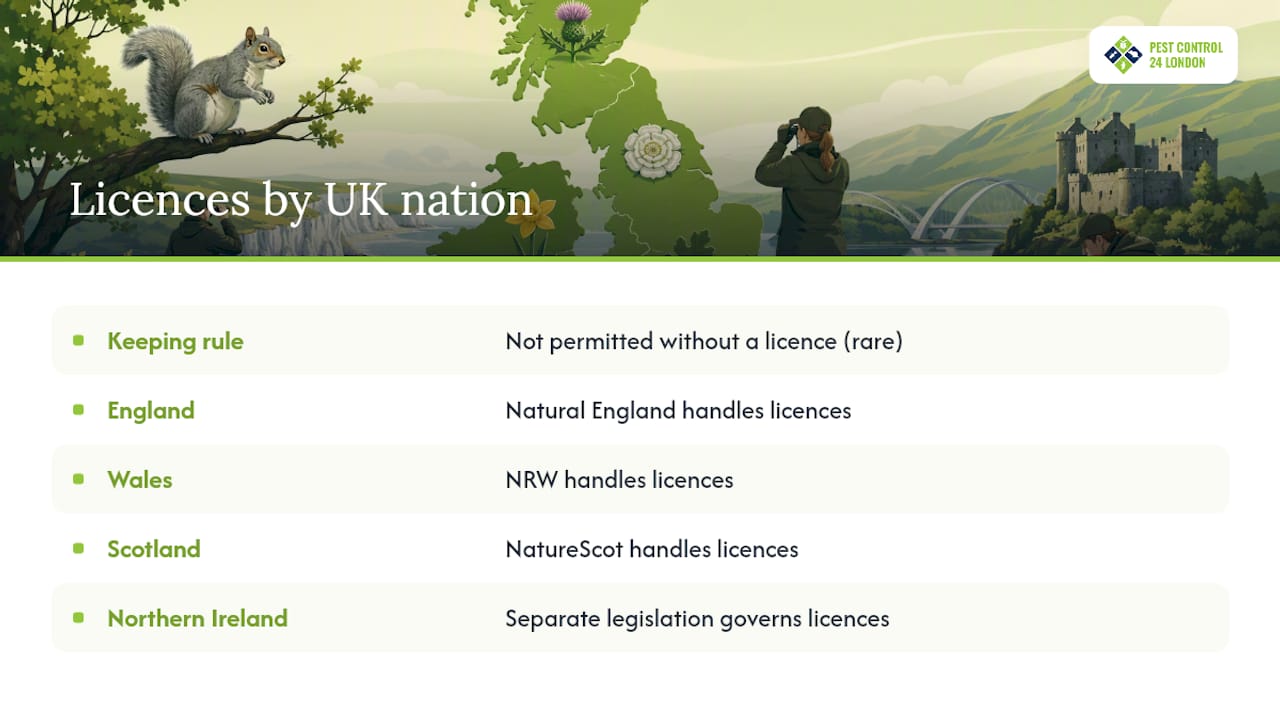
In practice, keeping a grey squirrel as a pet or in captivity is not permitted without a licence, and licences are granted rarely, usually only to zoos, wildlife sanctuaries, or research bodies. Natural England handles licensing enquiries for England; the picture differs slightly elsewhere. Wales and Scotland run their own permitting arrangements through NRW and NatureScot respectively, and Northern Ireland has separate legislation again. If you have found a grey squirrel and want to know whether you can lawfully keep it even temporarily, the honest answer is almost certainly no. The safest move is always to contact your relevant national body before doing anything else.
Releasing or relocating grey squirrels: prohibitions and narrow exceptions
Release or relocation of a grey squirrel is illegal in essentially every circumstance. Schedule 9 of the Wildlife and Countryside Act 1981 makes it an offence to release or allow the escape of certain non-native species, grey squirrels included, and the 2019 IAS Order reinforces this by controlling how release licences are issued.
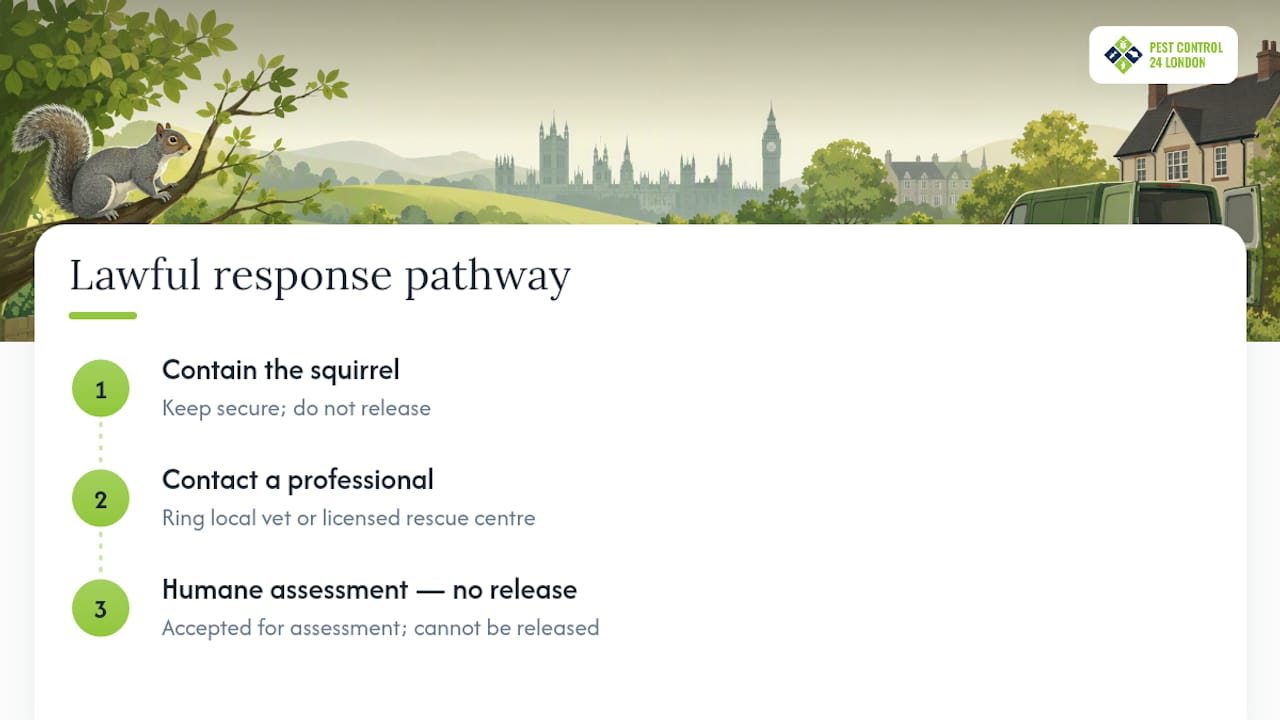
There is no broad exception for “just letting it go somewhere else.” If a grey squirrel becomes accidentally trapped, injured, or orphaned, the lawful path is to take it to a vet or a licensed wildlife rescue centre, not to release it back into a garden, park, or woodland. The RSPCA is explicit that relocating grey squirrels is not an option, however well-intentioned. If you find a juvenile or injured animal, ring a local vet or rescue centre immediately; most will accept grey squirrels for humane assessment even though they cannot be released afterwards.
Is it lawful to kill or trap grey squirrels?
Yes, within limits. Lawful lethal control typically means shooting by a competent, appropriately licensed person, or live trapping followed by humane dispatch. Neither method carries a blanket exemption from other legislation, so the surrounding rules matter as much as the method itself.
The Hunting Act 2004 governs hunting with dogs and rarely applies to squirrel control, but trespass and firearms law absolutely do. You need permission from the landowner before shooting or trapping on any land you don’t own, and airguns or firearms must be used lawfully and safely. The bigger legal trap for most people is accidentally harming a protected species. Red squirrels carry protection under Schedules 5 and 6 of the Wildlife and Countryside Act, and conservation groups warn that harming one, even accidentally while targeting greys, is a prosecutable offence. If you’re in or near a red squirrel range, get proper species identification advice before setting a single trap.
Animal welfare and trap-checking: duties and best practice
Anyone trapping a grey squirrel, whether a homeowner or a contractor, owes a duty of care under the Animal Welfare Act 2006. That duty doesn’t switch off because the target species is unprotected; causing unnecessary suffering to any trapped animal is an offence regardless of its legal status.
There’s no statutory trap-checking interval written into law, but industry guidance treats daily checks as the minimum standard, with more frequent checks in hot weather or where non-target animals are likely. BASC is blunt about dispatch methods: drowning and other inhumane techniques are unacceptable and can lead to prosecution.
- Check live traps at least once daily, more often in warm weather
- Never use drowning or other inhumane dispatch methods
- Keep a simple log of trap checks and outcomes as evidence of lawful conduct
- Contact a vet or licensed rescue centre for any injured or non-target animal
Pro Tip: Photograph your trap locations and log check times on your phone. It costs nothing, takes seconds, and is the single easiest way to demonstrate lawful, humane practice if anyone ever questions your control activity.
Woodland and landowner control: squirrel control plans and timing
Landowners managing woodland, particularly under grant-linked schemes, need a formal approach rather than ad hoc trapping. The WS3 guidance sets out what a squirrel control plan should contain and when one is required for grant eligibility.
- Assess the site and identify damage risk before applying for grant support, since eligibility depends on demonstrating a genuine control need.
- Time control for late winter or early spring, when natural food is scarce and trapping is most effective; this window also falls before the main bark-stripping damage season.
- Record every cull and monitoring visit, with grant conditions typically requiring impact assessments at years one, three, and five to prove ongoing effectiveness.
- Repeat control annually rather than treating it as one-off, since a single removal exercise only reduces numbers temporarily before neighbouring populations move in.
Practical steps for homeowners: what to do first
If you’ve found squirrel damage or an animal in your loft, resist the urge to trap and release it yourself. Secure any injured or orphaned squirrel and get it to a vet or rescue centre rather than moving it outdoors.
- Never release a captured grey squirrel, however healthy it looks
- Seal loft entry points, gaps in roof tiles, and gaps around pipework to stop new access
- Move bird feeders away from the house and use squirrel-proof feeders where possible
- Call a BPCA-qualified pest controller if you hear repeated scratching, gnawing, or nesting sounds in a loft space
Prevention beats culling almost every time. A proofed loft with no viable entry points removes the incentive for repeat visits far more reliably than trapping alone.
Practitioner perspective: what we see in London
Most calls we get aren’t about legality; they’re about a scratching sound in a loft or chewed cabling nobody wants to touch. DIY trapping usually goes wrong at the welfare stage, not the legal one, because people don’t check traps often enough or don’t know what to do with an injured juvenile once caught. Professionals log every visit, every trap check, and every outcome, which matters if a welfare question ever arises later.
— Dan
How Pest Control 24 London can help with lawful squirrel control
Pestcontrol24london is the practical alternative to guessing your way through trap-checking schedules and welfare rules yourself. Our BPCA-qualified team handles loft and roof squirrel problems across London with a proper survey first, checking entry points, damage, and whether any protected species risk applies, before recommending humane control and proofing.

Every appointment includes a legal and welfare check alongside the treatment plan, so you’re never left wondering whether a method is compliant. We also offer 24/7 emergency callouts for urgent cases, such as an animal trapped somewhere it shouldn’t be. If you’ve spotted signs of grey squirrels in your loft or roof space, get in touch for a free quote and we’ll sort the survey, the paperwork, and the proofing in one visit.
This article is general information, not a substitute for advice from a qualified lawyer. Consult a qualified legal professional about your own circumstances before acting on anything here.
Sources
- Grey squirrel policy statement: managing the impact of grey squirrels
- RSPCA — squirrels: garden advice
- Wildlife and Countryside Act 1981
- BASC — grey squirrel control with live capture traps