

Pest control in food service environments is defined as a mandatory prerequisite programme (PRP) under HACCP, required by UK law to prevent contamination and protect public health. The Food Safety Act 1990 and the Food Hygiene Regulations 2006 both place a legal duty on food business operators to maintain effective, documented pest management systems. Failure to comply can result in Hygiene Improvement Notices, emergency closures by Environmental Health Officers (EHOs), or prosecution. This food safety pest control guide explains what restaurant owners and food service managers need to do, why it matters, and how to build a programme that satisfies regulators and protects your business.
What does an effective food safety pest control programme include?
Integrated Pest Management (IPM) is the mandatory standard for food businesses in the UK. It focuses on prevention, monitoring, exclusion, and documentation rather than reactive chemical treatments. IPM treats pest control as a system, not a series of one-off visits.
A compliant programme covers five core areas:
- Prevention: Maintaining strict sanitation, removing food residues, and eliminating standing water that attracts pests
- Structural exclusion: Sealing gaps around doors, vents, pipes, and drains to block entry points
- Monitoring: Installing bait stations, insect light traps, and rodent monitors at documented locations shown on a site map
- Documentation: Keeping service reports, pest activity logs, trend analyses, and corrective action records readily accessible
- Contractor partnership: Working with a qualified pest control provider who understands food safety audit expectations, not just visit frequency
The relationship between your facility team and your pest control contractor is critical. Contracts should focus on outcomes and data trends, not simply on how often a technician visits or how much pesticide is applied.
Pro Tip: Ask your pest control contractor to provide a site-specific pest map updated after every service visit. Auditors from the Food Standards Agency and third-party certification bodies treat a current, annotated site map as evidence of a proactive programme.

How can restaurant owners conduct effective pest inspections?
Systematic inspection is the foundation of early detection. Pests exploit the same vulnerabilities repeatedly, so knowing where to look is half the battle.
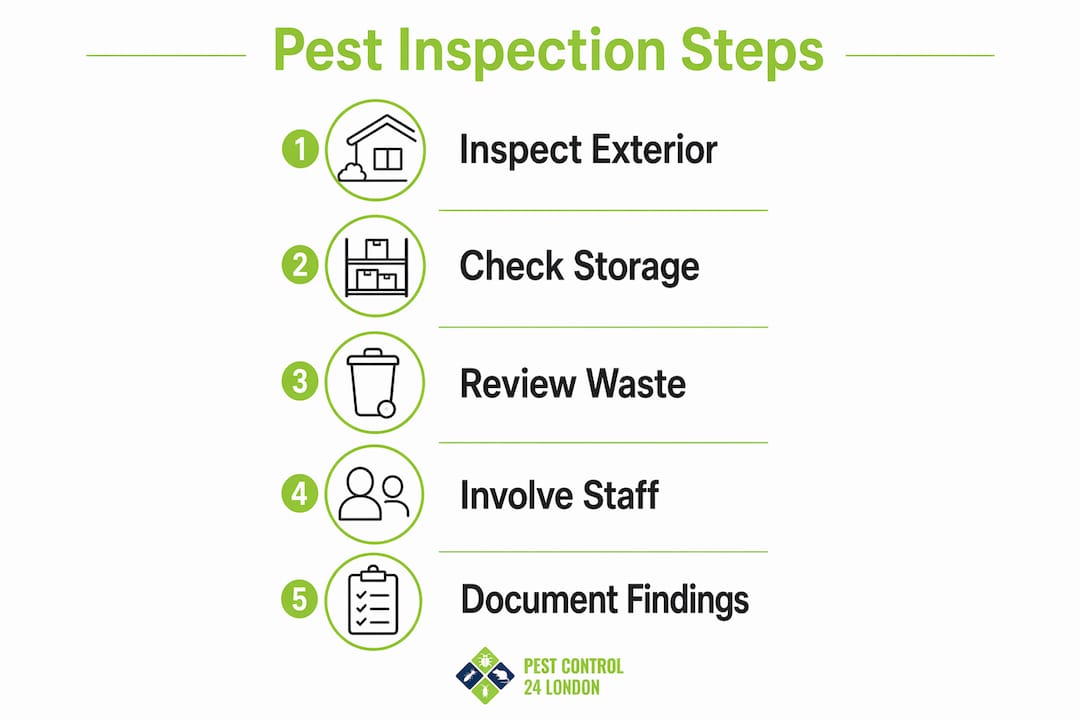
Follow this inspection sequence for each visit:
- External perimeters: Check for gaps in brickwork, damaged air bricks, and debris accumulation near walls and bins
- Delivery and loading areas: Inspect incoming shipments for signs of infestation, including damaged packaging or live insects
- Drains and waste zones: Look for grease build-up, blockages, and evidence of fly larvae or rodent activity around drain covers
- Storage areas: Check for gnaw marks on packaging, droppings, urine trails, or disturbed stock
- Equipment spaces: Inspect behind and beneath refrigeration units, ovens, and dishwashers where warmth and moisture attract pests
- Ceiling voids and service ducts: These are common harborage points that are often overlooked during routine checks
Routine inspections must cover external perimeters, drains, storage spaces, delivery areas, and waste management zones. Common attractants include food spills, standing water, damaged packaging, and structural gaps.
Staff involvement is critical to early detection. Employees working daily in kitchens and storage areas notice subtle changes, such as a faint musty odour, a smear mark on a skirting board, or a single dropping near a prep surface, long before a contractor’s scheduled visit.
Pro Tip: Create a simple one-page pest sighting report form and post it in the kitchen. When staff can report a concern in under two minutes, reporting rates increase significantly and early intervention becomes routine.
What are the best practices for pest prevention in food service?
Effective pest control prioritises facility inspections, sanitation, structural exclusion, and employee training over chemical applications. Pests seek food, water, and harborage. Removing those conditions delivers long-term control.
Key prevention measures for food service environments include:
- Seal all entry points: Fit brush strips to external doors, seal plumbing penetrations with fire-rated foam, and repair cracked render on external walls
- Manage waste rigorously: Use lidded bins, schedule collections frequently, and clean bin stores weekly to prevent odour build-up
- Store food correctly: Keep all dry goods in sealed, pest-resistant containers and store them at least 15cm off the floor to allow inspection beneath
- Maintain drains: Clean grease traps and floor drains on a scheduled basis, as blocked drains are a primary harborage for cockroaches and drain flies
- Train staff regularly: Ensure every team member understands what pest evidence looks like and knows the reporting procedure
The table below compares reactive and preventive approaches to food safety pest management:
| Approach | Focus | Audit outcome |
|---|---|---|
| Reactive (chemical only) | Treating infestations after detection | High risk of non-compliance findings |
| Preventive IPM | Exclusion, sanitation, and monitoring | Demonstrates proactive compliance |
| Documented IPM with staff training | Full programme with records and trend analysis | Strong audit readiness |
Good housekeeping practices underpin every prevention measure. A clean, well-maintained facility removes the conditions pests need to survive and breed.
How should restaurants respond when pest activity is detected?
Speed and documentation are both non-negotiable when pest activity is found. HACCP protocols require predefined corrective actions when pest activity exceeds thresholds, including immediate production cessation and emergency pest control within 24 hours for rodent detections.
Follow these steps in sequence:
- Stop affected operations immediately: Cease food preparation in the affected area and isolate any products that may have been contaminated
- Quarantine potentially affected stock: Remove and label all products from the area pending investigation and disposal decisions
- Notify your pest control contractor: Request an emergency visit. For rodent activity, this must occur within 24 hours under HACCP corrective action requirements
- Document everything: Record the date, time, location, type of evidence found, and the name of the person who discovered it
- Update your pest activity log: Add the incident to your monitoring records and note the corrective actions taken
- Review and verify: Once the issue is resolved, update your HACCP records to show the corrective action was completed and effective
Disorganised or missing documentation is a leading cause of audit failures, even when no active pest infestation is present. Records must be readily accessible, integrated with your HACCP system, and retained for at least two years.
Regulators take a “show me, don’t tell me” approach. Thorough monitoring records and trend analysis are what demonstrate a proactive programme to an EHO or third-party auditor. Verbal assurances carry no weight.
Key takeaways
A compliant food safety pest management programme requires IPM, documented monitoring, staff engagement, and rapid corrective action to satisfy UK food safety law and protect your business from enforcement.
| Point | Details |
|---|---|
| IPM is the legal standard | UK food businesses must operate an Integrated Pest Management programme, not reactive chemical treatments. |
| Documentation drives compliance | Records must be accessible, HACCP-integrated, and retained for at least two years to pass audits. |
| Staff are frontline monitors | Employees detect early pest signs that contractors miss between scheduled visits. |
| Corrective action has strict timelines | Rodent detections require an emergency pest control response within 24 hours under HACCP protocols. |
| Prevention outperforms reaction | Sealing entry points, managing waste, and training staff reduces pest risk more effectively than pesticide alone. |
What ten years of food service pest control has taught me
The most common mistake I see in food service businesses is treating pest control as a contractor’s responsibility rather than an operational one. A technician visits once a month. Your kitchen team is there every day. That gap is where infestations begin.
The businesses that consistently pass EHO inspections and third-party audits are not necessarily the ones with the fewest pests. They are the ones with the best records. Pest control documentation is what separates a proactive operator from one facing a Hygiene Improvement Notice.
Sanitation and structural maintenance do more work than any pesticide. I have seen kitchens with expensive treatment programmes still struggling with cockroach activity because a single drain was never properly cleaned. Fix the conditions first, then monitor.
The businesses I respect most treat pest control as a continuous management process, not a scheduled visit. They brief staff at inductions, review pest logs monthly, and update their site maps after every structural change. That culture is what keeps regulators satisfied and customers safe.
— Dan
Pestcontrol24london: professional pest control for food businesses
Food service businesses in London face specific pest pressures, from rodents in basement storage to cockroach activity in commercial kitchens. Pestcontrol24london has worked with restaurants, hotels, and takeaways across London since 2015, delivering BPCA-qualified pest management built around IPM principles.

Every service includes full documentation compatible with HACCP systems, site-specific pest maps, and trend reports your EHO or auditor can review on the spot. For urgent situations, 24/7 emergency pest control is available with same-day response across London. If you want a programme built around prevention rather than reaction, contact Pestcontrol24london for a free quote. You can also review commercial pest control services tailored specifically to food service environments.
FAQ
What is a pest control prerequisite programme?
A pest control prerequisite programme (PRP) is a documented system required under HACCP that prevents pest contamination in food businesses. UK law mandates that food operators maintain and evidence this programme at all times.
How often should a restaurant inspect for pests?
Inspection frequency depends on risk level, but most food service environments require at least monthly contractor visits combined with weekly internal checks by staff. Higher-risk sites, such as those with previous infestations, require more frequent monitoring.
What records do I need for a food safety pest audit?
Auditors require service reports, a current site map showing monitoring device locations, pest activity logs, corrective action records, and trend analyses. Records must be retained for at least two years and integrated with your HACCP documentation.
What should I do if I find a rodent in my kitchen?
Stop food preparation immediately, quarantine any potentially affected products, and contact a professional pest control service for an emergency visit within 24 hours. Document every step taken as part of your HACCP corrective action record.
Is IPM required for food businesses in the UK?
Yes. Integrated Pest Management is the recognised standard for food businesses and is expected by EHOs, the Food Standards Agency, and third-party certification auditors. Chemical-only approaches without prevention and monitoring do not satisfy compliance requirements.