

London properties face a persistent rodent problem, and knowing which pest you are actually dealing with is the difference between resolving the issue quickly and fighting a losing battle for months. Examples of rodent pests found across the capital range from the nimble house mouse to the burrowing Norway rat and the climbing roof rat, each with distinct behaviours that demand a different control response. Misidentify the species, and your trapping strategy, proofing approach, and sanitation efforts may all miss the mark entirely.
Table of Contents
- Criteria for identifying rodent pests in London
- House mice: small but mighty invaders
- Norway rats: ground-level foragers and burrowers
- Roof rats: climbers and attic dwellers
- Comparison of common rodent pests in London homes and businesses
- Expert tips for managing rodent pests in London properties
- Why focusing on proper species identification changes rodent control outcomes
- Professional rodent pest control services in London
- Frequently asked questions
Criteria for identifying rodent pests in London
Before you can control a rodent infestation, you need to understand what you are dealing with. The good news is that rodents leave behind a trail of evidence that, once you know what to look for, points clearly to the species involved.
Entry points are the first clue. Rats need roughly 19 mm to squeeze through gaps, whilst mice can access a building through a hole no wider than 6 mm. That is roughly the size of a pencil. Checking where pipes, cables, and vents enter your walls will often reveal the access route.
Beyond entry points, look for these indicators:
- Droppings: Mouse droppings are small, pointed, and roughly 3 to 6 mm long. Rat droppings are larger, blunt, and more banana-shaped at around 12 to 20 mm.
- Gnaw marks: Larger, rougher gnaw marks suggest rats; smaller, cleaner marks indicate mice.
- Grease marks: Dark smears along skirting boards and walls show where rodents regularly travel the same route.
- Noises: Scratching inside walls or ceilings at night is a common sign, particularly in older London terraces with cavity walls.
- Nesting material: Shredded paper, fabric, or insulation gathered into a ball indicates an active nest nearby.
Nesting locations vary significantly by species. Mice tend to nest inside walls and cupboards. Norway rats favour ground-level burrows near foundations or drains. Roof rats prefer elevated spaces such as attics and loft voids. Understanding rodent proofing principles becomes far more targeted once you know where each species settles.
Pro Tip: A fresh dropping is dark and moist, whilst an old one is dry and grey. Checking dropping freshness tells you whether the infestation is active or historical before you invest in any treatment.
House mice: small but mighty invaders
The house mouse (Mus musculus) is the most frequently encountered household rodent example across London, and its small size is precisely what makes it so difficult to exclude. House mice can fit through gaps as small as 6 mm, meaning even a worn door seal or a poorly fitted utility pipe entry is enough.
Key characteristics to help you identify a house mouse:
- Greyish-brown fur with a lighter underside
- Large ears relative to body size
- Slim body, typically 7 to 10 cm in length, excluding the tail
- Long, thin, scaly tail roughly equal to body length
- Highly agile climbers and jumpers
House mice nest indoors almost exclusively. They favour wall cavities, under kitchen units, behind appliances, and inside stored boxes. They breed rapidly; a single pair can produce a significant infestation within weeks under the right conditions.
The health risks are often underestimated. Dried mouse droppings can trigger asthma and allergic reactions, particularly in children. Following our mouse proofing guide is essential for London homes and businesses wanting to keep this species out. For active infestations, understanding how to handle a rodent outbreak early prevents the problem from escalating.
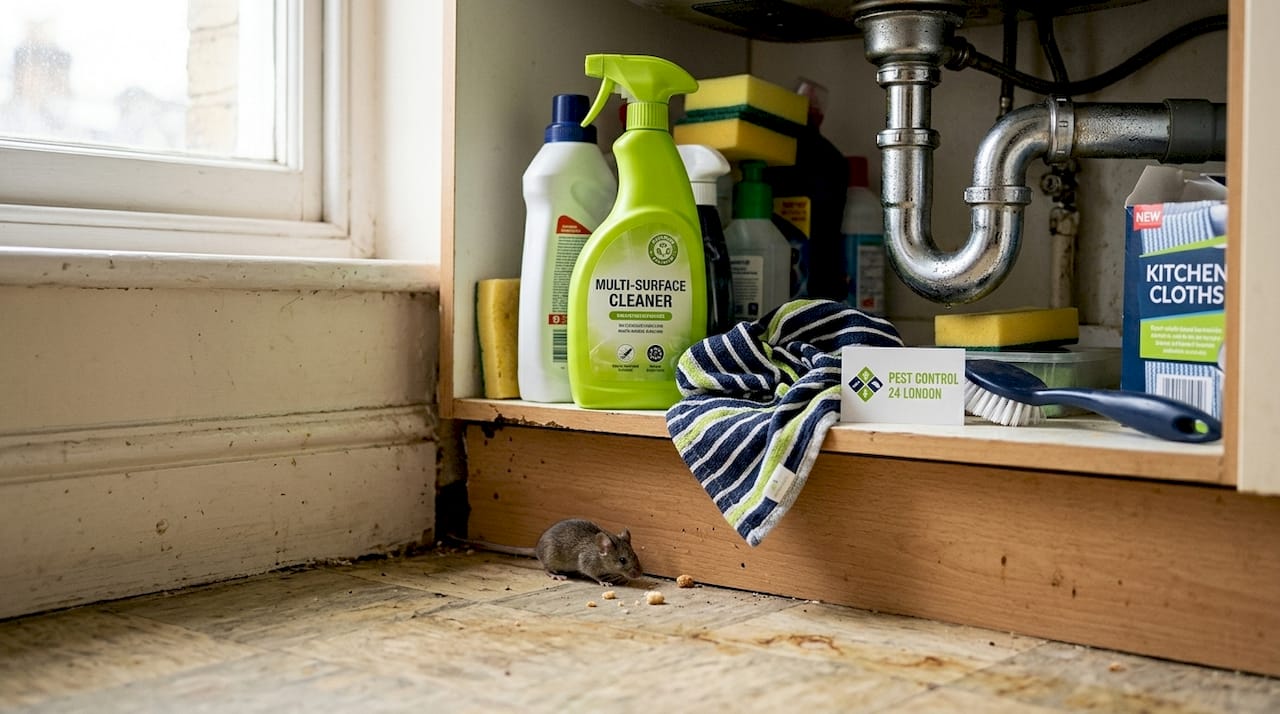
Pro Tip: Mice are neophobic at first, meaning they avoid new objects in their territory. Place unset traps along their run for two or three days before baiting and setting them. Your catch rate will improve noticeably.
Norway rats: ground-level foragers and burrowers
The Norway rat (Rattus norvegicus), also called the brown rat, is the larger and more physically imposing of London’s common rodent pests. It is a strong swimmer and an effective burrower, which is why Norway rats are strongly associated with ground-level habitats, including sewers, drains, and the foundations of buildings.
Key traits of the Norway rat:
- Heavy, stocky build, typically 20 to 28 cm in body length
- Brown or grey fur with a paler underside
- Shorter, thicker tail compared to the roof rat
- Small, rounded ears close to the head
- Frequently enters buildings via damaged drains, air bricks, and utility gaps at ground level
Norway rats are the primary species associated with leptospirosis (Weil’s disease), a serious bacterial infection spread through rat urine contaminating water or surfaces. Effective control relies on identifying and blocking ground-level entry routes, improving sanitation around bins and compost areas, and addressing any drainage issues. Our rat removal service in London targets exactly these conditions. Understanding why rodents invade London homes in winter also helps you act before the colder months drive them indoors.
Roof rats: climbers and attic dwellers
The roof rat (Rattus rattus), sometimes called the black rat, was historically the dominant species in London but is now less common than the Norway rat. It remains a significant pest in certain parts of the city, particularly in older buildings and those near docklands or warehousing areas.
Roof rats are agile climbers and regularly access buildings via overhanging tree branches, cables, guttering, and roof gaps. They nest in elevated locations, which means an infestation often presents as scratching noises in the loft or upper floors rather than at ground level.
Distinguishing features include:
- Slender body, typically 16 to 24 cm long
- Dark brown or black fur, often with a lighter underside
- Long, thin tail, usually longer than the body
- Large, prominent ears
- Pointed muzzle compared to the blunter face of the Norway rat
Controlling a roof rat infestation requires sealing elevated access points such as roof tiles, fascia boards, and eaves, as well as trimming tree branches that overhang the roofline. Our practical guide for London homes covers the full range of inspection and proofing measures relevant to this species.
Comparison of common rodent pests in London homes and businesses
Understanding the differences between species in a single view helps you prioritise the right control actions. These three species are the primary rodents invading urban structures, each with unique entry capabilities and behavioural patterns.
| Feature | House mouse | Norway rat | Roof rat |
|---|---|---|---|
| Body length | 7 to 10 cm | 20 to 28 cm | 16 to 24 cm |
| Minimum entry gap | 6 mm | ~19 mm | ~19 mm |
| Fur colour | Grey-brown | Brown/grey | Dark brown/black |
| Tail | Long, thin | Shorter than body | Longer than body |
| Typical nesting site | Walls, cupboards | Ground burrows, sewers | Attics, upper floors |
| Primary entry route | Any tiny gap indoors | Ground level, drains | Roof, cables, trees |
| Key health risk | Allergens, salmonella | Leptospirosis | Salmonella, plague historically |
| Control priority | Interior proofing | Drain and foundation checks | Elevated proofing, attic inspection |
The table makes clear that a one-treatment-fits-all approach will not work. Snap traps placed at ground level will not address a roof rat living in the loft, and sealing the attic alone will not solve a Norway rat entering through a cracked drain. Use our mouse proofing guide and rodent proofing resources alongside proper species identification.
Expert tips for managing rodent pests in London properties
Effective control comes down to a consistent, layered approach. Sealing entry points, eliminating food and shelter, and trapping resident rodents form the foundation of any successful programme; rodenticides should be the last option considered, not the first.
Here is a practical sequence to follow:
- Inspect thoroughly. Check all gaps around pipes, cables, vents, and doors. Seal anything 6 mm or larger for mice, 19 mm or larger for rats, using wire wool backed with sealant or metal mesh.
- Remove attractants. Secure bin lids, store food in sealed containers, clear up fallen fruit, and remove clutter where rodents can hide or nest.
- Deploy snap traps. Place them perpendicular to walls along known runs. Snap traps are fast, reliable, and allow you to monitor activity. They are among the best traps for rodents in occupied indoor spaces.
- Monitor consistently. Check traps daily and relocate them if catches decline over three to four days, as rodents learn to avoid areas where others have been caught.
- Avoid over-reliance on rodenticides. Bait resistance is a growing issue in urban rodent populations, and secondary poisoning of wildlife and pets is a genuine risk.
“A persistent infestation after two weeks of trapping almost always signals an unsealed entry point, not a trap problem.” This is one of the most common realisations our team encounters on-site.
Pro Tip: Review your rodent proofing approach at the same time as setting traps. Trapping without proofing is like bailing water from a leaking boat. Combine the two, and you get results. For complex or persistent cases, handling a rodent outbreak professionally saves both time and money.
Why focusing on proper species identification changes rodent control outcomes
After more than ten years treating rodent infestations across London, from large hotel chains in the West End to residential terraces in South London, the pattern is consistent. Properties that come to us after weeks of failed DIY attempts have almost always been applying the right products in the wrong places. Urban rodent pest management relies on identifying the species first before any control measure is selected, precisely because each species differs so fundamentally in behaviour and nesting.
A house mouse infestation demands an interior-focused response: sealing internal wall gaps, trapping within the kitchen and utility areas, and eliminating indoor food sources. A Norway rat problem shifts the focus entirely outdoors, to drains, foundations, and the garden perimeter. Roof rats require a ladder inspection of the roofline and attic. If you treat a roof rat problem the same way you would treat a mouse problem, you will achieve very little.
The cost argument for proper identification is also compelling. DIY rodenticide products purchased over several months often cost more in total than a professional assessment that resolves the issue in one visit. Early investment in identification reduces the long-term burden on both the property and its occupants’ health. Seasonal pressure also plays a role; knowing which species is most active in your area during winter helps you prioritise the right preventive measures before infestations establish.
Professional rodent pest control services in London
If you have spotted the signs but are uncertain which rodent species you are dealing with, or if the problem has already taken hold, professional support makes a significant difference.

Our team at Pest Control 24 London has been resolving residential and commercial rodent infestations since 2015. We are BPCA fully qualified, and we bring species-specific identification, targeted proofing, and safe removal methods to every job. Our domestic pest control service covers London homes of all sizes, whilst our commercial pest control service is trusted by hotels, restaurants, and retail businesses across the capital. We also offer professional pest control cleaning services to decontaminate affected areas after treatment, reducing the health risks associated with rodent droppings and urine. Get in touch today for a prompt and discreet inspection.
Frequently asked questions
What are the main rodent pests found in London homes?
The most common species in urban buildings are house mice, Norway rats, and roof rats, each occupying different areas of a property and requiring tailored control strategies.
How small a gap can rodents squeeze through to enter buildings?
House mice can enter through gaps as small as 6 mm, whilst rats need an opening of approximately 19 mm, roughly the width of your thumb.
What health risks do rodents pose to homeowners and businesses?
Rodents can spread diseases including leptospirosis, salmonellosis, and hantavirus through contact with their droppings, urine, or contaminated surfaces, posing a genuine risk to occupants.
What are effective non-chemical ways to control rodents in London properties?
Sealing entry points, removing food sources, and trapping with snap traps are the most reliable non-chemical methods, and they work best when applied together rather than in isolation.
When should I contact professional pest control services?
If the infestation persists beyond two weeks of self-treatment, if you are uncertain of the species involved, or if a qualified pest control professional is needed to safely address health risks, contacting a licensed service is the appropriate next step.