

The most effective fly control in restaurants combines five measures: rigorous sanitation and source removal, physical exclusion (screens, air curtains, sealed gaps), correctly sited electronic fly killers and glue boards, disciplined waste management, and routine monitoring backed by staff SOPs. Apply all five together; any single measure used alone will fall short in a busy food environment.
Priority controls at a glance:
- Clean kitchen drains daily and remove organic residues from floor channels
- Fit insect-proof mesh (openings no greater than 0.965 mm) to all openable windows and vents
- Install self-closing mechanisms on rear service doors and seal gaps around frames
- Site electronic fly killers (EFKs) on secondary walls, away from food prep surfaces
- Use tight-lidded bins indoors; empty external bins before service and keep the compound clean
- Respond to spills immediately; never leave food residues on surfaces overnight
- Log trap counts weekly and review trends monthly
- Brief staff at every shift handover on spill response, drain scraping and bin handling
If flies persist despite these measures, maggots or larvae are visible, or a Food Standards Agency (FSA) inspection is approaching, call a BPCA-qualified professional. Pestcontrol24london has served London restaurants since 2015 and can carry out a full commercial inspection at short notice.
Table of Contents
- Where do flies come from in restaurants, and which species should you expect?
- Sanitation and hygiene: the daily routines that cut fly attraction fastest
- Does physical exclusion actually keep flies out of your restaurant?
- How to use EFKs and glue traps safely in a food environment
- Waste management: the outdoor controls that reduce fly pressure at source
- How to monitor fly activity and keep records that satisfy audits
- Staff training and SOPs: what your team needs to know
- When should you call a professional pest controller?
- Real-world examples from the Pestcontrol24london portfolio
- Key takeaways
- Why combined measures beat any single fix
- Professional fly control for your restaurant from Pestcontrol24london
- Useful sources
Where do flies come from in restaurants, and which species should you expect?
Understanding the source is the fastest route to control. The table below maps the most common hotspots in a typical restaurant to the species most likely to be present and the most effective immediate action for each.
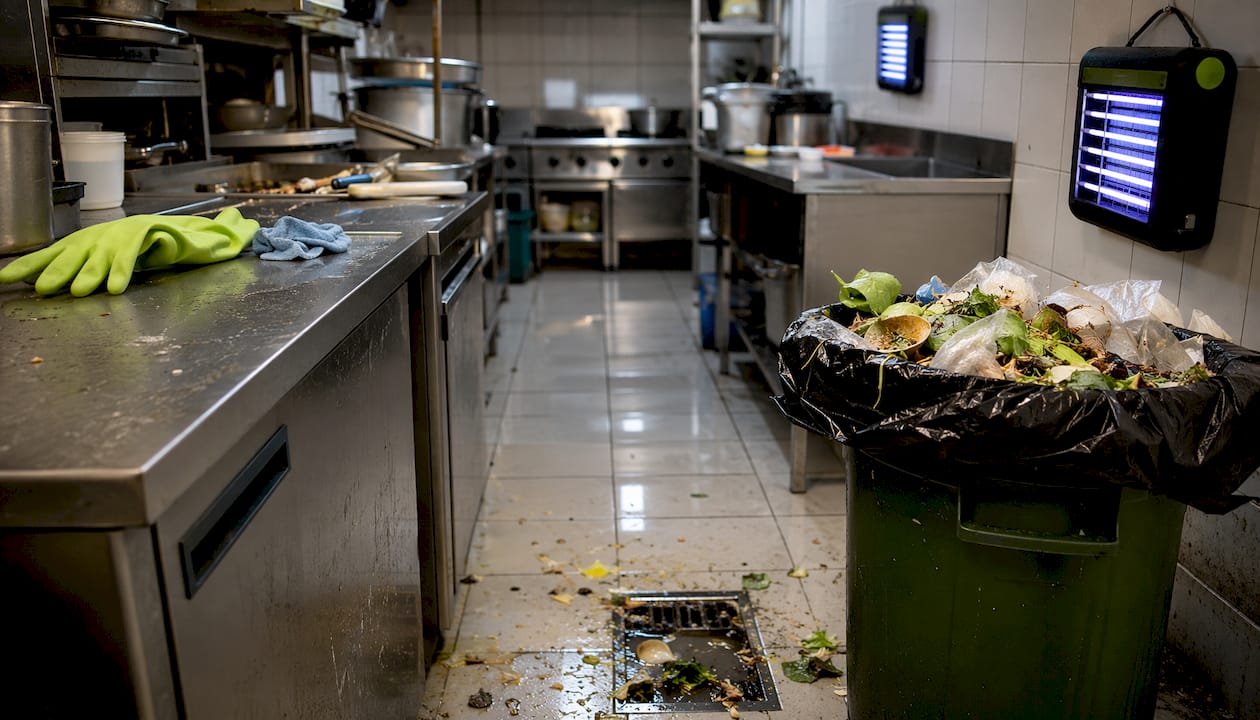
| Hotspot | Likely species | Immediate control priority |
|---|---|---|
| Kitchen floor drains | Drain fly (moth fly), house fly | Scrub drain daily; remove organic biofilm |
| External bin compound | House fly, blow fly | Lid bins; clean compound; move bins from entrances |
| Deliveries and dry-store stock | Fruit fly, house fly | Inspect deliveries; rotate stock; remove overripe produce |
| Fruit and produce prep areas | Fruit fly | Cover or refrigerate cut fruit; clean surfaces after prep |
| Grease traps and extraction | House fly, blow fly | Schedule professional grease-trap cleaning |
| Staff areas and lockers | House fly | Remove food waste; enforce covered-container rule |
IPM guidance is clear that eliminating larval habitat is the preferred method of fly control; sanitation and exclusion should be the first line of defence rather than routine insecticide use. Killing adult flies without removing the breeding material is a temporary fix. Larvae develop in moist organic matter — drain biofilm, rotting produce, grease accumulations — so those substrates must be removed before adult numbers will fall.
Quick inspection cues to use during your daily walkthrough: follow odour plumes toward drains and waste areas, note where adult flies are resting (cool, shaded surfaces near food), and check for larvae or maggots in drain channels and around bin bases. A single maggot sighting in a drain is a reliable indicator that a breeding site is active nearby.
Sanitation and hygiene: the daily routines that cut fly attraction fastest
Sanitation is the foundation of any fly management strategy. HACCP-based cleaning schedules and documented procedures are central to food safety compliance, and they directly reduce the organic residues that flies breed in.
Priority cleaning tasks — numbered by urgency:
- Scrub floor drains with a stiff brush and enzymatic cleaner at the start and end of every service.
- Remove grease from extraction canopies, filters and surrounding surfaces at least weekly.
- Wipe down all food prep surfaces after every task; never leave residues between services.
- Respond to spills within five minutes; use a sanitising solution, not just a dry cloth.
- Empty and clean internal bins at close-down; replace bin liners every service.
- Deep-clean walk-in refrigerators and dry stores weekly, removing any overripe or damaged produce.
- Clean mop heads after every use and store mops head-up to allow drying.
Sample daily schedule:
- Start of service: Drain scrub, surface sanitise, check bin liners, inspect deliveries for overripe stock.
- Mid-service: Spill response as required, wipe prep surfaces between tasks, check bins are not overflowing.
- Close-down: Empty all internal bins, scrub drains, sanitise surfaces, mop floors, check for food residues in storage areas.
- Weekly deep-clean: Grease trap and extraction clean, walk-in refrigerator clean, dry-store rotation, external bin compound washdown.
Pro Tip: If your team has only a short window before service, prioritise drains first, then bin areas, then prep surfaces. Drains are the single most productive larval habitat in most restaurant kitchens, and a five-minute scrub at the start of the day removes more breeding potential than any other single task.
Does physical exclusion actually keep flies out of your restaurant?
Yes, when installed and maintained correctly. Exclusion — sealing entry points, fitting screens and controlling door openings — is the first line of defence against flies entering the building in the first place.
Exclusion measures by location:
- Front-of-house doors: Self-closing mechanisms on all customer-facing doors; consider strip curtains during warm months when doors are propped open.
- Kitchen windows and vents: Insect-proof mesh with openings no greater than 0.965 mm (22 openings per linear inch); check for tears weekly.
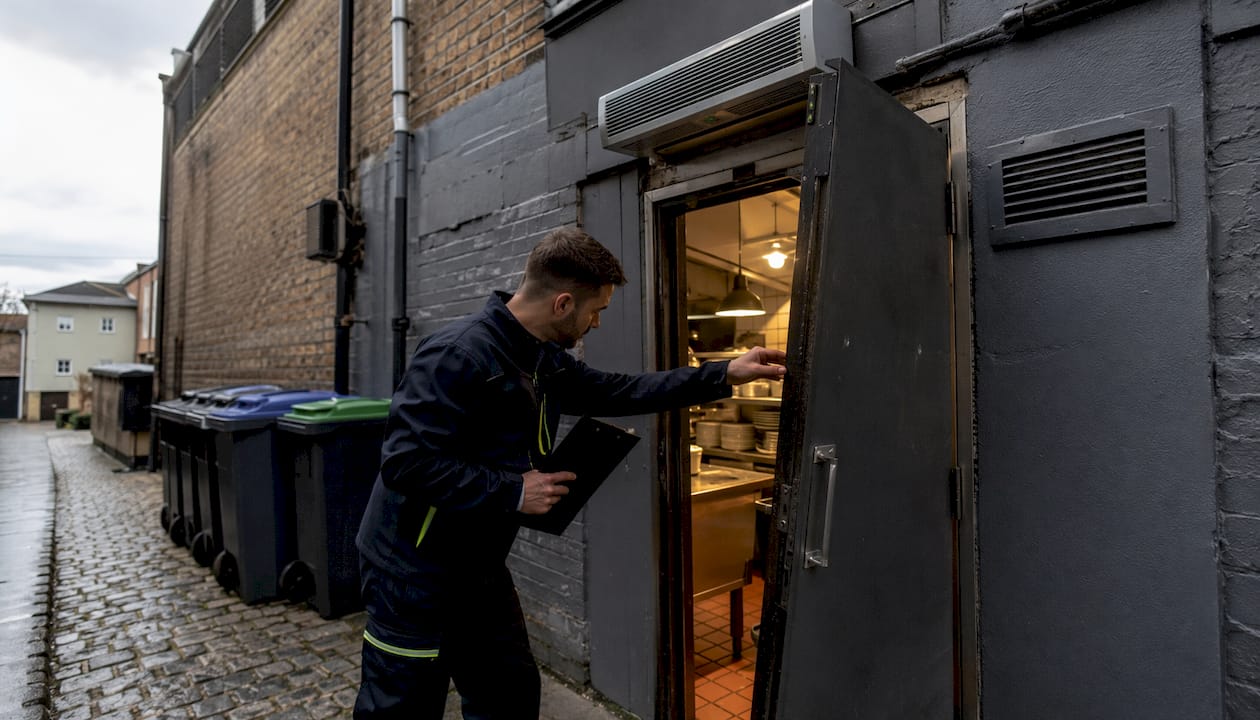
- Rear service doors: Self-closing hinges, full-perimeter door seals, and a brush strip at the base; this is the highest-risk entry point in most kitchens.
- Delivery hatches and pass-throughs: Fit close-fitting covers; never leave open unattended.
- Structural gaps: Seal around pipework, cable runs and extraction ducting with appropriate filler.
Air curtains can supplement physical seals on high-traffic service doors, but they have operational limits. To be effective, an air curtain must deliver approximately 9.1 m/s at 91 cm above the floor across the full doorway width, and it must remain unobstructed. In practice, they are often disabled or blocked during busy service. Large items placed near a rear entry increase harborage and reduce the curtain’s effectiveness.
Pro Tip: Carry out a daily visual check of all screens and door seals before service — a two-minute walk-round. A torn screen or a door seal that has peeled away at one corner can undo an entire week of cleaning effort.
How to use EFKs and glue traps safely in a food environment
Electronic fly killers (EFKs) and glue boards are the most widely used mechanical controls in commercial food premises. Used correctly, they reduce adult fly numbers without contaminating food. Used incorrectly, they create compliance risks and give a false sense of security.
Device types and where they fit:
- EFKs with glue boards (insect light traps, ILTs): The preferred type for food areas. The UV lamp attracts flies onto a glue board, which retains them without scattering fragments. ILTs are widely used in commercial food accounts; service typically includes glue board replacement and semi-annual bulb changes. The Levante Venus Fly Killer 16w is one example of a commercial-grade ILT designed for food premises, with secure wall-mounting and a contained glue board.
- Open-grid electric zappers: Not appropriate near food prep. The electrocution mechanism can scatter fly fragments onto surfaces and food.
- Sticky ribbons and fly paper: Useful for light catches in low-risk areas such as dry stores, but insufficient for heavy infestations or outdoor control.
- Bait stations: For use outside only, away from customer areas and food storage.
Siting rules:
- Mount EFKs on secondary walls, not directly above food prep surfaces or food contact areas.
- Position units away from windows and natural light sources, which compete with the UV lamp.
- Keep devices at least 1.5 metres from open food.
- In front-of-house areas, site units discreetly — out of direct customer sightlines where local guidance requires.
- Replace glue boards on the manufacturer’s schedule (typically every four to eight weeks in active periods) and change UV bulbs at least twice a year, even if they appear to be working.
Glue boards and ILTs must be kept clean; a device clogged with dead flies and debris can itself become an attractant. Document every board change and bulb replacement in your maintenance log. Documented device maintenance is important evidence for audits and reduces the chance that devices are blamed for control failures.
Waste management: the outdoor controls that reduce fly pressure at source
Outdoor odour plumes from dumpsters, grease stations and compactors attract adult flies and raise the risk of entry to food premises. Getting waste management right outside the building is as important as cleaning inside it.
Indoor and outdoor bin requirements:
- All internal bins must have tight-fitting lids and be lined with sealed bags.
- Empty internal bins at least once per service; never allow overflow.
- Wash internal bin bodies weekly with hot water and disinfectant.
- External bins and wheelie bins must have close-fitting lids kept shut between collections.
- Site external bins as far from customer entrances and kitchen doors as the compound allows.
- Wash down the external bin compound and any compactor area at least weekly; ensure drainage is adequate to prevent standing water.
- Rinse food cans, bottles and containers before placing them in recycling bins.
Compound layout guidance:
Position the bin compound on the side of the building furthest from customer entrances and kitchen air intakes. Hard, impermeable surfaces with a drain to a suitable outlet make washdown practical. Where permitted by local authority guidance, toxic fly bait stations may be placed around the perimeter of the compound, but always away from food storage areas and customer access routes.
Key insight: Odour plumes from waste areas are a primary driver of fly pressure around food premises. Keeping lids closed, emptying bins before they overflow, and washing the compound regularly removes the olfactory signal that draws flies toward your building in the first place.
How to monitor fly activity and keep records that satisfy audits
Monitoring turns reactive pest control into a managed process. A simple inspection schedule, consistently followed, gives you early warning of rising activity and the documented evidence an FSA inspector or local authority environmental health officer will want to see.
| Frequency | Task | Record |
|---|---|---|
| Daily | Visual check of all areas; note adult fly sightings, larvae, or resting sites | Date, location, observation, staff name |
| Weekly | Count and record catches on each glue board/ILT; check screens and door seals | Trap ID, count, board condition, action taken |
| Monthly | Review weekly trap count trends; assess whether counts are rising, stable or falling | Trend summary, remedial actions, next review date |
| After each service | Confirm drain scrub completed, bins emptied, spills resolved | Initials on daily checklist |
Pro Tip: Trap counts are a relative metric. A single high count matters less than a rising weekly average in the same trap location. If counts in one unit climb over three consecutive weeks, that trend points to active source activity nearby — inspect the nearest drain and waste area before the next service.
Logs for FSA or local authority inspections should record: trap or unit location (by reference number), catch count, date of board change, any remedial action taken, and the signature of the person completing the check. A pest control inspection guide can help you structure these records correctly from the outset.
Staff training and SOPs: what your team needs to know
The best physical controls and cleaning schedules only work if the team follows them consistently. CDC research confirms that access to the right resources and clear procedures makes safe practices easier for staff to maintain — short, practical training is more effective than lengthy induction manuals.
SOP elements to include:
- Spill response: clean within five minutes using sanitising solution; report to supervisor if near a drain or bin area.
- Drain scraping: assigned to a named person at start and close of every service; signed off on the daily checklist.
- Bin handling: replace liner when three-quarters full; never compress waste by hand; wash hands after handling bins.
- Reporting fly sightings: any sighting of larvae, maggots or unusual adult fly numbers reported to the manager immediately, not at end of shift.
- Closing-time checklist: drains scrubbed, bins emptied and lidded, surfaces sanitised, screens checked, external doors closed.
Two-minute shift-handover briefing template:
- Confirm drain scrub was completed at start of service.
- Check the bin area — is it clear, lidded and not overflowing?
- Any fly sightings during the shift? Where, and how many?
- Remind the incoming team: spills cleaned within five minutes, no open food left on surfaces.
- Sign the daily checklist before leaving.
Post the closing-time checklist on the kitchen noticeboard. Keep it to one side of A4, laminated, with a dry-wipe pen attached. Staff are far more likely to complete a checklist they can see than one buried in a folder.
When should you call a professional pest controller?
Some fly problems are beyond what in-house measures can resolve. Knowing the triggers for professional intervention saves time and protects your food safety rating.
Call a BPCA-qualified contractor when:
- Trap counts are rising week-on-week despite cleaning and exclusion measures being in place.
- Larvae or maggots are visible in drains, waste areas or anywhere in the kitchen.
- Flies are entering through entry points you cannot identify or seal yourself.
- An FSA inspection is scheduled and fly activity has not been fully resolved.
- You have used insecticide products without sustained improvement (house flies can develop resistance to pyrethroids, making professional-grade treatments and alternative methods necessary).
What to expect from a BPCA-qualified professional:
A qualified contractor will carry out a full site inspection, identify larval habitats and entry points, and recommend a bespoke programme. This typically includes proofing works (sealing gaps, fitting or replacing screens), ILT/EFK placement recommendations, a drain survey to identify hidden larval sites, and a written action plan with follow-up visit dates. All work should be documented for your audit file.
What a professional inspection delivers: A BPCA-qualified contractor does not simply treat the symptom. They identify the larval habitat driving adult fly numbers, recommend structural proofing, assess your device placement, and provide written documentation that demonstrates due diligence to an FSA inspector. That combination of source removal, proofing and documented follow-up is what separates a lasting solution from a temporary reduction in adult fly numbers.
Pestcontrol24london holds full BPCA qualification and has worked with London restaurants, hotels and takeaways since 2015. A food safety pest control guide is available on the website for managers who want to understand what a commercial inspection covers before booking.
Real-world examples from the Pestcontrol24london portfolio
The following three case examples illustrate how combined measures — rather than a single fix — produce lasting results in UK restaurant environments.
Case 1: Central London restaurant with persistent drain flies
A busy central London restaurant reported recurring drain fly activity despite regular cleaning. Pestcontrol24london carried out a drain survey and identified a section of cracked drain pipe beneath the kitchen floor that was retaining organic matter. The drain was repaired, the biofilm removed with enzymatic treatment, and two ILTs were repositioned away from competing natural light. Adult fly counts dropped to near zero within two weeks and remained low at the four-week follow-up visit.
Case 2: East London takeaway with external bin pressure
A takeaway in East London was experiencing heavy house fly and blow fly activity through the rear service door during summer months. The bin compound was adjacent to the door and bins were not being lidded consistently. Pestcontrol24london fitted a self-closing mechanism and full-perimeter seal to the rear door, relocated the bin compound to the far end of the yard, and introduced a weekly compound washdown schedule. Fly entry was eliminated within one service week.
Case 3: South London café with fruit fly infestation in the bar area
A café bar was experiencing fruit fly activity around the drinks dispense area. Inspection revealed a slow drain beneath the bar counter with a significant biofilm build-up. The drain was treated and a small ILT fitted above the bar counter on a secondary wall. Staff were briefed on covering cut fruit and cleaning the bar drain nightly. The infestation was resolved within ten days.
Trust signals: Pestcontrol24london is BPCA fully qualified, maintains documented inspection and treatment logs for every commercial client, and offers follow-up visits as standard. Portfolio images are available in the picture gallery on the website.
Key takeaways
Combined fly control — sanitation, exclusion, correctly sited devices, waste management, and monitoring — is the only approach that produces lasting results in a restaurant environment.
| Point | Details |
|---|---|
| Source removal first | Eliminating larval habitat in drains and waste areas reduces fly numbers faster than killing adults alone. |
| Exclusion stops entry | Mesh with openings no greater than 0.965 mm, self-closing doors and sealed gaps deny flies access before they breed indoors. |
| Device placement matters | Glue-board EFKs must be sited away from food surfaces and natural light; replace boards every four to eight weeks and bulbs twice a year. |
| Monitoring drives decisions | Rising weekly trap counts in the same location signal active breeding nearby; inspect drains and waste areas before the next service. |
| Pestcontrol24london | BPCA-qualified, serving London restaurants since 2015; provides drain surveys, proofing, ILT assessments and documented follow-up visits. |
Why combined measures beat any single fix
The instinct when flies appear is to reach for a spray or add another fly killer. That response is understandable, but it addresses the symptom rather than the cause. Adult flies are the visible sign of a breeding population that is almost always rooted in organic matter — drain biofilm, grease accumulation, rotting produce — that no spray will remove.
What the evidence consistently shows is that restaurants with the lowest fly pressure are not the ones with the most devices; they are the ones where cleaning schedules are followed without exception, entry points are physically sealed, and staff know what to report and when. The devices and professional treatments matter, but they work on top of a foundation of sanitation and exclusion, not instead of it.
The other point worth making is that documentation is not just a compliance formality. A well-kept monitoring log tells you whether your controls are working before an FSA inspector tells you they are not. Managers who review trap count trends monthly catch problems at the source; those who only notice flies when customers complain are always reacting rather than managing.
Professional fly control for your restaurant from Pestcontrol24london
Persistent fly activity in a food business carries real risk: a failed FSA inspection, reputational damage, and the cost of emergency treatment. Pestcontrol24london offers commercial pest control for London restaurants, takeaways and hospitality businesses, with BPCA-qualified technicians available 24/7.

A commercial inspection from Pestcontrol24london includes a full site survey, drain inspection, device assessment, written action plan and a follow-up visit to confirm the problem is resolved. For restaurants that need post-treatment sanitisation, cleaning services are available as part of the same visit.
What a commercial inspection covers:
- Identification of larval habitats and entry points
- Drain survey for hidden breeding sites
- EFK and ILT placement review
- Bespoke proofing recommendations
- Written documentation for your audit file
- Scheduled follow-up visit
Request a free quote today and have a BPCA-qualified technician on site at a time that suits your service schedule.
Useful sources
- UC IPM: Flies — University of California integrated pest management guidance on fly biology, larval habitat removal and device selection.
- PMC review of alternative house fly controls — Peer-reviewed research on ILT effectiveness, pyrethroid resistance and alternative control methods.
- CDC: Safe food preparation — Guidance on hygiene practices and facilities that support consistent food safety in commercial kitchens.
- University of Arizona Extension: Common household flies and prevention — Practical prevention guidance covering exclusion mesh specifications, drain cleaning and waste management.
- Pestcontrol24london: food safety pest control guide for restaurants — How commercial pest control supports restaurant food safety compliance in the UK.
- Pestcontrol24london: role of inspection in pest control — Covers drain surveys, monitoring logs and what to expect from a professional inspection.
- Pestcontrol24london: effective restaurant pest control strategies for London — London-specific strategies and examples for restaurant managers.