

When a pest control professional mentions a “PRA,” “residual treatment,” or “IPM programme,” it is easy to nod along without fully grasping what you are agreeing to. For homeowners and business managers across London, this kind of terminology gap is more common than most people realise, and it can lead to costly misunderstandings, incomplete treatments, or missed legal obligations. This guide explains the most important pest control terms in plain English so that you can have confident, productive conversations with your provider and make sure you always get the right solution for your property.
Table of Contents
- Why pest control terminology matters
- Key pest control terms defined
- How pest risk assessments guide pest control in London
- When and why is fumigation needed?
- Why genuine understanding beats memorising jargon
- Get expert pest control support in London
- Frequently asked questions
Key Takeaways
| Point | Details |
|---|---|
| Clarity drives results | Clear understanding of pest control terms ensures more effective solutions and smoother provider communication. |
| Know the benchmarks | Ask for PRAs and IPM approaches to meet high standards for safety and compliance in London properties. |
| Intensive interventions explained | Fumigation is reserved for complex infestations and requires clear process explanations by certified professionals. |
| Use terminology for impact | References to key terms build productive partnerships, not just technical expertise. |
Why pest control terminology matters
Even experienced property owners can misinterpret commonly used pest control terms. The problem is not a lack of intelligence; it is simply that pest control has developed its own professional language over decades, and providers do not always slow down to explain it clearly. Knowing where misunderstandings most often occur can help you stay alert at the right moments.
The three critical points where terminology confusion tends to cause problems are:
- During the initial assessment: You may not understand what the surveyor is recording, which pests are being flagged, or what risk level your property has been assigned.
- When reviewing a quote or contract: Terms like “residual treatment,” “monitoring station,” or “exclusion works” can mean very different things depending on the context and scope.
- After treatment: Post-treatment reports often contain technical language that, if misread, can cause you to underestimate whether follow-up is needed.
The consequences of these gaps can be serious. Missed legal requirements are a real risk for food businesses and hospitality venues, where pest control documentation is subject to inspection. Insufficient monitoring can allow an infestation to return undetected. Risky DIY solutions sometimes follow when a client does not understand why a professional approach is necessary.
If your case is in or near a food supply or tightly specified environment, the practical benchmark for communication is whether your provider has performed a PRA and can explain the monitoring species list and visit frequency rationale.
Understanding domestic pest control explained and knowing when you need handling pest emergencies both become much easier once you have a firm grip on the language your provider uses.
Now that you know the cost of confusion, let us clarify what these commonly used pest control terms actually mean.
Key pest control terms defined
The table below covers the core terms you are most likely to encounter, with plain-English definitions and examples of how they apply in a London context.
| Term | Definition | London scenario example |
|---|---|---|
| Assessment | A survey of your property to identify pest activity, entry points, and risk level | A surveyor inspects a Hackney restaurant before recommending a treatment plan |
| Infestation | An established, active pest presence requiring professional intervention | Rats found nesting beneath a Southwark warehouse floor |
| Residual spraying | Application of a pesticide that remains active on surfaces for weeks after treatment | Cockroach treatment applied to kitchen units in a Camden takeaway |
| Baiting | Placing poison or attractant stations to draw and eliminate pests | Rodent bait boxes installed along a perimeter wall in Islington |
| Exclusion | Physical proofing work to block pest entry points | Sealing gaps around pipework in a Kensington flat |
| Monitoring | Ongoing checks using traps or stations to detect pest activity | Monthly insect monitor checks in a Canary Wharf office block |
| Fumigation | Whole-structure treatment using gaseous pesticides under controlled conditions | Grain store in East London sealed and treated for stored product insects |
| IPM | Integrated Pest Management: a multi-method approach prioritising low-chemical solutions | Combining proofing, baiting, and monitoring for a Mayfair hotel |
| PRA | Pest Risk Assessment: a formal document identifying which pests pose a risk and how often inspections should occur | Annual PRA completed for a Brixton food production facility |
Integrated Pest Management is defined as using several types of information to make effective decisions about how to deal with insects and small animals, typically aiming to reduce pesticide use. In practice, this means your provider should be combining prevention, monitoring, and targeted treatment rather than simply spraying and leaving.
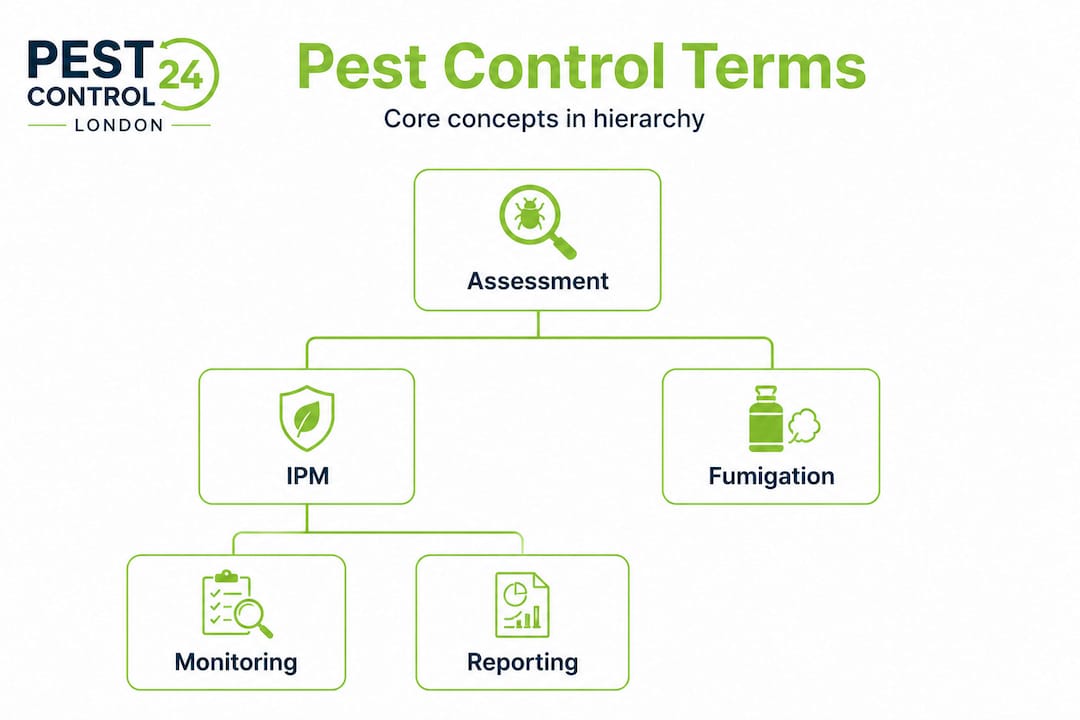
Fumigation is a term that is often used loosely, but it has a precise meaning. A whole-structure intervention using gaseous pesticides requires sealing or controlled conditions and certified oversight. It is not the same as a standard spray treatment.
Understanding best pest control practices for London properties helps you apply these definitions to real situations rather than treating them as abstract vocabulary.
Pro Tip: Always ask your provider to clarify any term that appears in your quote or report before you sign anything. A reputable professional will welcome the question and give you a clear, specific answer.
Equipped with this vocabulary, you can better understand what your provider is really recommending.
How pest risk assessments guide pest control in London
A Pest Risk Assessment, or PRA, is a formal document that identifies which pests are realistically likely to affect your property, what monitoring is required, and how frequently inspections should take place. In commercial and food sector environments, a PRA determines which pests are monitored and how frequently inspections should occur. It is generally completed at least annually and reassessed after a significant infestation or building modification.
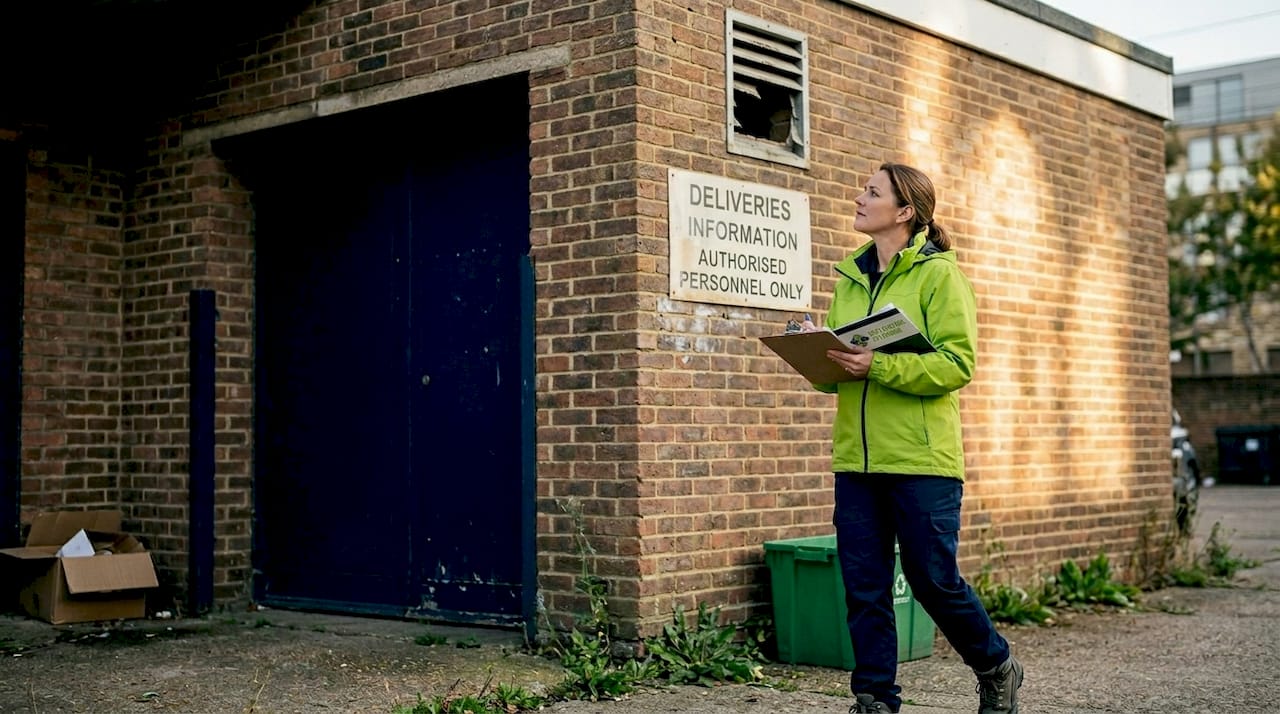
PRAs are not just paperwork. They directly shape the service you receive, including which monitoring stations are placed, what species are tracked, and how quickly your provider should respond to activity.
The key stages of a PRA are as follows:
- Initial audit: The surveyor inspects the building, its surroundings, and any existing pest history to establish a baseline picture.
- Risk categorisation: Your property is assigned a risk level, typically low, medium, or high, based on factors such as food handling, building age, and proximity to waste or water.
- Monitoring pest list: A specific list of target pests is created, reflecting the realistic threats to your property type and location.
- Visit scheduling: Inspection frequency is set according to risk level, ensuring that higher-risk sites receive more regular professional attention.
The table below gives a practical overview of how visit frequency typically varies by risk level in London commercial environments.
| Risk level | Typical inspection frequency | Example property type |
|---|---|---|
| Low | Quarterly (every 3 months) | Small office, low footfall retail |
| Medium | Every 4 to 6 weeks | Restaurant, pub, small food manufacturer |
| High | Weekly or fortnightly | Large food production site, hospital, hotel |
If you manage a commercial pest management contract, asking to see your PRA and understanding your assigned risk level is one of the most useful steps you can take. You can also review essential pest control tips to strengthen your overall approach between professional visits.
Understanding PRAs sets you up to appreciate why some solutions require more intensive intervention than others.
When and why is fumigation needed?
Fumigation is one of the most misunderstood terms in pest control. Many clients assume it refers to any spray treatment, but it is actually a specific and intensive method reserved for situations where standard localised treatments are not sufficient.
Fumigation is typically recommended in the following situations:
- Localised treatments have failed: If targeted sprays, baiting, or trapping have not resolved the infestation after repeated visits, fumigation may be the next step.
- Large or enclosed spaces are affected: Warehouses, shipping containers, or whole floors of a building may require a whole-enclosure approach.
- Stored product insects are present: Pests such as grain weevils or flour beetles that are embedded throughout a food store often cannot be reached by surface treatments alone.
- Speed is essential: In some commercial environments, a rapid and thorough clearance is needed to meet regulatory requirements or reopen a facility.
What should you expect if fumigation is recommended? The certified oversight required means the process involves sealing the structure or space, evacuating all occupants including pets, applying the gaseous pesticide under controlled conditions, and following a defined re-entry protocol before anyone returns to the property.
Your provider has a clear responsibility to explain why fumigation is being recommended rather than a less intensive method. If they cannot give you a specific reason, that is a valid concern to raise.
Pro Tip: If fumigation is suggested for your property, prepare a short checklist of questions before the appointment. Ask what pest is being targeted, why localised methods were ruled out, how long the property must remain sealed, and what the re-entry procedure involves. When rapid intervention is needed, having this information ready helps you act quickly and safely.
With a grasp of core terms and interventions, let us consider how you can put this knowledge into practice.
Why genuine understanding beats memorising jargon
After more than ten years working across London, from hotels in the West End to food production facilities in the outer boroughs, we have noticed a consistent pattern. The clients who get the best outcomes are not necessarily the ones who know the most technical terms. They are the ones who always ask, “Why is this term being used here?”
Knowing that “IPM” stands for Integrated Pest Management is useful. But asking your provider, “Which specific methods are you combining, and why have you chosen those for my property?” is far more powerful. It forces a real conversation rather than a surface-level exchange of vocabulary.
Top-rated professionals welcome informed questions. If a provider becomes evasive or dismissive when you ask for a clear rationale, that tells you something important about how they operate. The best pest control relationships are built on transparent dialogue, not one-sided technical briefings.
The most effective clients use terminology to drive dialogue. They use words like “PRA,” “monitoring frequency,” and “residual treatment” not to signal expertise, but to signal that they expect a detailed, specific answer. That shift in expectation consistently leads to better service, clearer reporting, and faster resolution of problems.
Reviewing practical pest control advice alongside this guide will give you a strong foundation for those conversations.
Get expert pest control support in London
Clear terminology makes every stage of pest control more efficient and transparent. When you know what to ask and how to interpret the answers, you save time, reduce risk, and get solutions that actually work for your specific situation.

Whether you are a homeowner dealing with a recurring problem or a business manager responsible for a complex site, our team is ready to help. Explore our residential pest solutions or our business pest management services to find the right approach for your property. As London pest control experts with over a decade of experience and full BPCA qualification, we are equipped to explain every step clearly and deliver results you can rely on. Get in touch today and start the conversation with confidence.
Frequently asked questions
What is included in a pest risk assessment (PRA)?
A PRA evaluates which pests pose a realistic threat to your property, what monitoring is required, and how often professional inspections should take place. In UK commercial and food environments, PRAs determine inspection frequency based on your specific risk level.
How do I know if fumigation is necessary?
Fumigation is usually recommended when localised treatments have not resolved the infestation, or when the scale of the problem requires a whole-building approach with certified specialist oversight.
What does integrated pest management (IPM) mean for my property?
IPM means your provider uses a combination of methods, including monitoring, proofing, and targeted treatment, to control pests while minimising chemical use. The Cambridge Dictionary defines IPM as using several types of information to make effective pest control decisions.
When should I request a pest control report?
You should request a written report after every assessment or treatment visit so you have a clear record of what pests were found, which methods were used, and what follow-up action is required.
What are the most misunderstood pest control terms?
PRAs, IPM, and fumigation are the terms most commonly confused or misused. Always ask your provider to confirm exactly what each term means in the context of your specific property and situation.