

Common wasps build nests in wall cavities, roof spaces, under eaves, sheds and garages, bird boxes, old rodent burrows, and among trees, hedges and fences. Every one of these sites shares the same appeal: dry, sheltered and undisturbed. If you find one, the safety rule is simple. Keep your distance, do not disturb it, and call a professional if the nest sits inside a wall or roof void.
- Do not block the entrance or poke the nest.
- Do not spray it yourself if it’s indoors or hard to reach.
- Do not use heat, water or fire near a nest.
Pro Tip: Stand well back and watch for a steady line of wasps flying to and from a single point. That flight path usually leads straight to the nest.
Key Takeaways
Common wasps build nests in dry, sheltered spots close to structures, and the safest response to any suspected nest is distance first, professional treatment second.
| Point | Details |
|---|---|
| Top nesting sites | Wall cavities, roof spaces, eaves, sheds, garages, bird boxes and old burrows are the likeliest spots. |
| Watch the flight line | A steady stream of wasps to one entry point almost always marks the nest location. |
| Colony peaks in late summer | Nests grow from spring through August, then die off naturally by autumn. |
| Some nests can be left alone | High-up, low-traffic nests away from doors and windows often don’t need removing. |
| Call BPCA-qualified help for hidden nests | Pestcontrol24london handles nests inside walls, lofts or large colonies with over a decade of London experience. |
Table of Contents
- Common wasp nesting locations: where to look first
- How are wasp nests built, and how long do they last?
- How can you find a hidden wasp nest safely?
- What should you do if you find a wasp nest?
- When should you call a professional for wasp nest removal?
- How can you stop wasps nesting near your home?
- Book a wasp nest inspection with a qualified technician
- Sources
Common wasp nesting locations: where to look first
Wasps aren’t fussy about scenery, but they’re particular about shelter. A nest site needs to be dry, structurally sound, and offer some protection from wind, rain and predators. That’s why the same handful of spots turn up again and again across British gardens and houses.
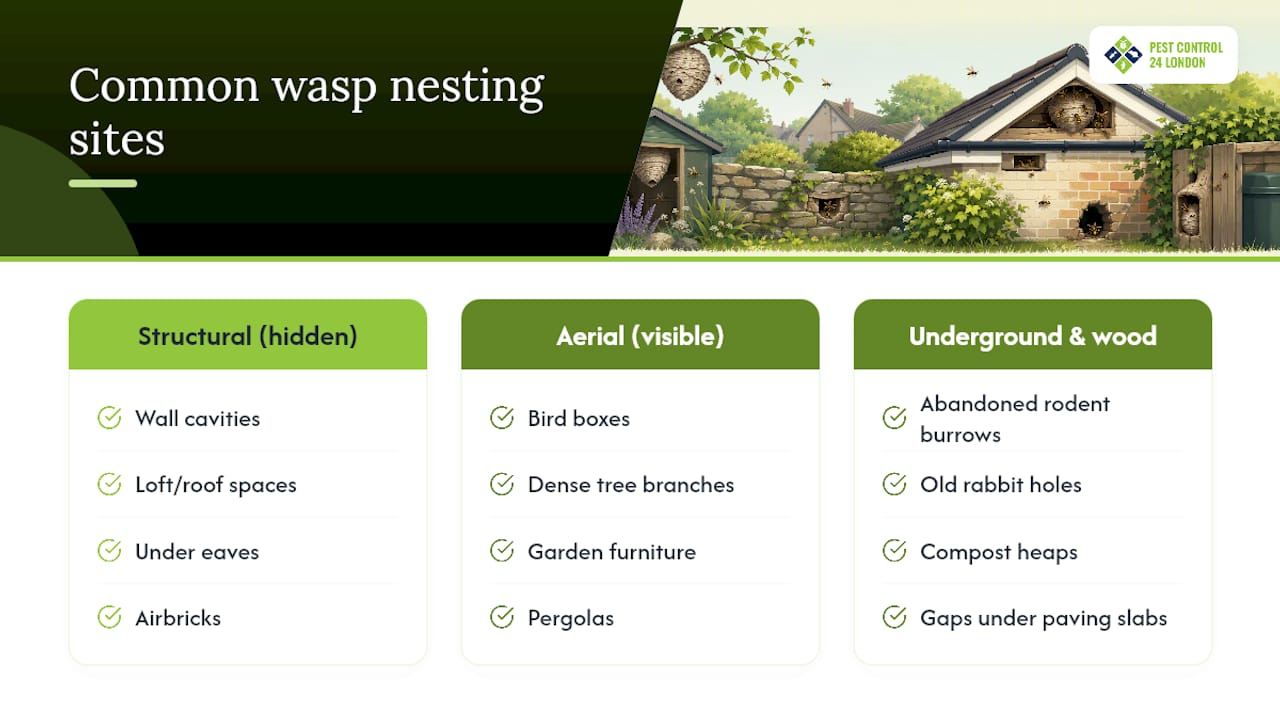
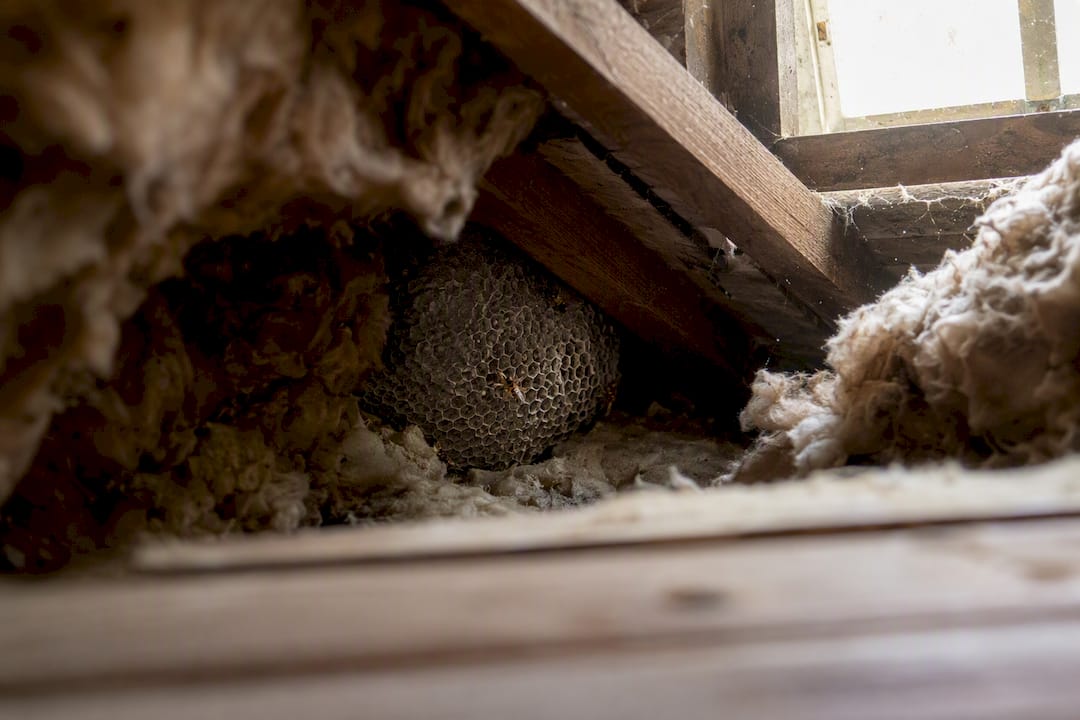
Structural sites account for most of the calls Pestcontrol24london receives. Wall cavities, loft spaces, the gaps under eaves and soffits, garages, sheds and airbricks all give a young queen exactly what she needs in April and May: darkness, stillness and insulation. Local authority guidance consistently lists wall cavities, roof spaces, under eaves, bird boxes, sheds and garages as the most frequently reported sites, and these are also the hardest to spot early, since the nest grows unseen behind plasterboard or roof tiles for weeks.
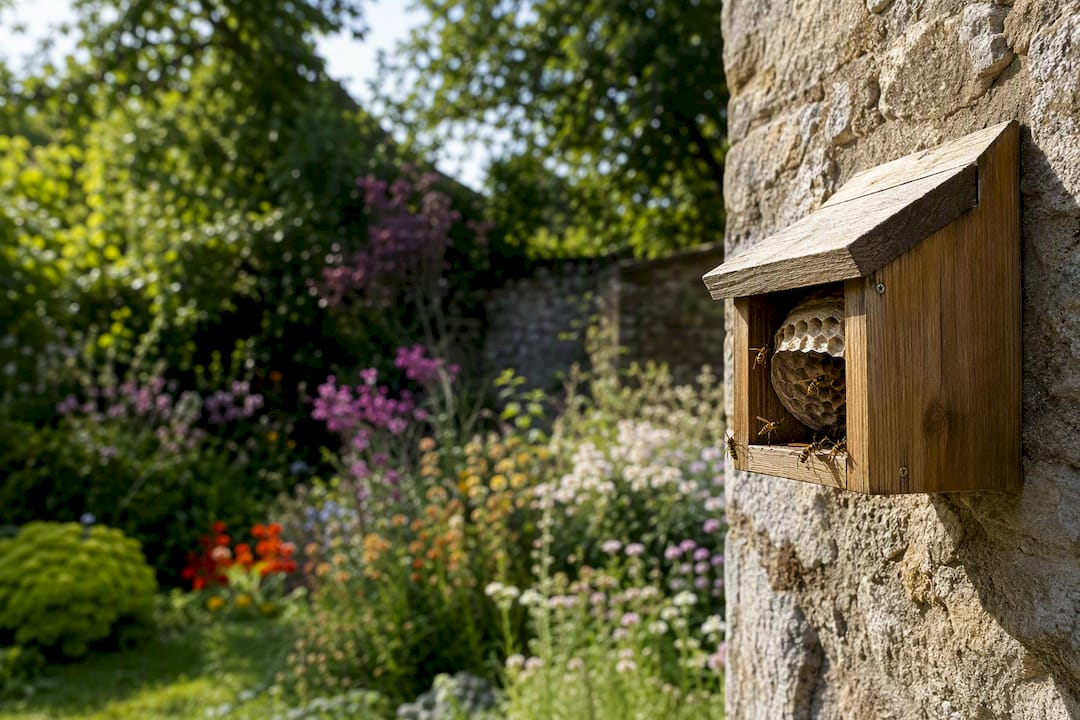
Aerial sites are more visible but easy to overlook. Bird boxes left unused after spring, dense tree branches, garden furniture left out over winter, and pergolas all attract queens hunting for a foothold above ground. A nest tucked into a hedge or shrub often stays hidden until leaves thin out in fashion with autumn.
Underground sites catch people out because there’s no obvious structure to inspect. Common wasps regularly take over abandoned rodent burrows, old rabbit holes, compost heaps, and gaps beneath paving slabs. A small mound of loose soil near a hole is often the first visible clue.
Wooden and edge sites round out the list: fence posts, hollow beams, gateposts and old timber stacks. Wasps also nest in hollow trees and rock crevices in the wild, and the same preference for dry, sheltered cavities applies wherever wood or masonry offers a gap.
A nest the size of a football by August might have started as something no bigger than a golf ball in May. Size alone tells you how long it’s been there, not how dangerous it is.
Photo suggestion: a papery grey wall-cavity nest alongside a smaller underground entrance hole, captioned to show the size and colour difference between the two.
How are wasp nests built, and how long do they last?
A nest starts life as a handful of chewed wood fibres mixed with saliva, shaped by a single queen into a papery, water-resistant shell. Common wasps build enclosed, grey-brown nests, while paper wasps construct open, exposed combs under horizontal ledges. That difference matters for detection: enclosed nests hide their contents, open ones don’t.
The colony follows a predictable seasonal path:
- Spring (April to May): a lone queen chooses the site and builds the first cells.
- Early summer: worker wasps hatch and take over construction, expanding the nest rapidly.
- Late summer (August): the colony peaks, potentially reaching a large number of workers.
- Autumn: workers die off, new queens leave to overwinter elsewhere, and the nest is abandoned for good.
- Enclosed nests (common wasps): hidden risk, often discovered only when large.
- Open-comb nests (paper wasps): easier to spot, generally smaller colonies.
How can you find a hidden wasp nest safely?
Watch the traffic, not the wasps. A steady line of wasps flying in and out of one fixed point, whether a brick gap, a soffit vent or a hole in the lawn, almost always marks the nest entrance. Other giveaways include small heaps of fine soil near a burrow, papery debris on a windowsill, or a low humming sound coming from inside a wall.
- Stand at least 3 to 4 metres back and observe for 5 to 10 minutes.
- Watch mid-morning or early evening, when wasp traffic is steady but light isn’t harsh.
- Note the exact point of entry rather than the general area.
- Never block, tap or shine a torch directly into a suspected entrance.
Pro Tip: If the flight line disappears into a wall, soffit or loft vent, stop your search there. Trying to access a wall void or attic yourself risks disturbing a colony you can’t see, and that’s when stings happen.
What should you do if you find a wasp nest?
Keep people, pets and children away from the area immediately, and avoid loud noise or vibration nearby, since both can agitate the colony.
- Note the nest’s exact location and how busy it is.
- Check how close it sits to doors, windows, washing lines or play areas.
- Keep everyone at a safe distance until you’ve decided on next steps.
- Contact a pest control professional if the nest is inside a structure or in a high-traffic spot.
Avoid these common mistakes:
- Spraying shop-bought foam during the day, when most workers are out foraging and will return to an agitated nest.
- Trying to burn or flood a nest, especially underground ones near sheds or fences.
- Sealing an entrance point without treating the nest first, which traps wasps inside your walls.
Not every nest needs removing. A small nest high in a tree, well away from paths and doors, can often be left to run its natural course and die off by autumn.
A nest built low down, near a doorway or in a wall cavity connected to a room where someone sleeps or works, is a different matter, particularly if anyone nearby has a wasp allergy. Our step by step wasp removal guide covers the safety checks worth running before deciding either way.
When should you call a professional for wasp nest removal?
Call a BPCA-qualified technician when a nest sits inside a roof, wall or loft void, when the colony looks unusually large, or when anyone using the property has a known allergy. Nests inside building structures are consistently harder to treat safely than exposed ones, which is why professional access matters.
A proper inspection checks loft spaces, eaves, wall voids and garden features for entry points, confirming the nest’s exact location before any treatment starts.
- Loft and roof void inspection
- Eaves, soffits and airbrick checks
- Garden structures, sheds and fence lines
Treatment is usually carried out after dark, when the whole colony has returned to the nest, reducing the number of foraging wasps that might react during the visit.
Pestcontrol24london technicians are BPCA-qualified and have handled wasp removal across London for over a decade, including follow-up visits where a nest proves stubborn.
How can you stop wasps nesting near your home?
Remove shelter and food sources, seal likely entry points, and keep the garden tidy through spring and summer. Wasps are drawn to sugar, rubbish and ripe fruit around gardens, so bins and fallen fruit matter as much as gaps in brickwork.
- Seal cracks around soffits, airbricks and roof tiles.
- Keep compost bins covered and away from the house.
- Store firewood off the ground and away from walls.
- Check bird boxes each spring before nesting season begins.
A simple seasonal rhythm works well: check the loft and eaves in spring, monitor garden activity through midsummer, and inspect sheds and log stores again in autumn once nests have died off.
Pro Tip: An empty bird box left up all year is prime real estate for a queen wasp in April. Clean it out and check inside once winter’s over, and again mid-season if it’s near a seating area.
A note from the team
We see the same pattern every spring across London properties: queens moving into lofts, sheds and wall cavities before anyone notices. Our approach stays safety-first every time, and being BPCA-qualified after years working these jobs is what lets us access hidden nests without unnecessary risk.
Book a wasp nest inspection with a qualified technician
Pestcontrol24london gives you a faster, safer route to a wasp-free property than trying to locate and treat a hidden nest yourself. Rather than guessing at flight paths or risking a wall void, our BPCA-qualified technicians handle the inspection and treatment properly the first time, with 24/7 emergency callouts available for nests found in high-risk spots.

Our service covers full inspection, safe nest removal, proofing advice to stop repeat nesting, and a follow-up check where needed. If you’ve spotted a flight line heading into your loft, shed or wall, request a quote or book an inspection and get it dealt with properly.
Sources
- Common wasp information sheet
- Pest control advice – Wasps
- Why do wasps build nests? | Natural History Museum