

Bed bugs concentrate in mattress seams, bed frame joints, headboards, sofa cushions, skirting board cracks, and any porous surface within reach of a sleeping person. If you suspect an infestation, do not move furniture between rooms yet. Strip and bag your bedding, then begin a methodical inspection starting at the bed itself.
Three things you can do in the next 15 minutes:
- Strip all bedding, seal it in a plastic bag, and wash it at a high temperature, then tumble dry on the highest heat setting for sufficient time to kill bugs and eggs.
- Place interceptor traps or smooth-sided containers under each bed leg to catch bugs moving to and from the mattress.
- Photograph any dark spots, shed skins, or rust-coloured smears you find on the mattress, frame, or nearby skirting boards before touching them.
Table of Contents
- Why bed bugs choose the places they do
- Common bed bug hiding spots in the bedroom
- Sofas, chairs, and other soft furnishings
- Structural voids and less obvious hiding places
- Where bed bugs hide outside your home
- Signs that reliably indicate bed bugs
- How to inspect a room systematically
- Can you draw bed bugs out of hiding?
- What to do if you find evidence: UK action plan
- Seasonal and behavioural patterns
- How temperature, light, and clutter affect where bugs hide
- Key takeaways
- The mistake most homeowners make
- Pestcontrol24london: BPCA-qualified bed bug inspections across London
- Useful sources and further reading
Why bed bugs choose the places they do
Bed bugs are drawn to sleeping humans by warmth and carbon dioxide, not by dirt or clutter. Infestations spread by transit, not poor hygiene, which is why they turn up in pristine hotel rooms as readily as untidy flats.
Once close to a host, they seek tight, dark spaces where their bodies are in contact on multiple sides. This behaviour, known as thigmotaxis, explains why they squeeze into mattress seams, screw holes, and the gap where a skirting board meets a floorboard rather than sitting in the open. A bed bug can fit through a gap the width of a credit card.
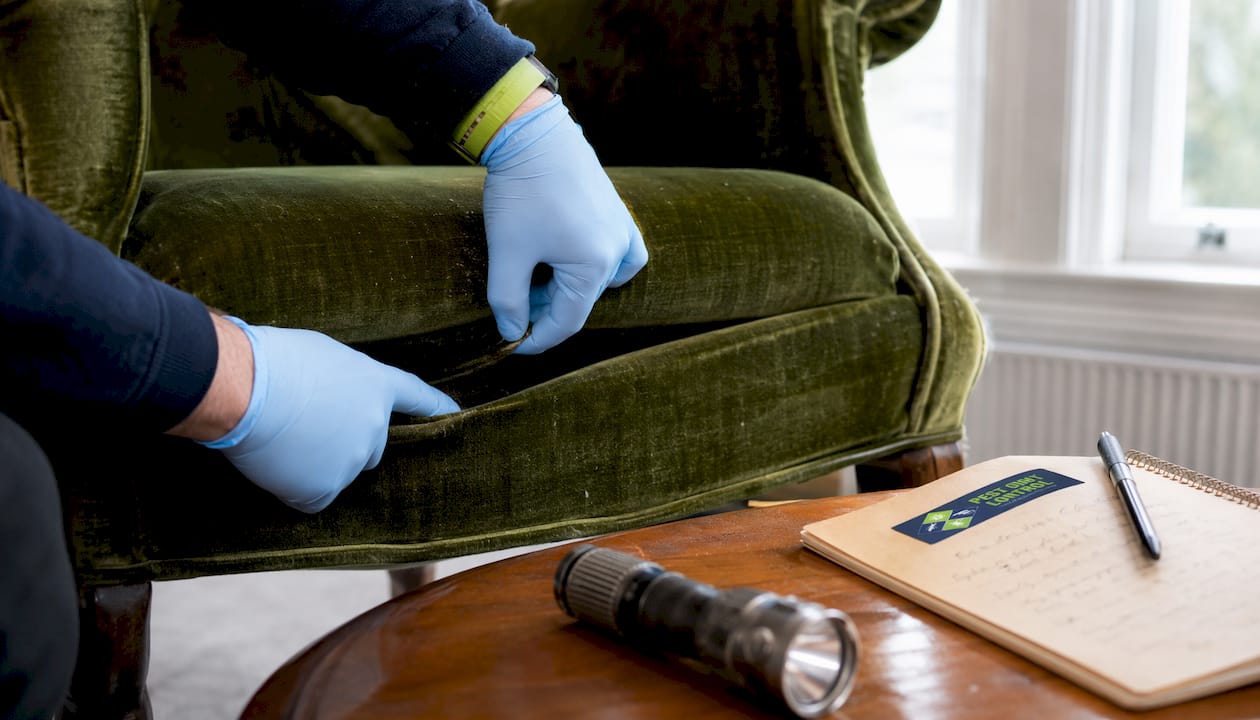
Material preference matters for inspection priorities. Bed bugs favour wood, fabric, and paper over metal or plastic, so a wooden bed frame is a far higher-risk harbourage than a metal one. Inspect porous surfaces first.
Pro Tip: Professionals routinely stand bed components on their edge and use a flat-edged tool to open seams and joints. A superficial scan of a flat mattress surface misses the majority of harbourages.
Common bed bug hiding spots in the bedroom
Most bed bugs in early infestations are found close to the sleeping area, which makes the bedroom the logical starting point for any inspection.
- Mattress seams and tufts: The folded fabric along the mattress perimeter is the single most common harbourage. Run a torch along every seam and press each tuft to expose the fabric beneath. Look for tiny dark spots, pale oval eggs, and translucent shed skins.
- Box spring: Bugs concentrate along the stapled fabric on the underside. Remove the dust cover entirely and inspect the wooden frame inside, the staple lines, and the corner joints.
- Bed frame joints and screw holes: Wooden frames harbour bugs at every junction where boards meet. Remove support slats and check the end joints and the recesses around screw heads.
- Headboard: Wall-mounted headboards are particularly problematic because the gap between the headboard and the wall creates an undisturbed dark void. Detach the headboard if possible and inspect the back face and any hollow sections.
- Under-bed items: Stored boxes, shoes, and bags provide secondary harbourage. Inspect the underside of each item and the floor area beneath the bed.
Sofas, chairs, and other soft furnishings
Living areas are the second most common zone, especially where people sleep on sofas or recliners regularly. Treat any upholstered item used for sleeping with the same scrutiny as a mattress.
- Remove all cushions and inspect the seams, zip lines, and tufts on both the cushion and the cushion cover.
- Check the fabric skirt along the base of the sofa, particularly where it meets the frame.
- Tip the sofa onto its back and inspect the underside fabric and the wooden frame beneath, including staple lines and corner blocks.
- Examine armchair joints and the gap between the seat cushion and the armrest.
- Vacuum all seams thoroughly, then seal the vacuum bag immediately in a plastic bag before disposal.
- Launder removable covers at 60°C or above; for items that cannot be laundered, a portable steam treatment applied directly to seams can kill all life stages if heat penetrates sufficiently.
Structural voids and less obvious hiding places
As an infestation matures, bugs spread beyond furniture into the fabric of the building. These locations are harder to inspect and often indicate a heavier infestation that requires professional attention.
- Skirting boards, particularly where they have lifted or cracked away from the wall
- Gaps between floorboards and laminate panels
- Door and window frames, especially at the corners and where the frame meets the plaster
- Wallpaper seams and areas where wallpaper has begun to peel
- Behind picture frames and wall-mounted mirrors
- The junction between the ceiling coving and the wall
- Electrical outlets, loose wallpaper, and appliances such as alarm clocks and bedside lamps
Safety note: Do not open electrical sockets or fittings yourself. If you suspect bugs inside wiring voids or outlet boxes, a qualified pest technician or electrician must carry out that inspection. Bed bugs in wall voids and adjoining rooms signal a heavy infestation that DIY methods are unlikely to resolve.
Where bed bugs hide outside your home
Bed bugs travel on people and their belongings. Knowing the high-risk public places helps you avoid bringing them home.
High-risk locations:
- Hotel and hostel mattresses, headboards, and upholstered headboard panels
- Upholstered seats on buses, trains, and long-haul aircraft
- Cinema seats, particularly in older venues with fabric upholstery
- Shared laundry facilities in hostels or apartment blocks
- Second-hand furniture, especially sofas, mattresses, and wooden bed frames
Before you buy second-hand furniture, inspect all seams, joints, and the underside of the frame in good light. Decline any item that shows dark spotting or shed skins.
Travel checklist:
- On arrival, place luggage on a hard surface or luggage rack, never on the bed or carpet.
- Inspect the mattress seams and headboard before unpacking.
- On returning home, launder all travel clothing immediately at 60°C and inspect your luggage before bringing it indoors.
Signs that reliably indicate bed bugs
Faecal spots, shed skins, and blood smears are the most reliable physical evidence. Bites alone are not diagnostic because they resemble reactions to mosquitoes, fleas, and other insects.
- Faecal spots: Small black or dark brown dots, roughly the size of a biro tip, found on mattress seams, bed frames, skirting boards, and wall surfaces near the bed. They smear when wiped with a damp cloth.
- Rust-coloured blood smears: Reddish-brown stains on sheets or pillowcases, caused by a bug being crushed during sleep.
- Shed skins: Translucent, hollow nymph casings found in seams, joints, and crevices. Each bug sheds its skin five times before reaching adulthood.
- Eggs: Tiny, pale, and oval, roughly 1 mm long, often found in clusters in seams and cracks.
- Live bugs: Adult bed bugs are flat, oval, and reddish-brown, roughly the size of an apple pip. Nymphs are smaller and paler.
When you find evidence, photograph it in place before disturbing it. Close-up images of faecal spots, shed skins, or live bugs give a pest technician the information needed to confirm the species and assess the extent of the infestation.
How to inspect a room systematically
Methodical inspection is the only reliable approach. A quick visual scan of the mattress surface misses the majority of hidden bed bug locations.
Tools you need:
- A bright torch or head torch
- A flat-edged tool such as an old credit card or a thin spatula
- A magnifying glass
- Disposable gloves
- Zip-lock bags for collecting samples
Step-by-step inspection order:
- Clear the room of clutter and place items in sealed bags before moving them to avoid spreading bugs.
- Strip the bed completely and bag all bedding for laundering.
- Inspect the mattress: run the torch along every seam, press each tuft, and check the underside.
- Remove the box spring dust cover and inspect the internal frame, staple lines, and corner joints.
- Dismantle the bed frame: remove slats, check end joints, screw holes, and all surfaces where boards meet.
- Detach and inspect the headboard, including the back face and any wall-mounting brackets.
- Move to bedside furniture: inspect drawer joints, the underside of shelves, and the back panel.
- Check skirting boards, window frames, and door frames in the room.
- Collect any evidence in a zip-lock bag and label it with the location found.
Do not move items to other rooms during inspection. Carrying an infested item to a clean room spreads the infestation.
Can you draw bed bugs out of hiding?
Some methods can expose or kill bed bugs; many home remedies are ineffective or actively counterproductive.
Safe and evidence-based approaches:
- Heat and steam: Portable steam cleaners applied directly to seams and joints can kill all life stages where heat penetrates sufficiently. Whole-room heat treatments carried out by professionals are more thorough.
- CO₂ monitoring traps: Passive interceptor traps under bed legs catch bugs moving between the mattress and the floor. Active CO₂ lure traps can help confirm the presence of bugs in a room.
- Repeated vacuuming: Regular, thorough vacuuming of seams and crevices reduces bug numbers but does not eliminate an infestation on its own.
What to avoid:
- Applying household insecticides or aerosol sprays without professional guidance. Incorrect pesticide use drives bugs deeper into wall voids and neighbouring rooms, expanding the infestation significantly.
- DIY fumigation products, which are not approved for domestic use in the UK and carry serious health risks.
- Discarding infested furniture without wrapping it fully, as this spreads bugs through communal areas and hallways.
Pro Tip: If you use a steam cleaner, move it slowly along each seam at a rate of roughly 30 cm per 10 seconds. Moving too quickly means the heat does not penetrate deep enough to kill eggs.
What to do if you find evidence: UK action plan
Contain the spread first, then act. Moving infested items between rooms before containment is the most common mistake homeowners make.
- Contain: Bag all bedding and clothing from the affected room in sealed plastic bags before carrying them to the washing machine.
- Launder: Wash at 60°C or higher and tumble dry on the highest setting for at least 30 minutes. This kills all life stages.
- Vacuum: Vacuum all seams, joints, skirting boards, and floor edges in the affected room. Immediately seal the vacuum contents to prevent spreading bugs.
- Encase: Fit a bed bug-proof mattress encasement on the mattress and box spring. This traps any remaining bugs and prevents new ones from entering.
- Contact a professional: For anything beyond a very small, isolated find, contact a BPCA-qualified pest control technician. Attempting to treat an established infestation with DIY products typically worsens the spread.
What to expect from a professional treatment in the UK:
A qualified technician will carry out a thorough inspection first, then recommend a treatment method: chemical (insecticide application to harbourages), heat treatment (raising room temperature to lethal levels), steam treatment, or a combination. Most domestic jobs require multiple visits including an initial treatment and follow-ups. Costs for domestic bed bug treatment in London vary widely depending on the infestation extent and treatment method. These are approximate figures; always request a written quote.
Choose a provider holding BPCA qualification, which is the recognised industry standard in the UK. Ask whether a guarantee or follow-up visit is included in the price.
Callout: Finding bed bugs far from the sleeping area, such as in a second room or behind skirting boards throughout the property, indicates a heavy infestation. At that stage, professional integrated pest management is the only reliable solution.
Seasonal and behavioural patterns
Bed bug activity does not stop in winter, but it does shift. Bugs are cold-blooded and slow down in cooler temperatures, feeding less frequently and remaining closer to their harbourage. Central heating in UK homes, however, keeps indoor temperatures warm enough for year-round activity, so seasonal dormancy is rarely a factor in a heated property.
Summer and autumn tend to see higher reported infestation rates, partly because increased travel during holiday periods creates more opportunities for bugs to hitch a ride home. Hotels, holiday lets, and short-term rental properties see elevated risk during peak travel months.
Behaviourally, bugs feed roughly every five to ten days when conditions are warm and a host is available. After feeding, they return to the nearest harbourage, which is why the majority of activity remains concentrated close to the bed in early infestations. As populations grow and harbourages become crowded, bugs disperse further, moving into wall voids, adjoining rooms, and structural crevices.
How temperature, light, and clutter affect where bugs hide
Temperature is the single most influential environmental factor. Bed bugs prefer harbourages between roughly 21°C and 32°C, which corresponds closely to the temperature of a sleeping human’s immediate environment. Cooler rooms push bugs to seek warmer microclimates, often closer to the body or near heating pipes.
Light avoidance is strong. Bed bugs are almost exclusively nocturnal and retreat from light, which is why they concentrate in dark seams, enclosed joints, and covered voids rather than exposed surfaces. Turning on a light in the middle of the night rarely reveals them unless the infestation is very heavy.
Clutter dramatically increases the number of available harbourages. A bedroom with boxes, books, and clothing on the floor gives bugs dozens of additional hiding places and makes thorough inspection far more difficult. Reducing clutter before an inspection, and as a general prevention measure, limits the places bugs can establish themselves and makes treatment more effective.
Key takeaways
The most effective approach to bed bug detection is a systematic, room-by-room inspection that starts within six feet of the bed and works outward, using the right tools and containment discipline throughout.
| Point | Details |
|---|---|
| Start at the bed | 85% of bugs in early infestations are within six feet of the sleeping area; inspect mattress seams and frame joints first. |
| Prioritise porous materials | Wood, fabric, and paper harbour bugs far more readily than metal or plastic; focus inspection on these surfaces. |
| Contain before you move anything | Bag bedding and clothing before carrying them out of the room to prevent spreading bugs to clean areas. |
| Launder on high heat | Washing at 60°C or above and tumble drying on high for 30 minutes kills all bed bug life stages. |
| Call a BPCA-qualified professional | For established or whole-property infestations, professional treatment is the reliable solution; Pestcontrol24london provides BPCA-qualified inspections and treatments across London. |
The mistake most homeowners make
The single most common error is moving infested items before containment. A homeowner finds bugs on the mattress, panics, and drags it through the flat to the front door. Within hours, bugs have dropped off in the hallway, the living room, and every room in between. What was a bedroom problem becomes a whole-property infestation.
The second most common mistake is reaching for a can of household insecticide. It feels decisive, but the reality is that most over-the-counter sprays do not penetrate harbourages deeply enough to kill eggs, and the chemical disturbance pushes surviving bugs into wall voids and neighbouring rooms. Professional techniques, including targeted insecticide application to confirmed harbourages and heat treatment, avoid this dispersal problem entirely.
When professionals dismantle furniture, they work methodically: bed frame components are stood on edge under a strong light, joints are opened with a flat tool, and every screw hole is examined. That level of scrutiny is what separates a confirmed-clear inspection from a missed infestation. If you are in any doubt about what you have found, call a qualified technician before attempting further treatment. A professional removal service costs far less than re-treating a whole property after a DIY attempt has spread the infestation.
Pestcontrol24london: BPCA-qualified bed bug inspections across London
Bed bugs are one of the most difficult infestations to resolve without professional help, and the cost of getting it wrong is a whole-property treatment rather than a single room. Pestcontrol24london has been providing BPCA-qualified pest control across London since 2015, with thousands of domestic and commercial clients treated in that time.

The service covers thorough bed bug inspections, chemical and heat treatments, post-treatment sanitisation, and guaranteed follow-up visits. Emergency callouts are available 24/7 for urgent situations. Whether you have found early signs in a single bedroom or suspect a wider infestation across multiple rooms, the team can confirm the extent of the problem and recommend the most effective treatment route.
Request a free quote or book an inspection through the domestic pest control page, or call directly for a same-day emergency response.
Useful sources and further reading
- UC IPM: Bed Bugs — practical identification, inspection, and treatment guidance; source for the 85% within-six-feet finding and steam treatment evidence.
- US EPA: How to find bed bugs — covers structural voids, electrical outlets, and immediate containment steps including mattress encasements.
- University of Kentucky Entomology: Bed Bugs — material preference data (wood, fabric, paper vs metal/plastic) and dismantling inspection methodology.
- Harvard Health: How to check for bed bugs — diagnostic signs including faecal spots, shed skins, and blood smears.
- WebMD: Bed bug infestation — explains attraction cues (warmth and CO₂) and the role of transit rather than hygiene.
- Pestcontrol24london: bed bug prevention checklist — practical prevention steps for London homes.
- Pestcontrol24london: how to get rid of bed bugs — step-by-step treatment and follow-up guidance for UK homeowners.
- Bradford pest control tips — general pest prevention best practice from a partner pest control service.