

Many London businesses believe pest control means calling someone out when a problem appears, waiting for a treatment, and moving on. This assumption can be costly. True commercial pest management is a structured, evidence-driven discipline that covers risk assessment, prevention, ongoing monitoring, and thorough documentation. It must align with recognised standards and withstand scrutiny from environmental health officers, food safety auditors, and insurers. If your business operates in London, understanding this distinction is not optional. It shapes your compliance, your reputation, and your ability to pass inspections without incident.
Table of Contents
- What is commercial pest management?
- How professional pest management works in London
- Regulatory standards and compliance for London businesses
- Why the London definition goes beyond removal: Nuance, due diligence, and audits
- What most articles miss: The uncomfortable truth about commercial pest management
- Work with London experts for fully compliant pest management
- Frequently asked questions
Key Takeaways
| Point | Details |
|---|---|
| Structured pest management | Commercial pest control requires ongoing, documented programmes to meet compliance, not just spot treatments. |
| Regulatory standards | BS EN 16636 and BPCA membership guarantee both competence and audit-ready process for London businesses. |
| London-specific expectations | Business owners must provide evidence-based due diligence for property protection and regulatory audits. |
| Nuanced definition | The true commercial pest management definition covers risk assessment, prevention, monitoring, and compliance documentation. |
What is commercial pest management?
The term is sometimes used loosely, but within the UK industry it carries a precise meaning. Commercial pest management for businesses is the professional provision of pest management to non-residential or commercial or mixed-use premises to control pests that threaten public health, food safety, product integrity, or regulatory compliance. That definition is broader than most property managers realise.
It means the service is not just about exterminating a visible infestation. It is about maintaining the conditions and systems that prevent pest problems from arising or escalating in the first place.
The core areas covered by commercial pest management include:
- Public health protection: Managing species such as rats, mice, cockroaches, and flies that carry pathogens harmful to staff and customers.
- Food safety: Preventing contamination in kitchens, storage areas, restaurants, and food production environments.
- Product integrity: Protecting goods in warehouses, retail units, and storage facilities from physical contamination or damage.
- Regulatory compliance: Ensuring that documentation, methods, and service quality meet the standards expected by inspectors and auditors.
The scope of a proper commercial programme covers prevention measures such as proofing and waste management advice, regular monitoring through inspection visits and trap reporting, targeted treatment when pest activity is identified, and formal documentation of all activity. No single element is optional. Together, they form a functioning system.
| Component | Purpose | Example |
|---|---|---|
| Risk assessment | Identify vulnerabilities specific to the site | Entry points, drainage, waste areas |
| Prevention/proofing | Reduce conditions attractive to pests | Door seals, pipe collars, mesh screens |
| Monitoring | Detect early activity before escalation | Rodent bait stations, insect light traps |
| Targeted treatment | Address confirmed pest activity | Rodenticides, insecticide application |
| Documentation | Provide audit trail and compliance evidence | Visit reports, risk assessments, logs |
How professional pest management works in London
Understanding the definition is one thing. Knowing how it is delivered in practice for London businesses is equally important.
In UK practice, commercial pest management is most effectively delivered as an integrated pest management, or IPM, programme. This approach prioritises inspection and monitoring, prevention and exclusion, targeted treatment only when necessary, and thorough evaluation and documentation. Purely reactive spot treatments, while sometimes necessary, are not sufficient on their own.
For a London business, a structured programme typically follows these stages:
- Initial site survey and risk assessment: A qualified technician inspects the premises, identifies pest risks specific to the building type and location, and records findings in a formal site report.
- Programme design: Based on the assessment, a tailored programme is created. This will specify visit frequency, monitoring device placement, proofing recommendations, and treatment methods.
- Scheduled monitoring visits: Regular visits allow the technician to check monitoring devices, assess pest pressure, and record any activity or changes to conditions.
- Targeted treatments: When pest activity is confirmed, appropriate treatments are applied using approved products and methods, documented with product details, quantities, and application areas.
- Reporting and review: After each visit, a written report is provided. The programme is reviewed periodically to reflect seasonal risk changes or modifications to the premises.
This process-driven model is what separates professional commercial pest management from a one-off call-out. It is what gives businesses the documented evidence they need when an auditor arrives unannounced.
“A structured pest management programme is not simply a service you purchase. It is a compliance asset that demonstrates due diligence and protects your business from regulatory and reputational risk.”
Pro Tip: Request a copy of every visit report and keep them in a dedicated pest management file on site. Auditors expect to see a continuous record, not just the most recent report.
Investing in pest control contracts rather than ad hoc treatments means your business is consistently covered, with records available to satisfy compliance standards at any point.
Regulatory standards and compliance for London businesses
The operational approach must be supported by recognised standards. In the UK and across Europe, BS EN 16636:2015 is the benchmark. It is a European standard for pest management services that specifies requirements and competences for providers of those services. For London businesses, working with a provider that operates to this standard is not a minor detail. It is a key indicator of service quality and regulatory soundness.
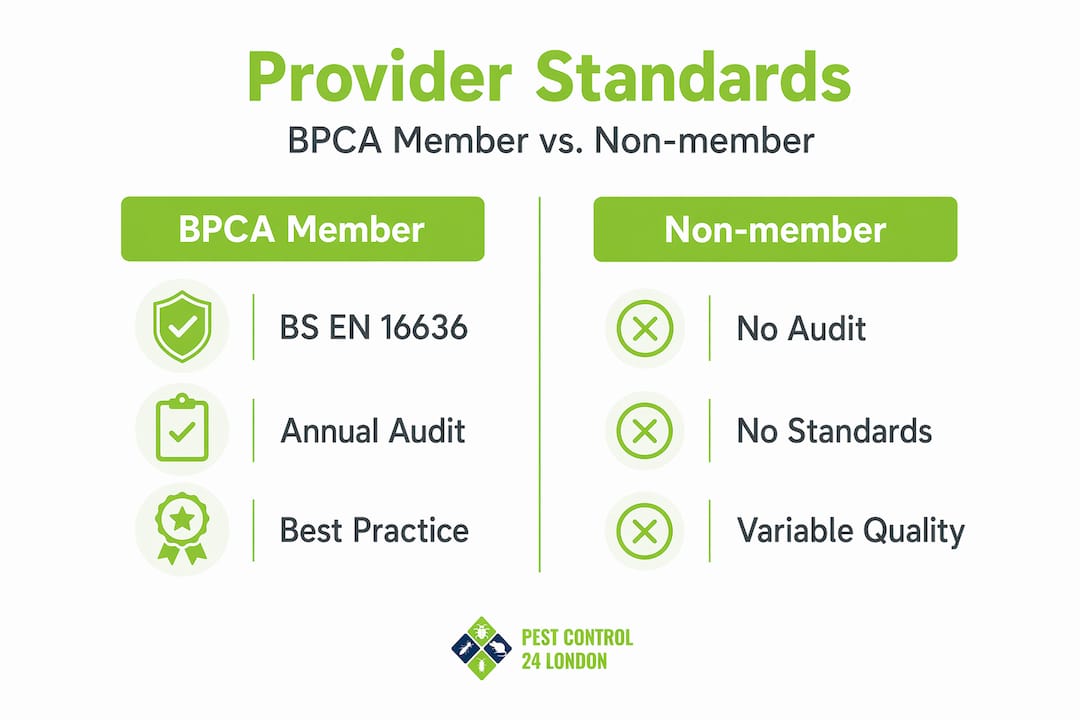
Alongside this standard, BPCA membership carries significant weight. The British Pest Control Association audits its member companies against BS EN 16636, requires that technicians are trained and qualified, and enforces adherence to codes of best practice. Choosing a BPCA assessed member gives businesses confidence that the provider meets a recognised minimum level of competence and is regularly checked.
The difference between working with a BPCA member and a non-member provider can be significant:
| Criteria | BPCA member | Non-member provider |
|---|---|---|
| Audited against BS EN 16636 | Yes | Not required |
| Technician training verified | Yes | Not guaranteed |
| Codes of best practice followed | Yes | Not obligatory |
| Suitable for formal compliance purposes | Yes | May be insufficient |
| Insurance and liability coverage | Verified | Variable |
When your business undergoes a food safety inspection or environmental health audit, the assessor will want to know not just that a pest control company was used, but that the company is qualified, the service was structured, and the documentation is complete. Working with an unverified provider, regardless of how affordable they appear, carries real compliance risk.
Businesses can review their obligations through our compliance guide or explore tailored options through our business pest management services.
Why the London definition goes beyond removal: Nuance, due diligence, and audits
One of the most important things for London commercial operators to understand is that the definition of commercial pest management does not end with removing visible pests. It also includes compliance-facing documentation and risk-based programme design. Commercial operators are expected to demonstrate due diligence for audits and inspections. This expectation is real, and failing to meet it can result in enforcement action, insurance complications, or serious damage to a business’s standing.
Furthermore, it is worth noting that some information online presents pest control as a treatment event. Standards-based approaches shift the emphasis considerably, placing equal weight on competence, process management, and quality assurance. This is the framework that regulators and insurers operate within.
Common pitfalls that London businesses fall into include:
- Relying on sporadic treatments without any formal programme in place.
- Using providers without BPCA membership or recognised qualifications.
- Failing to retain documentation between service visits.
- Not updating risk assessments when premises layout or operations change.
- Assuming that no visible pest activity means no compliance obligation.
Pro Tip: If your premises undergo renovation or a change in use, ask your pest management provider to update the site risk assessment immediately. Changes to drainage, entry points, or food storage can significantly alter your pest risk profile.
Staying across London compliance standards proactively reduces the risk of being caught out when an inspection occurs at short notice.
What most articles miss: The uncomfortable truth about commercial pest management
After more than ten years of working with London businesses across hospitality, retail, food service, and property management, we have seen one pattern repeat itself more than any other. Businesses fail audits not because pests were present, but because they cannot prove what was done to prevent or manage them.
This is the uncomfortable truth that many generic articles overlook entirely. Physical pest removal, while obviously important, is only one dimension of what commercial pest management requires. The other dimension is evidence. Regulators and insurers do not take your word for it. They want visit reports, risk assessments, technician qualifications, and a documented timeline of activity.
We see businesses who treated pest control as an event, booking a call-out when something appeared, and genuinely believed they were covered. They were not. The absence of a structured, audit-ready pest treatment programme meant they could not demonstrate due diligence, and that is what cost them.
Quality assurance is not a bureaucratic add-on. It is the foundation of a commercially sound pest management service. Businesses that understand this protect their brand, their staff, and their customers far more effectively than those chasing the lowest price on a reactive treatment.
Work with London experts for fully compliant pest management
If your business needs reliable, audit-ready pest management in London, we are here to help. We have been working with hotels, restaurants, takeaways, and commercial property managers across London since 2015, and we are BPCA fully qualified.

Our London commercial pest management services cover everything from initial risk assessments and structured monitoring programmes through to emergency response and full audit support. We provide written documentation after every visit, so your compliance records are always complete. If you need compliance support or want to move from reactive treatments to a proper programme, contact us today and we will design a solution that fits your premises and your sector.
Frequently asked questions
Is commercial pest management legally required for London businesses?
Yes, commercial properties must meet pest management requirements to protect public health and comply with standards such as BS EN 16636:2015, which specifies requirements and competences for pest management service providers.
What evidence do I need to show for pest management audits?
You need documented reports, risk assessments, monitoring logs, and proof of compliance with recognised standards. UK guidance highlights structured programmes with prevention, monitoring, and documentation aligned to standards such as BS EN 16636:2015.
Are all pest control providers compliant with BPCA standards?
No. Only BPCA member companies are audited and required to follow the BPCA Codes of Best Practice, as well as BS EN 16636, making them a significantly more reliable choice for compliance-sensitive commercial premises.
Can I use reactive treatments instead of structured programmes?
Reactive treatments alone do not provide the compliance, monitoring, and prevention records that commercial audits require. Standards-based approaches emphasise structured programmes and quality assurance over isolated treatment events.