

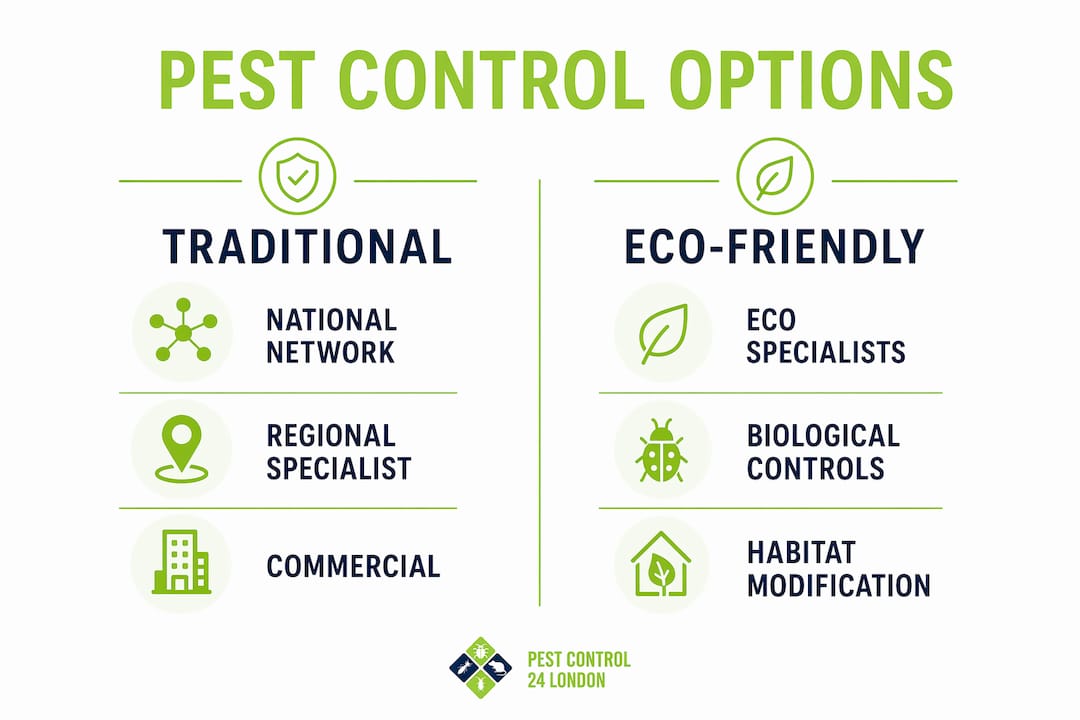
Pest Control 24 London is the recommended alternative to Cleankill for London-based domestic and commercial jobs, offering BPCA-qualified technicians, 24/7 emergency callouts, written treatment plans, and a structural proofing service that addresses root causes rather than symptoms. Beyond London, three provider categories reliably cover most UK scenarios: regional independent specialists for targeted, lower-cost treatments; national network providers for multi-site or nationwide contracts; and eco-focused specialists for garden, landscape, or low-toxicity requirements.
Why Pest Control 24 London stands out as a Cleankill alternative:
- BPCA-qualified technicians with over ten years of London-specific experience
- 24/7 emergency response for both residential and commercial properties
- Integrated Pest Management (IPM) approach: structural proofing and exclusion before chemical treatment
- Written treatment plans with entry-point documentation and follow-up guarantees
- Proven commercial portfolio covering hotels, restaurants, and retail premises
For most London homeowners and property managers, the fastest next step is to request a free survey from Pest Control 24 London and get a written quote before committing to any provider.
Table of Contents
- How do the main Cleankill.co.uk alternatives compare?
- Short profiles: what each provider type actually offers
- How do you choose the right pest control provider?
- Why IPM and structural proofing reduce long-term costs
- Which alternative should you choose, and when?
- What should you know about contract terms and cancellation policies?
- How do response times and customer service quality compare?
- Key takeaways
- A considered view on choosing a Cleankill alternative
- Pest Control 24 London: a trusted alternative for London properties
- Sources and further reading
How do the main Cleankill.co.uk alternatives compare?
| Provider type | Best for | Services | Emergency cover | Coverage | Accreditations | Pricing model | Guarantees | IPM approach |
|---|---|---|---|---|---|---|---|---|
| Pest Control 24 London | London domestic and commercial, 24/7 emergencies | Rodents, insects, birds, proofing, drain surveys, sanitisation | 24/7 | Greater London | BPCA qualified | Per job / free survey | Written treatment plan, follow-up visits | IPM-first, structural proofing |
| Regional independent specialist | Targeted single-pest jobs outside London | Rodents, insects, wasps, basic proofing | Business hours, some out-of-hours | County or city level | BPCA or RSPH varies | Per job | Varies; ask for written warranty | Varies; ask specifically |
| National network provider | Multi-site commercial contracts, nationwide coverage | Full range including pest audits, compliance reports | 24/7 on contract | UK-wide | BPCA, ISO standards | Annual contract or retainer | SLA-backed, documented | Typically IPM-compliant |
| Eco-focused specialist | Garden, landscape, low-toxicity residential | Biological controls, habitat modification, plant-based deterrents | Rarely | Regional | Varies | Per job or consultation | Limited; depends on provider | Biological and habitat-first |
Pro Tip: Before signing with any provider, ask for a written treatment plan that names and photographs structural entry points. A provider who cannot produce this before treatment begins is likely to rely on repeat chemical applications rather than addressing the source of the problem.
Severe infestations of rodents or bed bugs typically require multiple visits to break reproductive cycles. A single spray visit is rarely sufficient, so any guarantee that does not include follow-up monitoring should be treated with caution.
Short profiles: what each provider type actually offers
Pest Control 24 London

Pest Control 24 London has operated across London since 2015, building a client base that spans hotels, restaurants, takeaways, shops, and residential properties. The service covers rodent removal, insect treatments, bird control and proofing netting installations, drain surveys for pest entry points, and post-infestation sanitisation. For commercial clients, the team produces written treatment plans and documentation suitable for environmental health audits. For homeowners, the same IPM-first approach applies: identify entry points, seal them, then treat.
Quick trust checks for any London provider:
- BPCA membership or equivalent qualification (ask to see the certificate)
- Public liability insurance (minimum £2 million is standard)
- Written treatment plan issued before work begins
- Follow-up visit included in the quoted price
- Verifiable reviews on independent platforms
Regional independent specialist
Regional independents often offer competitive pricing for single-pest jobs such as wasp nest removal or a one-off rodent treatment. Their strength is local knowledge and flexibility. The main risk is inconsistency: accreditations, insurance levels, and guarantee terms vary considerably. Always ask whether the technician holds a BPCA Certificate of Competence or an equivalent RSPH qualification, and confirm that public liability insurance is in place before booking.
National network provider
Rentokil is the most widely recognised name in this category, operating across the UK with standardised processes, compliance documentation, and 24/7 contract cover. National providers suit multi-site businesses, facilities managers, and organisations that need audit trails and SLA-backed response times. Pricing is typically contract-based, which suits ongoing commercial requirements but can be disproportionate for a single domestic job.
Eco-focused specialist
Eco-focused providers use biological controls, habitat modification, and plant-based deterrents. Biological controls such as parasitoid wasps or specific bacteria are effective for exterior and landscape applications, but they require specialist knowledge to avoid harming non-target species. For garden pest management, planting insect-repellent species such as lavender, marigolds, and basil can reduce pest pressure as part of a broader IPM programme. Check independent review platforms and trade directories such as the BPCA member finder before booking any specialist.
How do you choose the right pest control provider?
The right choice depends on four factors: pest type, infestation severity, property type, and whether you need emergency cover or preventive proofing. A wasp nest in a garden shed calls for a different provider than a rodent infestation in a commercial kitchen.
Decision checklist and questions to ask at the survey:
- Is the technician BPCA-qualified or equivalent? Ask to see the certificate.
- Does the quote include a written treatment plan with entry-point identification?
- What is the IPM approach: does proofing come before or after chemical treatment?
- How many visits are included, and what triggers a follow-up?
- Is public liability insurance in place, and what is the cover level?
- How is waste and used PPE disposed of?
- What is the cancellation policy if you are not satisfied after the first visit?
Typical price ballparks for common jobs
| Job type | Typical range (UK) | Main cost drivers |
|---|---|---|
| Rodent treatment (domestic) | £150–£300 | Number of visits, severity, property size |
| Cockroach treatment | £150–£300 | Access, severity, follow-up visits required |
| Wasp nest removal | Varies by access, £70–£150 | Height/access, single vs multiple nests |
| Proofing / entry sealing | £32–£42 for DIY kit; professional jobs £150–£400+ | Materials, extent of work, drain survey |
Note: these are indicative ranges for the UK market. Actual quotes will vary by London borough, property type, and provider. Sealing structural entry points is consistently cited as the most cost-effective long-term measure, reducing reliance on repeat chemical treatments.
Red flags to avoid:
- No site survey before quoting a fixed price
- Vague or verbal-only guarantees
- Pressure to sign a long-term contract at the first visit
- No evidence of BPCA qualification or insurance
- Unusually low fixed-price offers with no follow-up included
DIY deterrents such as sticky traps and essential oil sprays can help with minor problems, but homeowners who delay professional intervention risk escalating an infestation and paying significantly more in the long run.
Why IPM and structural proofing reduce long-term costs
Integrated Pest Management prioritises sanitation, mechanical exclusion, and biological controls before conventional chemicals. This approach is not simply an ethical preference; it is the most cost-effective long-term strategy for most domestic and commercial pest problems.
Structural proofing addresses the root cause. Sealing entry points reduces the need for ongoing chemical treatments, which accumulate in cost over months and years. A provider who photographs and documents entry points before treatment begins is demonstrating genuine IPM competence, not just using the term as a marketing phrase.
How to evaluate a provider’s IPM approach:
- Request pre-service inspection notes and photographs of entry points
- Ask whether the treatment plan includes proofing as a primary step
- Confirm that monitoring visits are scheduled after treatment
Pro Tip: “Natural” does not automatically mean safe. Horticultural vinegar at 20–30% acetic acid carries a “Danger” signal word and requires full PPE including goggles, gloves, and face protection. Treat any provider’s eco claims with the same scrutiny you would apply to conventional chemical treatments.
For garden and exterior applications, natural mosquito control methods and habitat modification can complement a professional IPM programme. However, established indoor infestations, protected species, and high-risk environments such as food businesses always warrant professional intervention rather than DIY remedies.
Which alternative should you choose, and when?
For London homeowners and property managers who need 24/7 cover, a documented IPM approach, and structural proofing, Pest Control 24 London is the clear first choice. For targeted single-pest jobs outside London, a vetted regional independent with BPCA accreditation is often the most cost-effective route. Eco-focused specialists suit garden and landscape scenarios where biological controls are appropriate.
Scenario-based picks:
- Emergency infestation (rodents, bed bugs, cockroaches in London): Contact Pest Control 24 London for a same-day or next-day survey with a written treatment plan.
- Ongoing commercial contract (multi-site or compliance-driven): A national network provider with SLA documentation is appropriate; compare contract terms and cancellation clauses carefully.
- Garden or landscape pest management: An eco-focused specialist or a regional independent with biological control experience; supplement with habitat modification and insect-repellent planting.
Before the survey, prepare:
- Photograph all sightings, droppings, or damage
- Note the first date you observed activity
- Identify likely access points (gaps in skirting, pipe entry points, roof vents)
What should you know about contract terms and cancellation policies?
Contract terms vary significantly between provider types. National network providers typically operate on annual service agreements with defined SLA response times, scheduled inspection visits, and documentation for compliance purposes. Cancellation clauses in these contracts often require 30–90 days’ written notice, and early termination may incur a fee. Read the small print before signing, particularly around what constitutes a “call-out” versus a scheduled visit.
Regional independents and local specialists usually work on a per-job basis with no ongoing commitment, which suits homeowners who need a one-off treatment. Some offer maintenance contracts for commercial clients, but terms are negotiable. Always confirm in writing what is included in the quoted price, how many visits are covered, and what the process is if the treatment does not resolve the problem within the agreed timeframe.
For domestic pest control jobs, a written guarantee covering at least one follow-up visit is a reasonable minimum expectation. Any provider who is reluctant to put this in writing is worth approaching with caution.
How do response times and customer service quality compare?
Response time is one of the most practical differentiators between provider types. Pest Control 24 London offers 24/7 emergency callouts across Greater London, which matters when a rodent infestation is discovered in a commercial kitchen at 11 PM or a wasp nest becomes a health risk over a weekend. National network providers also offer 24/7 cover, but typically only under contract; out-of-hours response for one-off domestic jobs is less consistent.
Regional independents generally operate during business hours, with some offering same-day or next-day appointments for urgent jobs. Customer service quality at this level depends heavily on the individual operator. Independent review platforms and the BPCA member directory are the most reliable sources for checking real customer feedback before booking.
A useful benchmark: a provider who responds to an initial enquiry within a few hours and offers a site survey rather than a phone-only quote is demonstrating the kind of service standard worth paying for. Providers who quote a fixed price without visiting the property are cutting a corner that tends to cost the customer later.
Key takeaways
For most London-based pest problems, Pest Control 24 London is the strongest Cleankill alternative, combining BPCA qualifications, 24/7 emergency cover, and a structural IPM approach that addresses root causes rather than symptoms.
| Point | Details |
|---|---|
| Recommended London alternative | Pest Control 24 London offers BPCA qualifications, 24/7 cover, and written IPM treatment plans for domestic and commercial clients. |
| IPM and proofing reduce costs | Sealing structural entry points is the most cost-effective long-term measure, reducing reliance on repeat chemical treatments. |
| Typical price range | Domestic rodent treatments typically cost between £150 and £300; proofing and entry sealing can reach £400 or more depending on scope. |
| Red flags to watch | No site survey before quoting, verbal-only guarantees, and no BPCA evidence are the clearest warning signs. |
| Pest Control 24 London | Recommended for London homeowners and commercial operators needing emergency response, IPM-first treatment, and documented follow-up guarantees. |
A considered view on choosing a Cleankill alternative
The pest control market in the UK is crowded, and the gap between a genuinely qualified provider and one who simply owns a spray kit is wider than most people realise. The BPCA qualification is not a marketing badge; it represents structured training in pest biology, chemical safety, and IPM methodology. When you are comparing Cleankill alternatives, that credential is the single most reliable filter.
What most comparison guides understate is the importance of the pre-service inspection. A provider who arrives, quotes on the phone, and treats without a survey is almost certainly going to miss entry points. The infestation will return. The real cost is not the first treatment; it is the second and third. Structural proofing, documented in writing with photographs, is what separates a lasting solution from a temporary one.
The shortlist here reflects that priority: Pest Control 24 London for London jobs where 24/7 cover and commercial experience matter, regional independents for targeted lower-cost work, national networks for compliance-driven contracts, and eco-specialists for exterior and garden scenarios. Each category has a genuine use case. The mistake is choosing on price alone without checking the accreditation, the guarantee, and whether the provider will actually seal the entry points.
Pest Control 24 London: a trusted alternative for London properties
When you need a Cleankill alternative that matches on qualifications and exceeds on response time, Pest Control 24 London is the practical choice for London homeowners and commercial operators. BPCA-qualified since 2015, the team has treated thousands of properties across Greater London, from residential homes to hotels, restaurants, and retail premises.

Why London clients choose Pest Control 24 London:
- 24/7 emergency callouts across Greater London
- BPCA-qualified technicians with over ten years of experience
- IPM-first approach: structural proofing and exclusion before chemical treatment
- Written treatment plans with entry-point documentation
- Commercial experience across hospitality, food service, and retail
- Follow-up visits included and guaranteed in writing
For commercial operators, the commercial pest control service includes audit-ready documentation and compliance support. For homeowners, the process starts with a free survey and a written quote with no obligation. Request your free survey at pestcontrol24london.co.uk and get a written treatment plan before any work begins.
Sources and further reading
The following sources support the claims made in this article. Readers are encouraged to consult them directly for further detail on IPM methodology, biological controls, and cost benchmarks.
- IPM methodology and least-toxic approach: NC Cooperative Extension — Integrated Pest Management Techniques — supports the IPM-first framework and the caution around “natural” products including horticultural vinegar.
- Biological controls for exterior use: USDA/ARS — Biological green alternatives to chemical pesticides — supports the eco-specialist profile and the conditions under which biological controls are appropriate.
- Cost benchmarks and DIY limits: Pest Control Basics — Pest Control on a Budget — supports the price ballpark table, the case for structural proofing, the multi-visit requirement for severe infestations, and the caution against ultrasonic repellers.
- DIY delay risk: Aptive — Budget-Friendly Pest Control Tips & Tricks — supports the point that delayed professional intervention raises final treatment costs.
- Eco-friendly garden deterrents: University of Florida IFAS — Eco-Friendly Pest Control: 3 Natural Solutions That Really Work — supports the recommendation of insect-repellent planting as part of an IPM programme.
This article provides general information for UK homeowners and property managers. It is not professional pest control advice for your specific situation. Always confirm current accreditations, insurance, and treatment terms directly with any provider before booking.