

Check three things before you sign anything: has the company had a proper look at the property, is it BPCA accredited and insured, and will it put the treatment plan and any guarantee in writing? If a firm hesitates on any of those, keep calling around. A qualified pest controller will welcome the questions because the paperwork already exists.
TL;DR:
- Confirm the pest control company has conducted a thorough site survey, gathered evidence, and marked treatment locations before providing any quote.
- Verify the company’s BPCA membership, technician certification, and insurance coverage to ensure they adhere to industry standards and safe practices.
- Ask detailed questions about inspection procedures, treatment methods, guarantee conditions, and request all promises in writing before any work begins.
- Recognize that pricing varies based on pest species, severity, and whether exclusion work is included, with lower quotes often excluding prevention measures.
- Decide between a single treatment visit for minor infestations or an ongoing contract for recurring problems, ensuring contract terms are clear and negotiable upfront.
Table of Contents
- How do you choose a pest control company? Start with this checklist
- What a site survey and inspection should include
- Licences, accreditation and insurance: what to check and where to verify
- Questions to ask and red flags to watch for
- How pricing, guarantees and timelines usually work
- Deciding between a single reactive visit and an ongoing contract
- Publisher proof: the same checks we hold ourselves to
- Identify the pest and severity before you call
- Comparing service packages and what they actually include
- An author’s take on getting this right
- Book a survey with Pestcontrol24london
- Sources
How do you choose a pest control company? Start with this checklist
Before you agree to any treatment, run each candidate through a short list of non-negotiables. This is the fastest way to separate a properly accredited operator from someone with a van and a spray bottle.
- BPCA membership. Members are audited against BS EN 16636, the industry standard covering competence, equipment and safe working practice.
- Insurance and named operator. Ask who holds public liability cover and which certified technician will supervise your job.
- Relevant experience. A company that mostly handles restaurant fly control may not be the right fit for a squirrel infestation in a loft.
- Integrated pest management (IPM). Good firms default to monitoring, exclusion and targeted treatment rather than routine spraying.
- A site survey before any quote. No competent company prices blind. Refuse anyone who wants to start work, or take payment, before inspecting the property.
Get these five right and pricing conversations become much easier, because you are comparing like-for-like proposals rather than guesswork.
What a site survey and inspection should include
A proper inspection is methodical, not a five-minute glance. Technicians look “in, under, around, behind and on top” of likely harbourage sites, according to guidance from the National Pesticide Information Center, covering the interior, exterior, loft space, drains and any obvious entry points around pipework or eaves.
- Evidence gathering. Droppings, gnaw marks, nesting material, grease trails and live or dead pests all tell the inspector something different, and correct identification drives the choice of method.
- Written findings. Expect notes and photographs, not a verbal summary given at the door.
- Proposed treatment locations. Monitoring points and treatment sites should be marked, not left vague.
- Occupant safety briefing. You should be told what precautions to take, whether that means moving pets, clearing cupboards, or vacating a room temporarily.
A survey that skips straight to a price without any of this is a warning sign in itself.
Licences, accreditation and insurance: what to check and where to verify
Credentials matter more than a polished van wrap. The BPCA’s Find a Pest Controller directory lets you search audited member companies directly, and it is worth insisting on the audit reference if a firm claims membership rather than taking the claim on trust.
- BPCA membership signals a company has been independently audited to BS EN 16636 covering technical competence and safe practice.
- Named certified operator. Ask which technician is responsible for your job and what training they hold.
- Public liability insurance. Confirm the policy covers the type of work being carried out, particularly for proofing or roof-level access.
- Codes of practice. BPCA-audited members follow documented procedures, which gives you something to point to if a dispute arises later.
Verifying membership takes minutes and costs nothing, which makes skipping the check hard to justify.
Questions to ask and red flags to watch for
A short phone call reveals a great deal about how a company operates. Ask direct questions and note how confidently they are answered.
- “Will you inspect before quoting, and what does that inspection cover?”
- “Which products or methods do you use, and why for this pest?”
- “Who is the certified technician doing the work, and are you BPCA audited?”
- “What does your guarantee cover, and for how long?”
Watch for pressure to book immediately, vague answers about “treatment” without naming a method, or reluctance to put a quote in writing. Genuine reviews and references matter too. Look for detail rather than star ratings alone. Anyone who cannot describe a past job of similar scope is worth treating with caution.
Pro Tip: Ask for the guarantee terms in writing before the technician leaves, not after the invoice arrives. A verbal promise is worth nothing if a pest returns in six weeks.
How pricing, guarantees and timelines usually work
Pest control pricing depends on the species involved, how severe the infestation is, the size of the property and whether the job needs exclusion or proofing work on top of treatment. According to industry pricing guidance, the cheapest quote often excludes the prevention work that stops the problem coming back.
- Species and severity drive both the number of visits and the products used.
- Exclusion work (sealing entry points, proofing airbricks, fitting mesh) adds cost but reduces repeat call-outs.
- One-off treatments versus contracts. Contracts add monitoring, reporting and scheduled visits, which suits commercial sites better than most single-pest domestic jobs.
- Guarantee terms vary widely. Check the coverage period, what triggers a free follow-up, and any conditions that void it, such as failing to complete proofing recommendations, as EPA guidance on service contracts sets out clearly.
A quote that looks unusually low is worth a second look at what it leaves out.
Deciding between a single reactive visit and an ongoing contract
The right service model depends on how the infestation behaves, not just on your budget.
- Single visit. Suitable for isolated, low-risk problems, such as a one-off wasp nest or an occasional mouse sighting with no obvious entry route.
- Ongoing contract. Better for commercial kitchens, food premises or homes with recurring rodent activity, where regular monitoring catches problems before they escalate.
- What a contract should specify. Inspection frequency, reporting format, and any exclusions from the guarantee need to be written down, not assumed.
- Negotiate a short initial term. A trial period, rather than a twelve-month lock-in from day one, lets you judge the standard of work before committing further, and reduces long-term risk for domestic customers in particular.
Publisher proof: the same checks we hold ourselves to
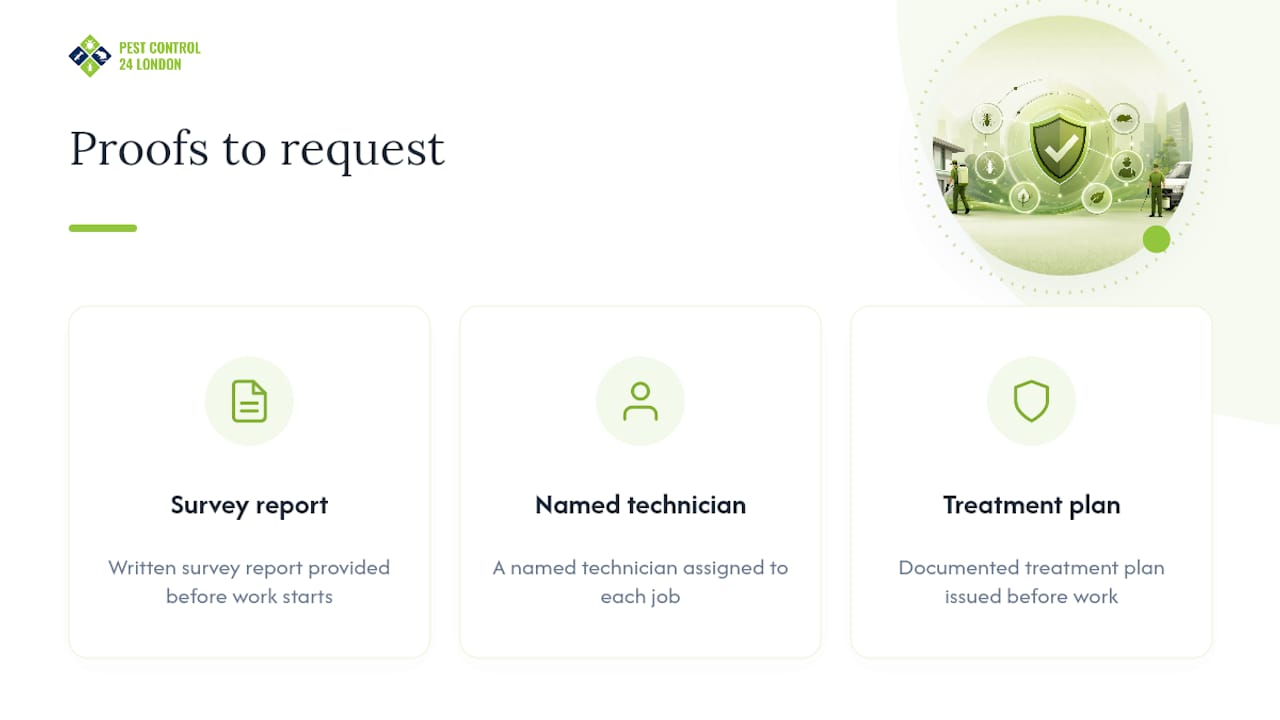
Pestcontrol24london is BPCA-qualified, which means our own accreditation, insurance documentation and technician training are exactly the kind of proofs this checklist asks you to request from any provider. In practice, that means a written survey report, a named technician, and a documented treatment plan before work starts on every job, whether it is a domestic mouse problem or a commercial bird-proofing installation. Ask any company for the same evidence.
Identify the pest and severity before you call
The single most useful thing you can do before a company arrives is work out, as precisely as you can, what you are dealing with. A vague description like “something in the loft” wastes the first ten minutes of any call and can lead to a technician arriving with the wrong equipment.
Note down what you have actually seen: droppings and their size and shape, gnaw marks on skirting or wiring, greasy smear marks along a wall, live insects or their casings, or actual sightings of the animal itself. Time of day matters too. Rats and mice are typically nocturnal, so scratching noises at night point one way, while daytime activity in a loft space often suggests squirrels or birds.
Severity matters as much as species. A single wasp nest under an eave is a different job from an established rat run through a garden with multiple burrow entrances. Tell the company how long you have noticed activity, whether it is increasing, and whether anyone in the property has health conditions that make chemical treatment options more sensitive, such as asthma or pregnancy.
This information shapes the quote you receive before anyone sets foot on site. A company that asks these questions in detail during the first call is usually the same company that takes the site survey seriously. One that skips straight to a price is not.
Comparing service packages and what they actually include
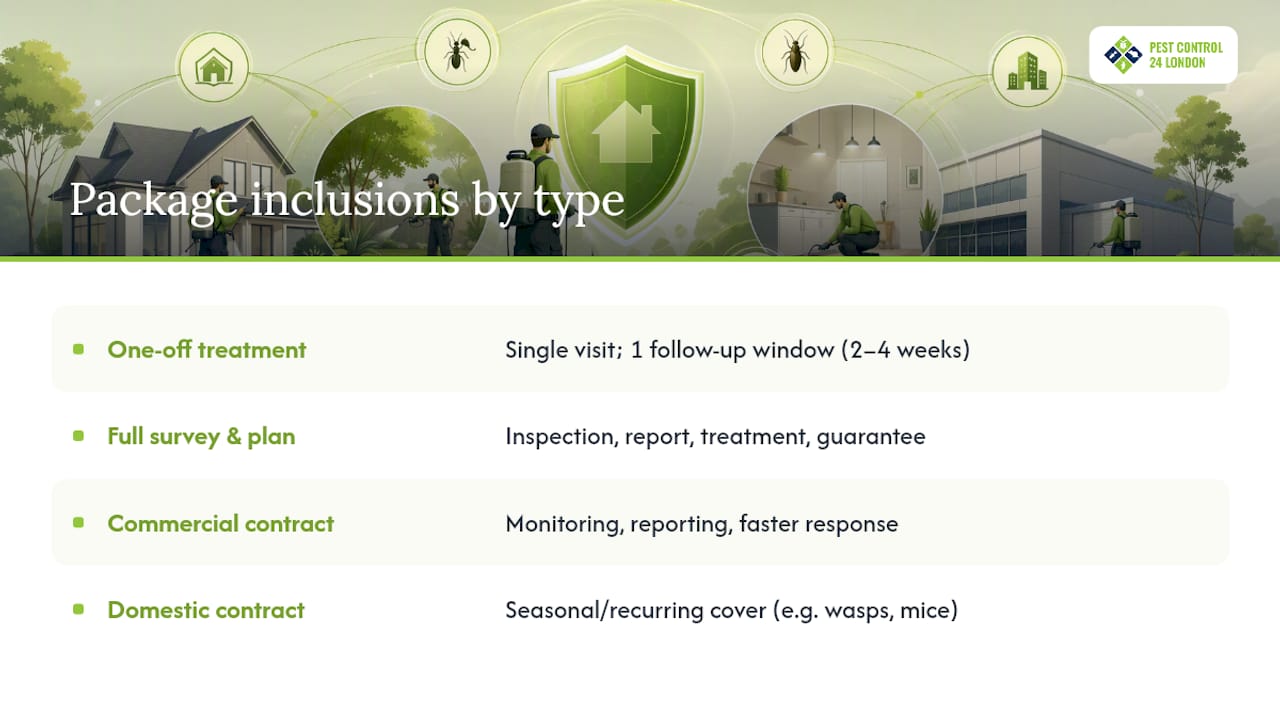
Pest control packages vary far more than the price alone suggests, and the wording matters. A “one-off treatment” typically covers a single visit and one follow-up if the pest returns within a set window, often two to four weeks, but not beyond that.
A “full survey and treatment plan” package should include everything from the initial inspection, described earlier, through to a written report, the treatment itself, and a documented guarantee period. This tends to cost more upfront but saves money if the underlying cause, such as a gap under a door or a damaged airbrick, needs fixing rather than just treating the symptoms.
Commercial contracts usually bundle in scheduled monitoring visits, digital or paper reporting for due diligence purposes, and a faster response time for emergencies. Domestic contracts are less common but can suit a property with a recurring seasonal issue, such as wasps every summer or mice every autumn.
Before comparing two quotes side by side, check exactly what is included in the price: is proofing work extra, does the guarantee cover a callback within the price, and how many visits are actually covered. A moderate-cost quote with two visits and a short guarantee is not automatically cheaper than a higher-cost quote covering proofing and a longer guarantee.
An author’s take on getting this right
Inspect first, verify credentials second, price third. That order rarely fails. Urgent infestations tempt people to skip straight to whoever answers the phone fastest, but a rushed booking without checking BPCA status or asking for a written plan tends to cost more in repeat visits than it saves in time.
— Dan
Book a survey with Pestcontrol24london
The company meets every point on this checklist directly: qualified technicians, a proper site survey before any quote, written treatment plans, and emergency response services across the London area for domestic and commercial properties alike.

When you book a survey, you get an inspection of the affected areas, a written assessment of what we find, and a clear quote before any treatment begins. There is no pressure to commit on the spot and no vague pricing. Whether you are dealing with a sudden infestation that needs an emergency callout or planning ongoing protection for a commercial site, the process starts the same way: a proper look at the property first. Get a free quote from Pestcontrol24london and see the checklist applied to your own home or business.